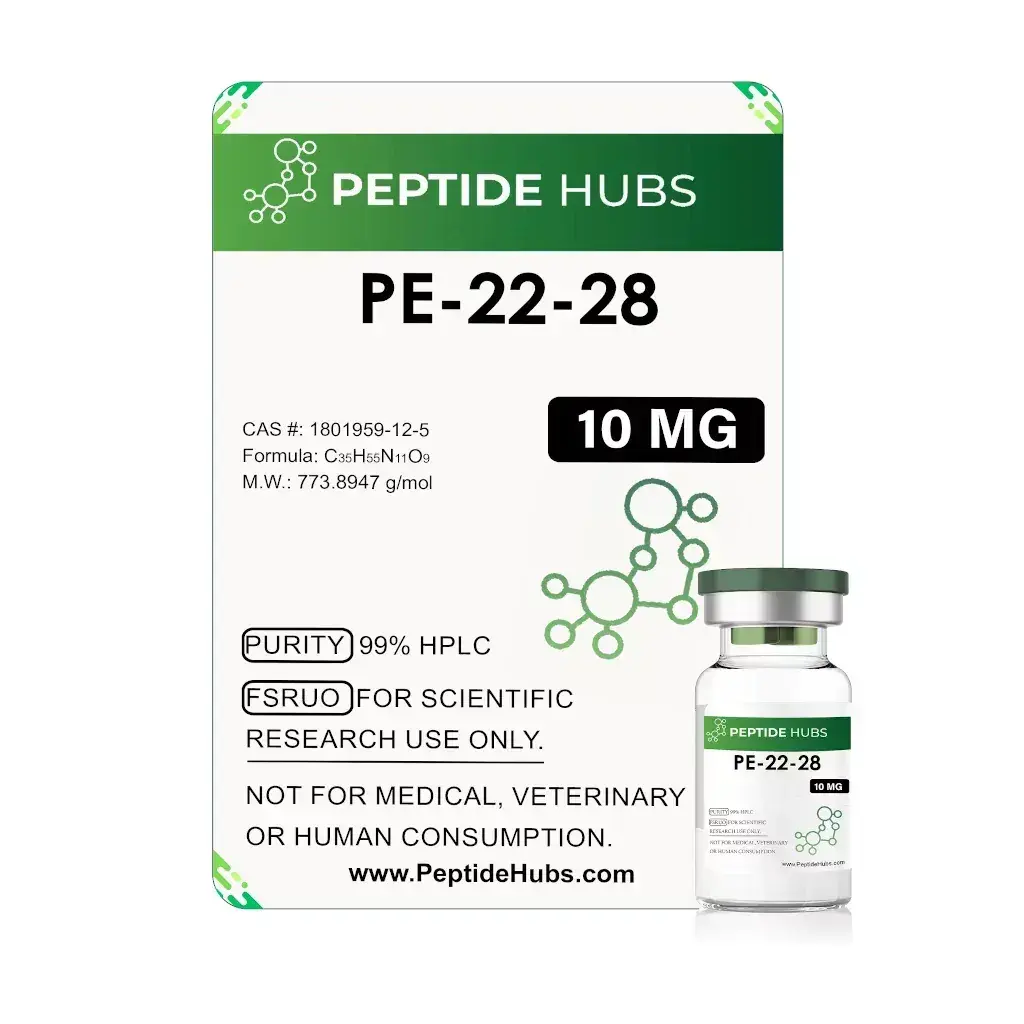
PE 22-28 10 mg is a lyophilized spadin-derived heptapeptide research product manufactured by Peptide Hubs and supplied as a 10 mg/vial powder in a 2 mL vial.
PE 22-28 10 mg contains PE 22-28, a synthetic seven-amino-acid peptide derived from spadin, an endogenous peptide that acts as a specific blocker of the TREK-1 potassium channel. PE 22-28 was developed as an optimized analog of spadin, demonstrating improved TREK-1 inhibition with an IC50 of 0.12 nM compared to 40–60 nM for spadin, along with greater in vivo stability and extended duration of action.
PE 22-28 works by binding to and blocking the TREK-1 (TWIK-related potassium channel-1) channel, a two-pore domain potassium channel expressed predominantly in the prefrontal cortex and hippocampus, brain regions involved in mood regulation, memory, and learning. TREK-1 overactivity has been associated with depressive states, partly through its regulation of serotonin release and neuroplasticity. In preclinical research, PE 22-28 has been shown to induce hippocampal neurogenesis after only a four-day treatment and to enhance synaptogenesis, measured by increased PSD-95 expression in mouse cortical neurons.
PE 22-28 is not FDA-approved for any human indication. As of April 2026, a PubMed search for PE-22-28 human studies returns zero results, and a comprehensive review of the TREK-1 blocker program explicitly acknowledges that no human pharmacokinetic or safety data exists. In non-medical research contexts, PE 22-28 is referenced for its potential rapid-onset antidepressant-like and neurogenic effects observed in rodent models, though such use falls outside approved indications and lacks clinical validation.
PE 22-28 10 mg is supplied as a lyophilized (freeze-dried) powder in a 2 mL vial. Reconstitution with an appropriate solvent is required before use in research contexts.
PE 22-28 is a synthetic heptapeptide with the sequence Gly-Val-Ser-Trp-Gly-Leu-Arg and a molecular weight of approximately 773.9 Da.
PE 22-28 belongs to the class of spadin-derived peptides, which are synthetic analogs of an endogenous peptide generated from the post-translational maturation of sortilin. Unlike typical research peptides that act through receptor binding, PE 22-28 functions by directly blocking the TREK-1 potassium channel, a mechanosensitive and thermosensitive channel that regulates neuronal excitability and neurotransmitter release.
In vitro studies using patch-clamp techniques on human TREK-1 expressed in HEK cells demonstrated that PE 22-28 has a better specificity and affinity for the TREK-1 channel compared to spadin, with an IC50 of 0.12 nM versus 40–60 nM for spadin. The peptide is selective for TREK-1 over other related potassium channels including TREK-2, TRAAK, TRESK, and TASK-1 at concentrations up to 100 nM. In vivo, PE 22-28 has demonstrated antidepressant-like effects in rodent behavioral models including the forced swimming test and novelty-suppressed feeding test, with effects lasting up to 23 hours after a single administration compared to 7 hours for spadin.
In non-medical bodybuilding contexts, PE 22-28 is primarily referenced for its potential cognitive and mood-related effects rather than for physique enhancement. Community protocols commonly reference intranasal or subcutaneous administration at 100–400 mcg once daily.
PE 22-28 is distinguished by its ability to induce hippocampal neurogenesis after only four days of treatment in mice, substantially faster than conventional antidepressants which typically require weeks to stimulate measurable neurogenic activity.
Peptide Hubs offers several research peptides targeting different neurological and physiological systems. Within this lineup, Semax is commonly discussed alongside PE 22-28 for its cognitive and neuroprotective effects, though Semax operates through modulation of the Ras/ERK signaling pathway rather than TREK-1 channel blockade.
For research focused on sleep and circadian rhythms rather than mood and cognition, DSIP represents a different approach entirely. For research requiring a reconstitution solution, Bacteriostatic Water is the standard diluent for preparing lyophilized peptides like PE 22-28 10 mg.
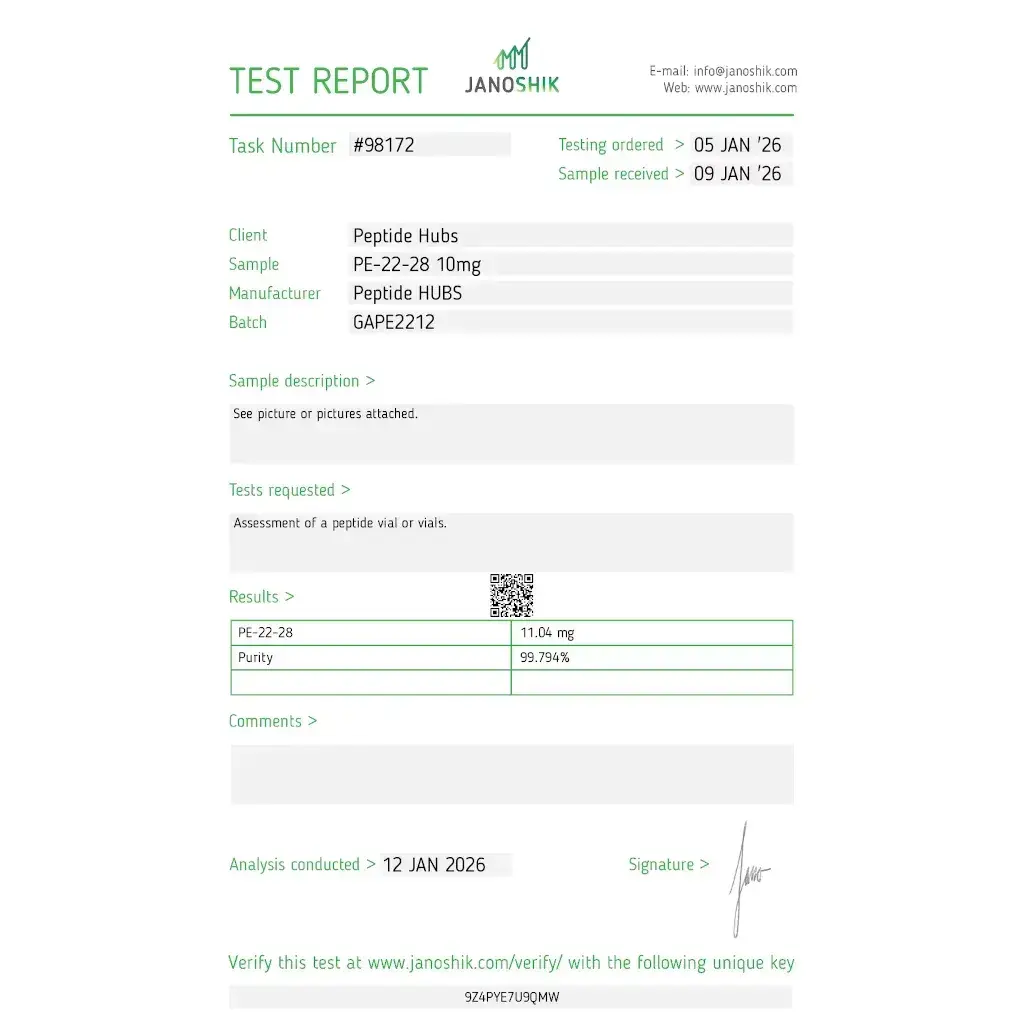
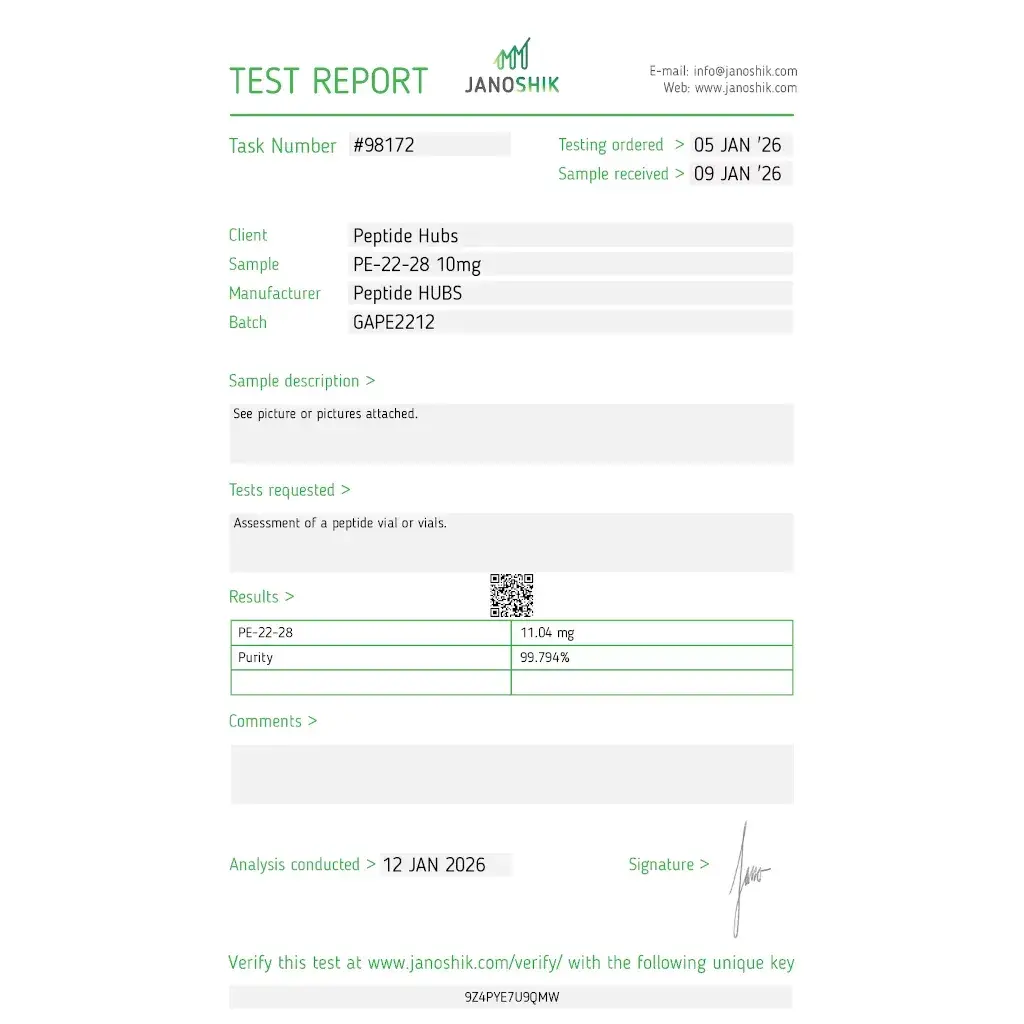
Published laboratory reports for PE 22-28 10 mg are shown below with the test date, measured content, and batch number.
 View Report
Laboratory results apply to the specific tested sample represented in each published report and should not be interpreted as a measurement of every vial or production batch.
The information below is provided for educational reference only. PE 22-28 is not an FDA-approved human drug. Its use for any non-medical purpose falls outside approved indications, and no established human dosing regimen exists.
Because PE 22-28 lacks FDA approval and human clinical trials, there is no medically established dosage range. All published dosing data is derived from preclinical mouse studies using intraperitoneal administration. Community protocols have extrapolated from these animal studies to intranasal and subcutaneous routes.
| Use Case | Common Reference Range | Administration |
|---|---|---|
| Preclinical mouse study (acute) | 3–4 mcg/kg | Intraperitoneal, single dose |
| Preclinical mouse study (sub-chronic) | 3–4 mcg/kg/day × 4 days | Intraperitoneal |
| Community protocol (non-medical) | 100–400 mcg | Intranasal or subcutaneous, once daily |
| Community conservative start | 100 mcg | Titrate based on response |
Preclinical studies used extremely low doses (microgram per kilogram range) reflecting the peptide's high potency at TREK-1. Community users employ fixed doses of 100–400 mcg, with some reports suggesting staying under 500–600 mcg to avoid lethargy. No dose-response studies or maximum tolerated dose studies have been published for humans.
PE 22-28 10 mg is supplied as a lyophilized powder and requires reconstitution before use. Typical research concentrations range from 0.1 to 1 mg/mL when reconstituted in sterile water or bacteriostatic water.
Reconstituted solution should be stored refrigerated at 2–8°C and used within 4 weeks, or aliquoted and frozen at -20°C. Avoid repeated freeze-thaw cycles.
In non-medical research contexts, PE 22-28 is sometimes discussed in combination with other cognitive peptides such as Semax or Pinealon, though no clinical evidence supports such combinations. Community protocols reference cycle lengths of 4–8 weeks with 1-week breaks between cycles.
No human pharmacokinetic or dose-response data exists for PE 22-28. All dosage information is derived from preclinical animal studies or community convention and should not be interpreted as medical guidance.
PE 22-28 is not FDA-approved for any human use. No human pharmacokinetic, safety, or efficacy studies have been conducted.
PE 22-28 has not received FDA approval and has never been tested in humans. A comprehensive 2019 review of the TREK-1 blocker program explicitly acknowledges that no human pharmacokinetic, safety, or efficacy data exists. The peptide is a preclinical research compound only.
An important counterpoint in the scientific literature comes from studies examining TREK-1 in vascular and neuroinflammatory contexts. Research has shown that TREK-1 deficiency can worsen blood-brain barrier damage and neuroinflammation after intracerebral hemorrhage, and that TREK-1 promotes blood-brain barrier breakdown and neuronal death after focal cerebral ischemia. These findings indicate that TREK-1's role in the brain is region-specific and context-dependent, and chronic blockade could plausibly carry risks in certain neurovascular settings that rodent depression models would not detect.
PE 22-28 is sold strictly as a research chemical for laboratory use only. It is not intended for human consumption, medical treatment, or veterinary applications. Non-medical use falls outside approved indications.
No rodent toxicology data specific to PE 22-28 is publicly available in peer-reviewed form. Community reports describe lethargy or excessive sedation as the most commonly reported side effect, particularly at doses above 500–600 mcg, possibly related to the mechanism of TREK-1 channel blockade affecting neuronal excitability.
The standard limitations of preclinical depression research apply: forced swim and tail suspension tests measure behavioral despair in rodents as proxies for antidepressant activity, but these assays have a high false-positive rate and a poor historical record of predicting human clinical outcomes. Rodent neurophysiology, plasma pharmacokinetics, and blood-brain barrier properties differ substantially from those in humans.
Given the complete absence of human safety data, any consideration of PE 22-28 use should involve consultation with a qualified healthcare professional. The region-specific and context-dependent role of TREK-1 in the brain suggests that chronic blockade could carry risks that are not well characterized.
No established monitoring protocol exists for PE 22-28. In research contexts, any adverse reactions should be documented and reported to appropriate authorities. Suggested baseline bloodwork in community protocols includes CBC with differential and comprehensive metabolic panel.
Store lyophilized powder at -20°C, protected from light and moisture. Reconstituted solutions should be refrigerated at 2–8°C and used within 4 weeks, or aliquoted and frozen at -20°C. Keep out of reach of children.
PE 22-28 10 mg is supplied through the official Peptide Hubs distribution chain and shipped in original manufacturer packaging with discreet handling.
The outer shipping package remains discreet, with privacy-focused handling. Products are supplied through the official Peptide Hubs distribution chain.
To verify your PE 22-28 10 mg product, use the security code on the vial label and cross-check it on the Peptide Hubs official site. Original packaging and manufacturer presentation help reinforce product legitimacy.
For complete delivery details, tracking policy, and reshipment terms, please see our Shipping Info page.
Proper storage conditions help preserve peptide stability and integrity throughout shelf life.
Store lyophilized powder at -20°C, protected from light and moisture. Under these conditions, the dry powder is stable for extended periods.
Once reconstituted, store refrigerated at 2–8°C and use within 4 weeks, or aliquot and freeze at -20°C. Avoid repeated freeze-thaw cycles to maintain peptide integrity.
Keep out of reach of children. Follow proper handling practices.
Answers to common questions about PE 22-28 10 mg, spadin-derived peptides, and research compound handling.
PE 22-28 10 mg is a research peptide studied in preclinical models for its TREK-1 channel inhibitory effects and potential rapid-onset antidepressant-like activity. In non-medical contexts, it is referenced for cognitive and mood-related research, though such use falls outside approved indications and lacks human clinical validation.
No established human dosing schedule exists. Preclinical mouse studies used intraperitoneal injection once daily for 4 days. Community protocols commonly reference intranasal or subcutaneous administration once daily at 100–400 mcg, but this is based on convention rather than clinical data.
PE 22-28 does not suppress endogenous testosterone production and does not require post-cycle therapy in the way anabolic steroids do. However, any non-medical peptide use should be approached with caution given the complete absence of human safety data.
PE 22-28 is a spadin-derived heptapeptide that blocks the TREK-1 potassium channel with high affinity (IC50 0.12 nM). In preclinical models, it induces hippocampal neurogenesis after only four days and enhances synaptogenesis, effects associated with rapid antidepressant-like activity.
Preclinical research demonstrated that PE 22-28 induces neurogenesis after only four days of treatment in mice, substantially faster than conventional antidepressants which typically require weeks. The peptide's duration of action after a single dose was reported as up to approximately 23 hours, compared to 7 hours for spadin.
There is no universally “best” TREK-1 inhibitor. PE 22-28 is a potent and selective inhibitor with an IC50 of 0.12 nM, demonstrating better specificity and affinity for TREK-1 compared to its parent compound spadin. However, no human comparative data exists.
PE 22-28 acts by blocking the TREK-1 potassium channel, while Semax modulates the Ras/ERK signaling pathway. They operate through entirely different mechanisms and address different aspects of neurobiology.
PE 22-28 targets mood and neuroplasticity through TREK-1 channel inhibition, while DSIP is studied for sleep architecture modulation. They operate through different biological systems and are not interchangeable.
400 mcg is within the upper range commonly referenced in community protocols (200–400 mcg). Preclinical mouse studies used much lower weight-based doses (3–4 mcg/kg), and no human dose-response data exists. Community reports suggest staying under 500–600 mcg to avoid lethargy.
PE 22-28 10 mg is labeled at 10 mg of PE 22-28 per vial. It is supplied as a lyophilized powder in a 2 mL vial.
Yes. A published laboratory report dated January 12, 2026 measured PE 22-28 10 mg at 11.04 mg, equivalent to 110.4% of its 10 mg label claim. The batch number is GAPE2212.
Store the lyophilized powder at -20°C, protected from light and moisture. Once reconstituted, refrigerate at 2–8°C and use within 4 weeks, or aliquot and freeze at -20°C.