DSIP Injectable
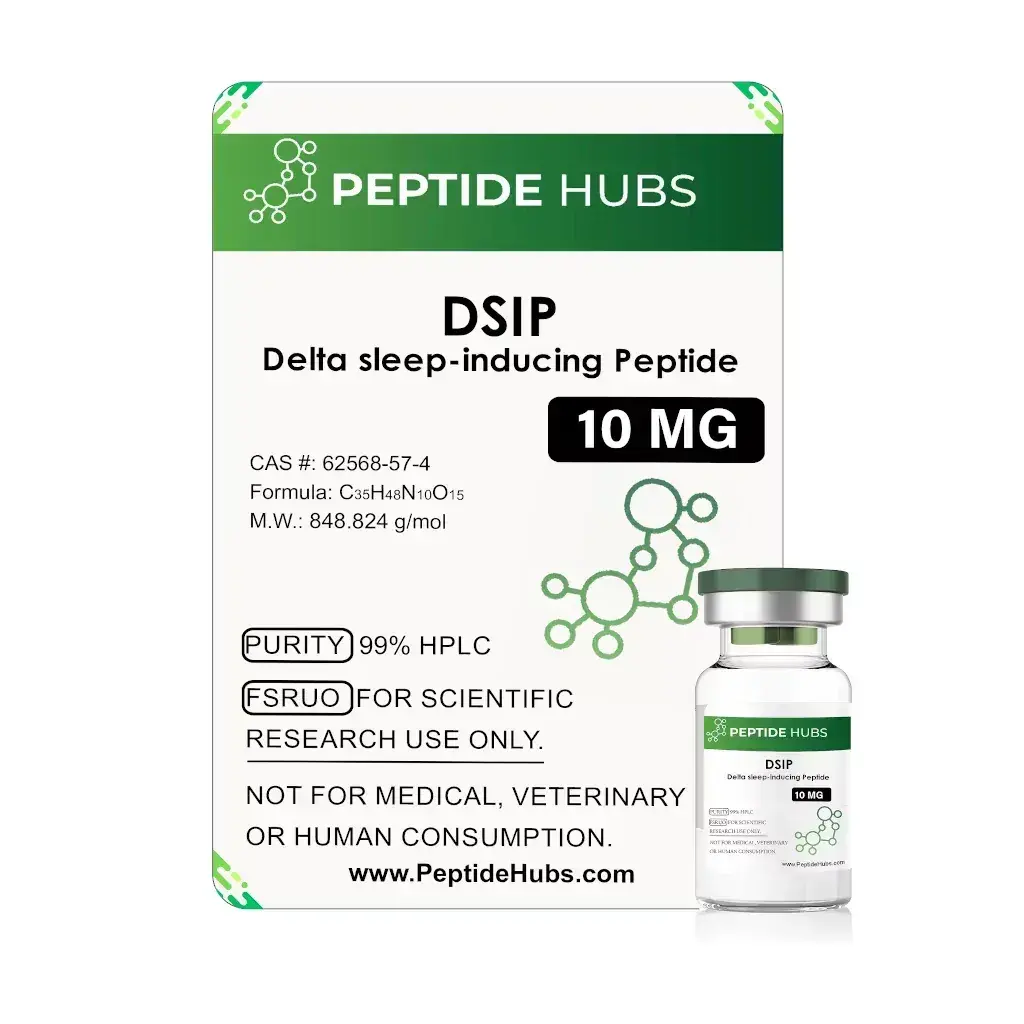
DSIP 10 mg contains delta sleep-inducing peptide, a naturally occurring nonapeptide with the amino acid sequence Trp-Ala-Gly-Gly-Asp-Ala-Ser-Gly-Glu. DSIP was first isolated in the 1970s from the blood of rabbits during slow-wave sleep and has since been studied for its effects on sleep architecture and neuroendocrine modulation.
DSIP belongs to a class of research peptides investigated for sleep-promoting properties and stress-axis modulation. Unlike sedative-hypnotics that act through GABA receptors, DSIP appears to normalize sleep architecture across consecutive nights without producing grogginess, rebound, or dependence. The peptide has also been studied for its interaction with circadian rhythmicity and stress responses.
In non-medical research contexts, DSIP is commonly referenced for its potential to enhance deep sleep and support recovery. However, DSIP is not FDA-approved for any human indication, and a specific receptor or precursor protein for DSIP has not been identified after decades of research.
Key Benefits of DSIP 10 mg
- Nonapeptide associated with sleep architecture modulation in research
- Lyophilized powder format for reconstitution flexibility
- Studied for effects on circadian rhythmicity and stress response
- 10 mg per vial for research and non-medical protocols
- Manufactured by Peptide Hubs
Research Peptide
DSIP belongs to a class of sleep-modulating research peptides first identified through humoral transmission studies in the 1960s and 1970s. The peptide was characterized and synthesized by Schoenenberger and colleagues, who demonstrated that intravenous administration produced sleep effects in multiple animal species.
DSIP has been shown to be released from nerve endings upon depolarization and inactivated by membrane-associated aminopeptidases. The peptide's half-life for proteolytic cleavage of tryptophan is approximately 15 minutes in brain tissue. Despite extensive research, no specific DSIP receptor or precursor protein has been identified, and the mechanism by which it promotes sleep remains unknown.
In non-medical research contexts, DSIP is commonly referenced for its potential to enhance deep sleep and support recovery processes. The peptide has been studied in human clinical trials for insomnia and opiate withdrawal protocols with no major adverse events reported at standard doses.
Defining Characteristic
Nonapeptide Structure
DSIP is distinguished by its short nine-amino-acid sequence (WAGGDASGE) and its discovery as one of the first chemically defined sleep-promoting substances. The peptide is believed to cross the blood-brain barrier and exert effects on sleep architecture through mechanisms that remain under investigation.
DSIP 10 mg vs Other Peptide Hubs Preparations
Peptide Hubs offers a range of research peptides targeting different biological systems. Within this lineup, CJC-1295 No DAC is commonly discussed alongside DSIP for its effects on growth hormone release, though CJC-1295 operates through the GHRH receptor pathway rather than sleep modulation.
For research focused on recovery and tissue repair rather than sleep, BPC 157 represents a different approach entirely, operating through angiogenic and cytoprotective mechanisms. Similarly, TB 500 addresses soft-tissue repair through a thymosin beta-4 fragment mechanism. These peptides are not interchangeable and target distinct biological pathways.
Typical Dosage Ranges
Because DSIP lacks FDA approval and published human dose-finding trials for its intended research applications, there is no medically established dosage range. In non-medical research communities, reference ranges are derived from clinical study protocols and community convention. Commonly referenced ranges are 100–500 mcg per injection administered before sleep.
| Use Case |
Common Reference Range |
Injection Frequency |
| Standard sleep protocol (community) |
100–200 mcg |
Once daily, 30–60 min before bed |
| Higher-dose protocol (community) |
250–500 mcg |
Once daily before bed |
| Clinical research (historical) |
25 nmol/kg |
Single injection before sleep |
These ranges are community conventions informed by historical clinical data. The clinical literature reports a parabolic dose-response curve with different effective optima depending on route of administration.
Reconstitution & Handling
DSIP 10 mg is supplied as a lyophilized powder and requires reconstitution before use. A 10 mg vial reconstituted with 2 mL of solvent yields a concentration of 5 mg/mL, meaning a 100 mcg dose would require drawing 0.02 mL (2 units on a U-100 insulin syringe).
Reconstituted solution should be stored refrigerated at 2–8°C and used within approximately 24 hours due to limited stability in solution. Unreconstituted powder is stable at room temperature and should be protected from moisture and light.
Stacking & Cycle Considerations
In non-medical research contexts, DSIP is sometimes combined with tissue-repair peptides such as BPC 157 or TB 500, based on the rationale that tissue repair peaks during deep sleep when growth hormone release is highest.
Community protocols commonly reference nightly dosing for 7–10 days to build the effect, then dropping to 3–4 times per week for maintenance, with cycles capped at 6–8 weeks followed by a 2–4 week break.
Important
Individual Response Varies
No human dose-response data for therapeutic outcomes exists for DSIP. All dosage information is derived from community convention or historical clinical data and should not be interpreted as medical guidance.
Important Safety Information
DSIP has not received FDA approval and is not recognized as Generally Recognized as Safe (GRAS). The FDA has not evaluated DSIP-related bulk drug substances for compounding, and there is no USP monograph for the peptide.
Historical clinical use was limited to controlled research settings. The total human safety database encompasses fewer than 200 subjects, which is insufficient to detect adverse events occurring at rates below 1–2%. Safety in pregnancy, pediatric populations, and individuals with significant hepatic or renal impairment has not been studied.
Important
Non-Medical Use
DSIP is sold strictly as a research chemical for laboratory use only. It is not intended for human consumption, medical treatment, or veterinary applications. Non-medical use falls outside approved indications.
Potential Adverse Effects
Across approximately 40 years of clinical research, no major adverse events have been reported at standard doses. Commonly referenced effects include injection-site irritation (mild redness or transient welt at subcutaneous sites), vivid dreams or altered dream recall, morning grogginess (usually a dose or timing issue), and occasional mild headache.
As a peptide administered parenterally, DSIP may pose immunogenicity risks. Individuals on ACE inhibitors (lisinopril, captopril, enalapril) should be aware of a theoretical peptidase interaction flagged in the anesthesiology literature.
Conditions Requiring Medical Evaluation
Given the limited human safety database, any consideration of DSIP use should involve consultation with a qualified healthcare professional. Individuals with pre-existing sleep disorders, those taking sleep medications, or those with hepatic or renal impairment should exercise particular caution.
Monitoring During Use
No established monitoring protocol exists for non-medical DSIP use. In research contexts, any adverse reactions should be documented and reported to appropriate authorities.
Product Care
Storage & Handling
Store lyophilized powder at -20°C protected from light and moisture. The powder is stable at room temperature but should be refrigerated or frozen for long-term storage. Once reconstituted, store refrigerated and use within 24 hours due to limited stability in solution. Keep out of reach of children.
Further Safety Information
USA Domestic 3–5 business days
International 10–15 business days
Order Processing 24–48 business hours
Tracking Provided after dispatch
Direct Supply
Discreet Delivery & Original Packaging
The outer shipping package remains discreet, with privacy-focused handling. Products are supplied through the official Peptide Hubs distribution chain.
What to Expect
- Orders are processed after payment confirmation
- USA Domestic shipping is typically faster when local stock is selected
- International orders include tracking, though update frequency may vary
- Multiple warehouses may result in separate shipments when applicable
Authenticity Verification
To verify your DSIP 10 mg product, use the security code on the vial label and cross-check it on the Peptide Hubs official site. Original packaging and manufacturer presentation help reinforce product legitimacy.
For complete delivery details, tracking policy, and reshipment terms, please see our Shipping Info page.
Recommended Conditions
Store lyophilized powder at -20°C protected from light and moisture. The powder is stable at room temperature, which is why it can be shipped without refrigeration, but long-term storage should be refrigerated or frozen.
Once reconstituted, DSIP is susceptible to degradation in solution. Store refrigerated at 2–8°C and use within 24 hours. Prepare fresh solutions for each use when possible.
Keep out of reach of children. Follow proper handling practices.
Quick Reference
Do & Don't
- Do store powder at -20°C for long-term storage
- Do protect from light and moisture
- Do refrigerate reconstituted solution at 2–8°C
- Don't store reconstituted solution longer than 24 hours
- Don't expose to excessive heat
- Don't use if solution appears cloudy or contains particles
What is DSIP 10 mg used for?
DSIP 10 mg is a research peptide studied for its potential effects on sleep architecture and neuroendocrine modulation. It was first isolated as a sleep-promoting substance and has been investigated for stress-axis modulation. In non-medical research contexts, it is commonly referenced for deep sleep enhancement and recovery support, though such use falls outside approved indications.
How often should DSIP 10 mg be injected?
No established human dosing schedule exists. Community protocols commonly reference once-daily administration 30–60 minutes before sleep, though clinical studies used single injections or short courses.
Does DSIP 10 mg require PCT?
DSIP does not suppress endogenous testosterone production and does not require post-cycle therapy in the way anabolic steroids do. However, any non-medical peptide use should be approached with caution given the limited human safety database.
What does DSIP do?
DSIP is a naturally occurring nonapeptide first identified as a sleep-promoting substance. It is believed to modulate sleep architecture and circadian rhythmicity without acting as a sedative. The mechanism remains unknown, as no specific DSIP receptor has been identified.
How long does DSIP take to work?
Clinical data suggests effects may build over consecutive nights. Community reports describe mild effects in the first few nights, with the clinical inflection point typically occurring around nights 4–7, and full effect by week 2–3.
Is DSIP the best sleep peptide?
There is no universally “best” sleep peptide. DSIP is one of the earliest chemically defined sleep-promoting substances, but it is not a sedative and does not knock users out. It is described as normalizing sleep architecture over time rather than producing acute sedation.
What is the difference between DSIP 10 mg and CJC-1295 No DAC?
DSIP targets sleep architecture and neuroendocrine modulation, while CJC-1295 No DAC is a GHRH analog that stimulates growth hormone release through pituitary receptors. They operate through entirely different mechanisms and address different biological goals.
What is the difference between DSIP 10 mg and BPC 157?
DSIP is a sleep-modulating peptide, while BPC 157 is a tissue-repair peptide studied for angiogenic and cytoprotective effects. They operate through entirely different mechanisms. Some non-medical protocols combine them based on the rationale that tissue repair peaks during deep sleep.
Is 500 mcg of DSIP a lot?
500 mcg is at the upper end of the range commonly referenced in community protocols (100–500 mcg). Clinical research reported a parabolic dose-response curve, meaning higher doses do not necessarily produce proportionally greater effects and may increase the risk of morning grogginess.
What strength is DSIP 10 mg?
DSIP 10 mg is labeled at 10 mg of DSIP per vial. It is supplied as a lyophilized powder in a 2 mL vial.
How should DSIP 10 mg be stored?
Store the lyophilized powder at -20°C protected from light and moisture. Once reconstituted, refrigerate at 2–8°C and use within 24 hours due to limited stability in solution.
Is DSIP on the WADA prohibited list?
DSIP has been referenced in discussions of WADA-prohibited substances in the research literature, though its specific classification may vary. Athletes subject to anti-doping testing should consult the current WADA Prohibited List for the most up-to-date information.
No reviews found
Please log in to write DSIP 10 mg review.