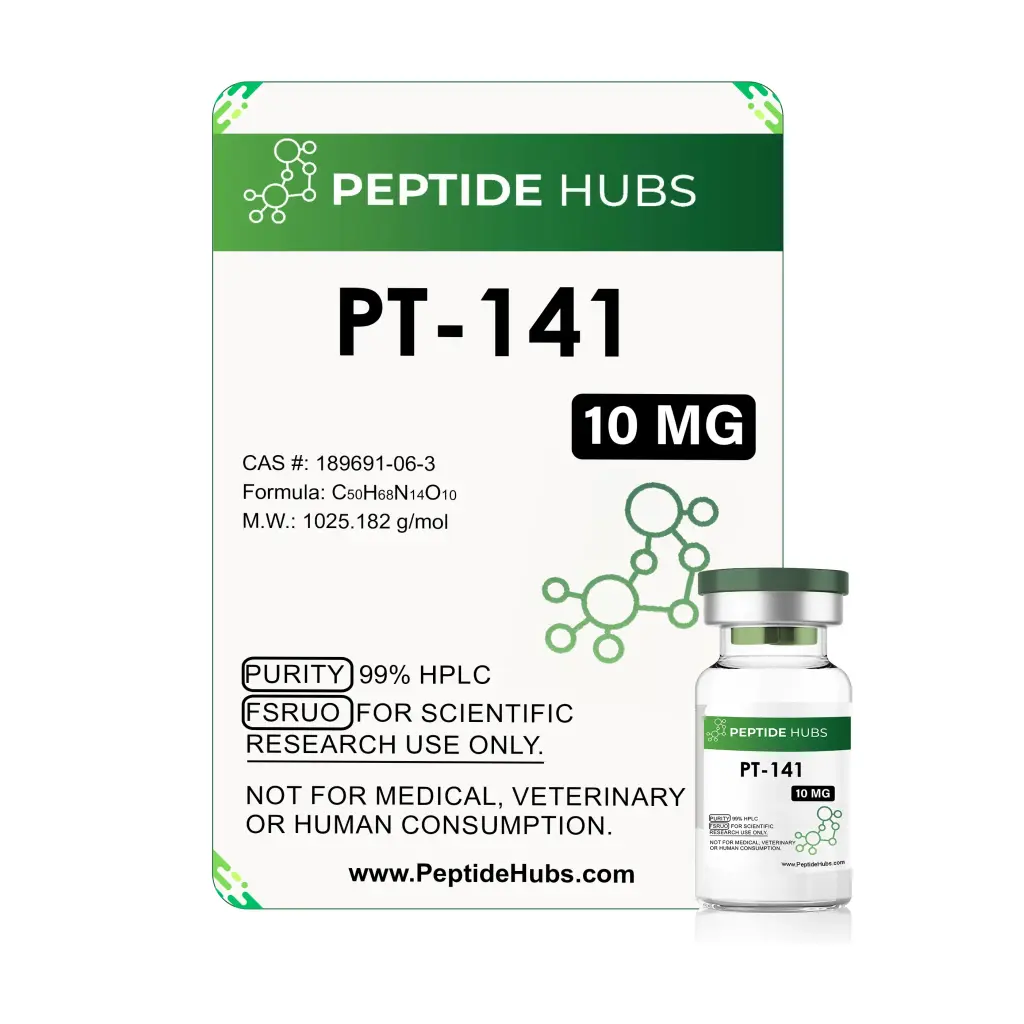
PT-141 10 mg is a lyophilized powder peptide manufactured by Peptide Hubs containing Bremelanotide at 10 mg per vial, supplied in a 2 mL vial.
Bremelanotide is a synthetic cyclic heptapeptide analog of alpha-melanocyte-stimulating hormone (α-MSH). It acts as a melanocortin receptor agonist, with primary activity at the MC4 receptor subtype, which is expressed in the central nervous system and is involved in pathways regulating sexual desire and arousal. Unlike PDE5 inhibitors that act on vascular blood flow, bremelanotide works upstream through central nervous system signaling.
In medical practice, bremelanotide is FDA-approved as VYLEESI for the treatment of acquired, generalized hypoactive sexual desire disorder (HSDD) in premenopausal women. The approved dose is 1.75 mg administered subcutaneously at least 45 minutes before anticipated sexual activity, with no more than one dose in 24 hours and no more than 8 doses per month. Use in men or for performance enhancement is not an approved indication.
In non-medical bodybuilding contexts, PT-141 is sometimes referenced for libido support during anabolic steroid cycles, where suppressed endogenous testosterone can reduce sexual motivation. This use falls outside approved medical indications, and the compound does not build muscle, burn fat, or enhance athletic performance. The FDA-approved safety profile includes transient blood pressure increases and a risk of focal hyperpigmentation with frequent dosing.
PT-141 10 mg is supplied as a lyophilized (freeze-dried) powder requiring reconstitution with a suitable diluent before use. This format supports extended shelf stability compared to liquid preparations. The product is presented in a 2 mL vial.
Bremelanotide is a centrally acting melanocortin receptor agonist with an on-demand pharmacokinetic profile. Its mechanism and dosing distinguish it from vascular-acting erectile dysfunction treatments.
Bremelanotide binds to melanocortin receptors, with its primary activity attributed to MC4R agonism in the central nervous system. This receptor pathway is involved in modulating sexual desire and arousal responses. The compound does not act directly on penile vascular smooth muscle like PDE5 inhibitors.
Pharmacokinetic data from FDA review documents indicate that after subcutaneous administration, bremelanotide reaches peak plasma concentrations at approximately 60 minutes, with a half-life of roughly 2–3 hours. Pharmacodynamic effects, however, can persist substantially longer, with clinical trials noting effects lasting up to 16 hours.
Bremelanotide is metabolized through hydrolysis of amide bonds to release constituent amino acids, with no parent drug detected in urine. Approximately 65% is cleared renally and 23% hepatically.
Bremelanotide is administered on demand, not as a daily therapy. The FDA label specifies dosing at least 45 minutes before anticipated activity, with no more than one dose in 24 hours or 8 doses per month. This contrasts with daily medications and reflects the compound's acute mechanism of action.
Peptide Hubs offers a range of research peptides with different mechanisms and applications. Bremelanotide's melanocortin pathway activity distinguishes it from compounds that act on growth hormone secretion, such as Ipamorelin or CJC-1295 No DAC, which are referenced for pituitary GH release.
Other Peptide Hubs products target entirely different systems. BPC 157 is studied for tissue repair pathways, while GHK-CU is a copper peptide referenced in skin and collagen research. Melanotan II, the parent compound from which bremelanotide was derived, is a non-selective melanocortin agonist with broader receptor activity including effects on pigmentation.
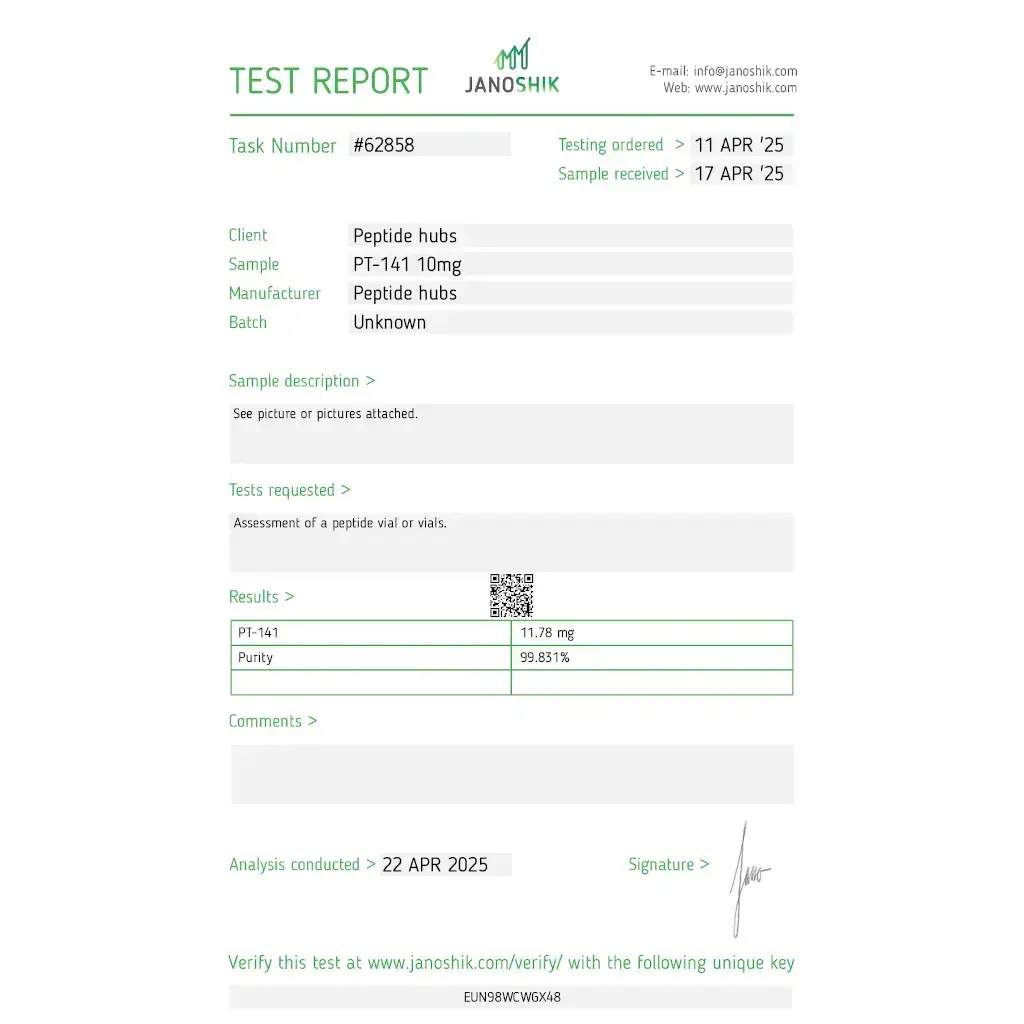
Published laboratory reports for PT-141 10 mg are shown below with the test date, measured content and percentage of the product's 10 mg label claim.
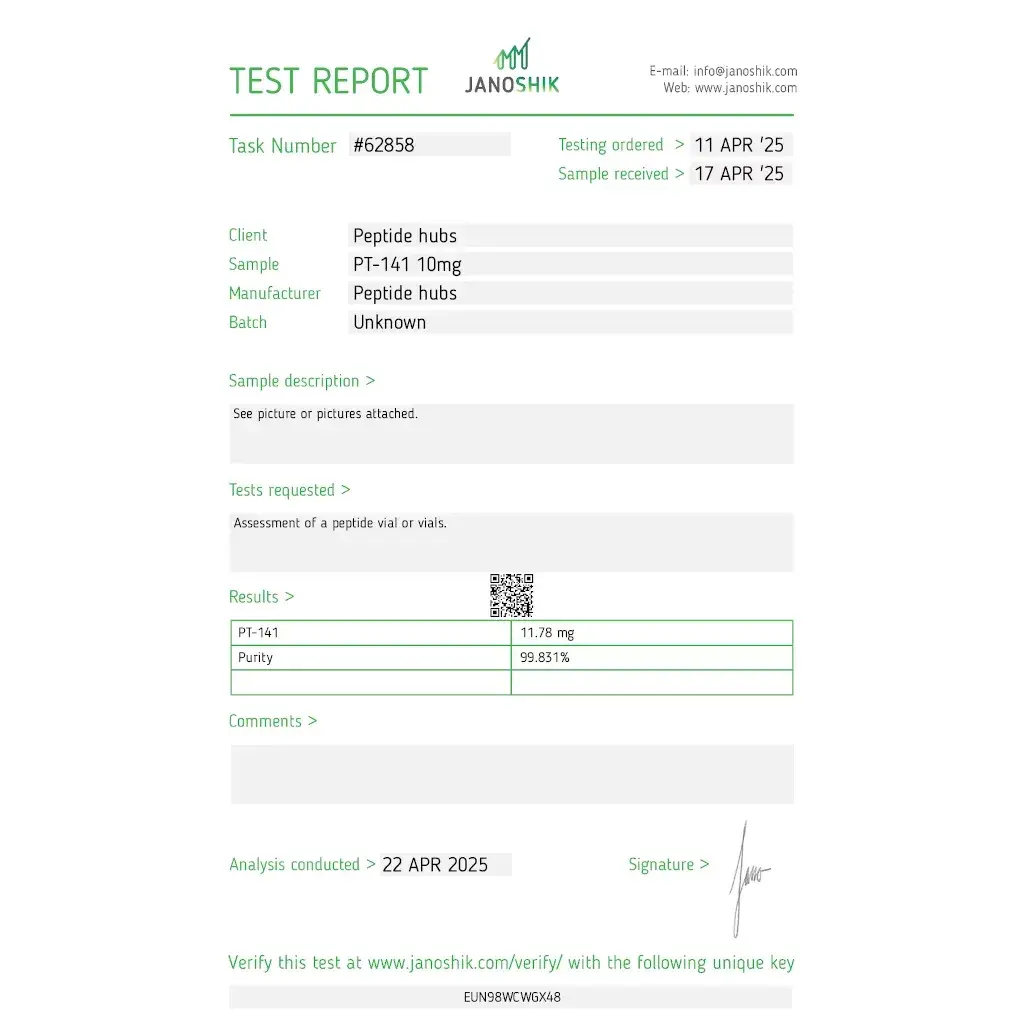 View Report
Laboratory results apply to the specific tested sample represented in each published report and should not be interpreted as a measurement of every vial or production batch.
The information below is provided for educational reference only. Bremelanotide is a prescription medication; medical use requires appropriate diagnosis, clinical supervision and ongoing monitoring. Non-medical use falls outside approved indications.
In medically supervised use, the FDA-approved dose of bremelanotide is 1.75 mg administered subcutaneously at least 45 minutes before anticipated sexual activity, with no more than one dose in 24 hours and no more than 8 doses per month. In non-medical contexts, some references describe lower starting doses to assess tolerance, though such use falls outside approved indications.
| Use Case | Common Reference Range | Frequency |
|---|---|---|
| FDA-approved (medical) | 1.75 mg subcutaneous | At least 45 min before activity; max 1 dose/24h, 8 doses/month |
| Non-medical (tolerance assessment) | 0.5–1.0 mg | As referenced in community discussions |
| Non-medical (working range) | 1.0–1.75 mg | As referenced in community discussions |
In non-medical bodybuilding contexts, PT-141 is sometimes referenced alongside other compounds. The primary rationale is libido support during cycles where suppressed endogenous testosterone may reduce sexual motivation. PDE5 inhibitors such as sildenafil act on different pathways and some references describe combined use, but cardiovascular screening is advised before combining agents that affect blood pressure.
Reconstitution should be performed with Bacteriostatic Water following standard sterile technique. There is no loading phase or taper for bremelanotide; effects are per-dose rather than cumulative.
Nausea is the most commonly reported adverse effect, occurring in approximately 40% of participants in clinical trials. Starting at a lower dose than the approved 1.75 mg may help assess individual tolerance. Other commonly reported effects include flushing, headache, and transient blood pressure increases.
Focal hyperpigmentation has been reported with frequent dosing. The FDA label recommends no more than 8 doses per month to limit this risk and the duration of blood pressure elevation.
Dosing strategies and tolerance should be assessed on an individual basis. The information above is for educational reference and does not constitute medical advice.
Bremelanotide is a prescription medication with a defined safety profile from clinical trials. Medical use requires appropriate diagnosis and supervision.
The FDA-approved indication for bremelanotide is acquired, generalized hypoactive sexual desire disorder in premenopausal women. It is not indicated for postmenopausal women or for men. Use outside these parameters falls outside approved labeling.
Bremelanotide is contraindicated in patients with uncontrolled hypertension or known cardiovascular disease. Blood pressure should be well-controlled before initiating therapy.
Bremelanotide is not indicated for performance enhancement or for use in bodybuilding contexts. Non-medical use may expose individuals to cardiovascular and other risks without clinical oversight.
Transient increases in blood pressure and reductions in heart rate occur after each dose. Clinical data show maximal increases of approximately 6 mmHg systolic and 3 mmHg diastolic, peaking at 2–4 hours and returning to baseline within 12 hours. Nausea is the most common adverse reaction, reported in 40% of clinical trial participants.
Focal hyperpigmentation, including involvement of the face, gums, and breasts, has been reported. Risk increases with more frequent dosing. Patients with darker skin may be more susceptible. Resolution was not confirmed in all patients after discontinuation.
Other reported effects include flushing, headache, and injection site reactions.
Bremelanotide is contraindicated in uncontrolled hypertension and known cardiovascular disease. Before initiating therapy, cardiovascular risk should be assessed and blood pressure controlled. Naltrexone use may interact with bremelanotide; concurrent use should be discussed with a healthcare professional.
Blood pressure should be monitored, particularly during initial use. For non-medical contexts, home blood pressure checks before and after dosing may help identify exaggerated responses. The FDA label recommends limiting use to 8 doses per month to reduce cumulative exposure and hyperpigmentation risk.
Store lyophilized powder under recommended conditions and protect from light and moisture. After reconstitution, follow appropriate storage guidelines and inspect the solution before use. Do not use if the solution appears cloudy, discolored, or contains particulate matter.
Keep out of reach of children.
PT-141 10 mg by Peptide Hubs is shipped with discretion and privacy-focused handling.
The outer shipping package remains discreet with no external product details. Products are supplied in original manufacturer packaging.
To verify your PT-141 10 mg product, check the vial label for security features and cross-reference with Peptide Hubs official presentation. The published laboratory report provides batch-specific analytical confirmation for the tested sample.
For complete delivery details, tracking policy, and reshipment terms, please see our Shipping Info page.
Proper storage conditions help preserve peptide stability and product integrity.
Store lyophilized PT-141 10 mg in a cool, dry place protected from light and moisture. For long-term storage, refrigeration or freezing may be recommended depending on the specific product guidelines. Keep the vial in its original packaging until reconstitution.
After reconstitution, store according to appropriate guidelines and inspect the solution before each use. Do not use if the solution appears cloudy, discolored, or contains particulate matter.
Keep out of reach of children.
Answers to common questions about PT-141 10 mg, bremelanotide, dosing, and laboratory testing.
PT-141 10 mg contains bremelanotide, a melanocortin receptor agonist. In medical practice it is approved for hypoactive sexual desire disorder in premenopausal women. In non-medical contexts it is sometimes referenced for libido support, though such use falls outside approved indications.
The FDA-approved dosing is at least 45 minutes before anticipated activity, with no more than one dose in 24 hours and no more than 8 doses per month. More frequent use increases the risk of hyperpigmentation and prolonged blood pressure elevation.
Bremelanotide activates melanocortin receptors, primarily MC4R, in the central nervous system. This pathway is involved in regulating sexual desire and arousal. Unlike PDE5 inhibitors, it does not act directly on vascular blood flow.
The FDA label specifies dosing at least 45 minutes before anticipated activity. Pharmacodynamic effects may persist longer than plasma half-life, with clinical trial data noting effects up to 16 hours. Individual response varies.
There is no universal "best" compound. Bremelanotide's central mechanism distinguishes it from vascular-acting treatments, and its efficacy and tolerability vary by individual. The FDA-approved indication is specific to premenopausal women with HSDD.
PT-141 (bremelanotide) is a metabolite of Melanotan II with more selective melanocortin receptor activity. Melanotan II is a non-selective agonist associated with broader effects including pigmentation. For comparison, see Melanotan II.
PT-141 acts on melanocortin receptors in the central nervous system. Kisspeptin acts upstream in the hypothalamic-pituitary-gonadal axis, influencing GnRH release. Their mechanisms and applications are distinct.
1.75 mg is the FDA-approved dose for bremelanotide. Whether a dose is appropriate depends on the individual, medical indication, and clinical assessment. Non-medical use of any dose falls outside approved labeling.
PT-141 10 mg contains 10 mg of bremelanotide per vial as a lyophilized powder, supplied in a 2 mL vial.
Yes. A published laboratory report dated April 22, 2025 measured PT-141 10 mg at 11.78 mg, equivalent to 117.8% of the 10 mg label claim. The complete report can be viewed in the Lab Reports tab.
Yes. PT-141 10 mg is supplied as a lyophilized powder requiring reconstitution with a suitable diluent such as Bacteriostatic Water before use. Follow appropriate sterile technique and storage guidelines after reconstitution.