
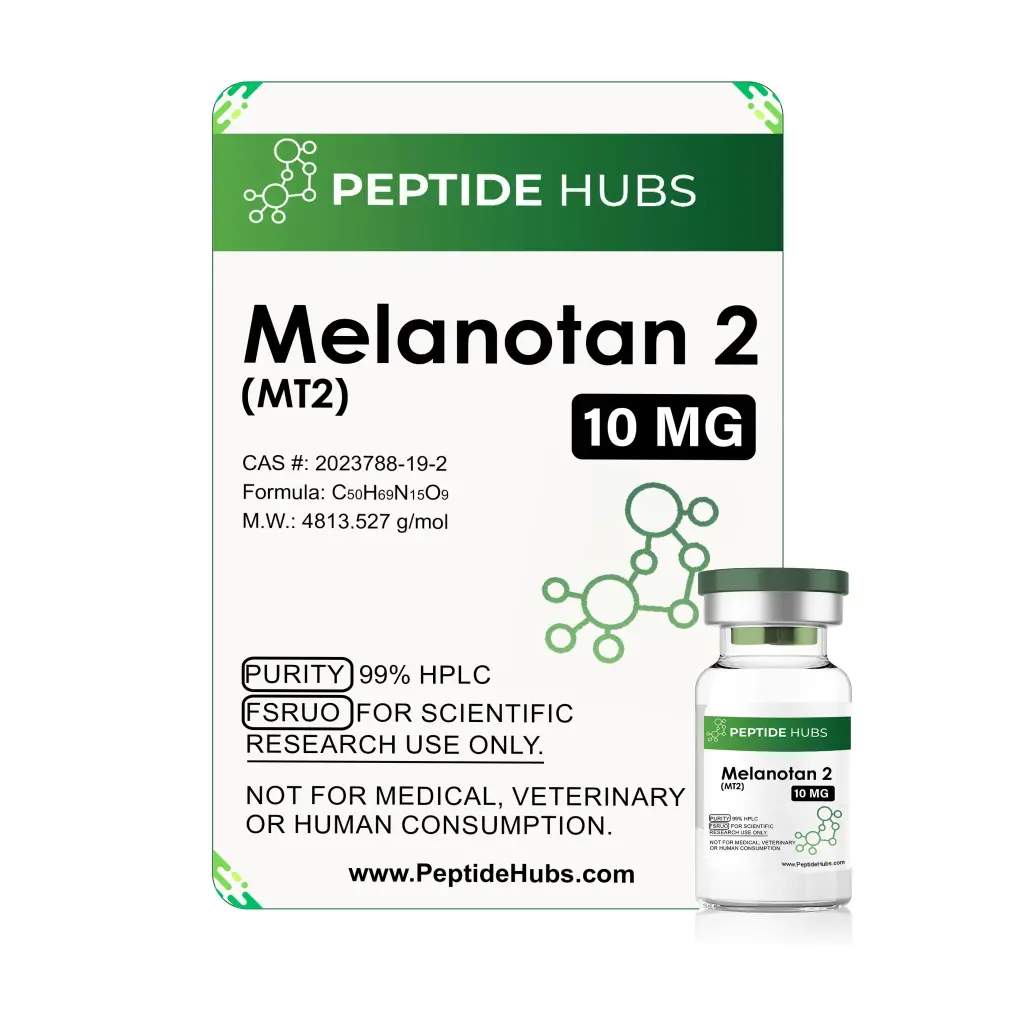
Melanotan 2 10 mg is a lyophilized Melanotan II research product manufactured by Peptide Hubs and supplied as a 10 mg/vial powder in a 2 mL vial.
Melanotan 2 10 mg contains Melanotan II (MT-II), a synthetic cyclic heptapeptide analog of alpha-melanocyte-stimulating hormone (α-MSH). Melanotan II is a non-selective melanocortin receptor agonist with high affinity for multiple receptor subtypes, including MC1R, MC3R, MC4R, and MC5R. Its activation of MC1R leads to increased melanin synthesis and skin pigmentation, while effects on MC3R and MC4R are associated with appetite suppression and enhanced sexual function.
Melanotan II is not FDA-approved for any human use and its sale is illegal in all 50 U.S. states, as well as in the United Kingdom and Australia. Despite this, it is marketed online as a research chemical and used non-medically for tanning purposes. Melanotan II works by stimulating the body's production of melanin, but it still requires exposure to UV rays to produce a tan. The effect is temporary and fades when use is discontinued.
Melanotan II is associated with a long list of potential adverse effects, including nausea, facial flushing, decreased appetite, and spontaneous erections. More serious risks include priapism (painful, sustained erections that can cause permanent erectile dysfunction), renal infarction, and rhabdomyolysis (muscle breakdown that can lead to kidney failure and death). Melanotan II is also associated with melanoma, an invasive skin cancer with a high risk of death.
Melanotan 2 10 mg is supplied as a lyophilized (freeze-dried) powder in a 2 mL vial. Reconstitution with an appropriate solvent is required before use in research contexts.
Melanotan II is a synthetic cyclic heptapeptide with the molecular formula C₅₀H₆₉N₁₅O₉ and a molecular weight of approximately 1,024.2 Da. Its CAS registry number is 121062-08-6.
Melanotan II belongs to the class of melanocortin receptor agonists, which are synthetic analogs of endogenous melanocyte-stimulating hormones. It is a non-selective agonist with high affinity for multiple melanocortin receptor subtypes. Binding affinity data shows Melanotan II has Ki values of 0.61 nM for MC1R, 3.9 nM for MC3R, 6.0 nM for MC4R, and 56 nM for MC5R.
Activation of MC1R on melanocytes stimulates melanin synthesis, leading to increased skin pigmentation. Effects on MC3R and MC4R are associated with appetite suppression and enhanced sexual function, which were discovered accidentally during research into skin pigmentation effects. Melanotan II works at the level of the brain for its sexual effects, eliciting a natural sexual response.
Melanotan II has a short half-life and requires frequent administration in non-medical protocols. It is associated with rapid receptor desensitization and a long list of adverse effects, including potentially life-threatening conditions.
Melanotan II is distinguished by its non-selective activation of multiple melanocortin receptor subtypes (MC1R, MC3R, MC4R, MC5R), which produces both its tanning effects and its broader systemic effects including appetite suppression and sexual arousal.
Peptide Hubs offers several research peptides targeting different biological systems. Within this lineup, PT-141 is a related melanocortin agonist (bremelanotide) that is an active metabolite of Melanotan II, with receptor selectivity shifted more toward MC3R and MC4R and reduced impact on pigmentation.
For research focused on tissue repair rather than melanocortin signaling, BPC 157 represents a different approach entirely, operating through angiogenic and cytoprotective mechanisms. For research requiring a reconstitution solution, Bacteriostatic Water is the standard diluent for preparing lyophilized peptides like Melanotan 2 10 mg.
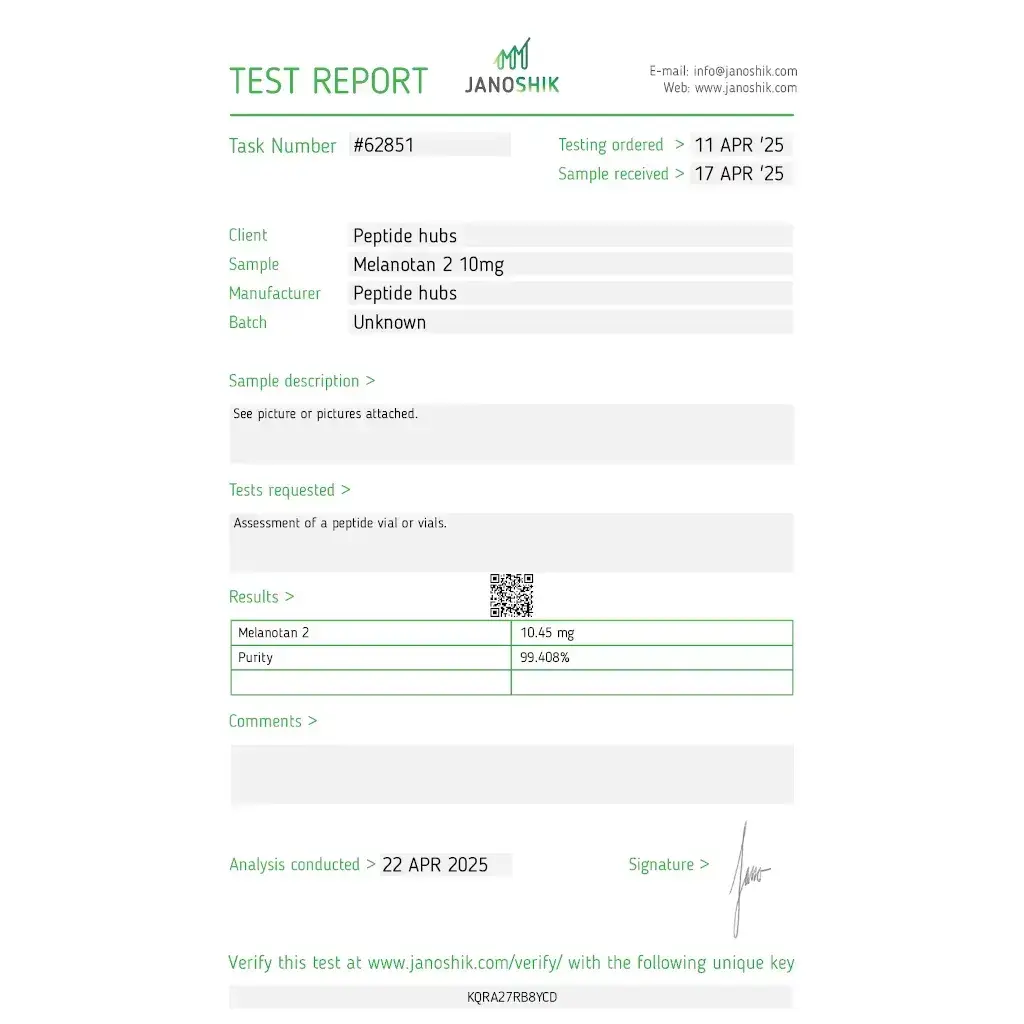
Published laboratory reports for Melanotan 2 10 mg are shown below with the test date and measured content.
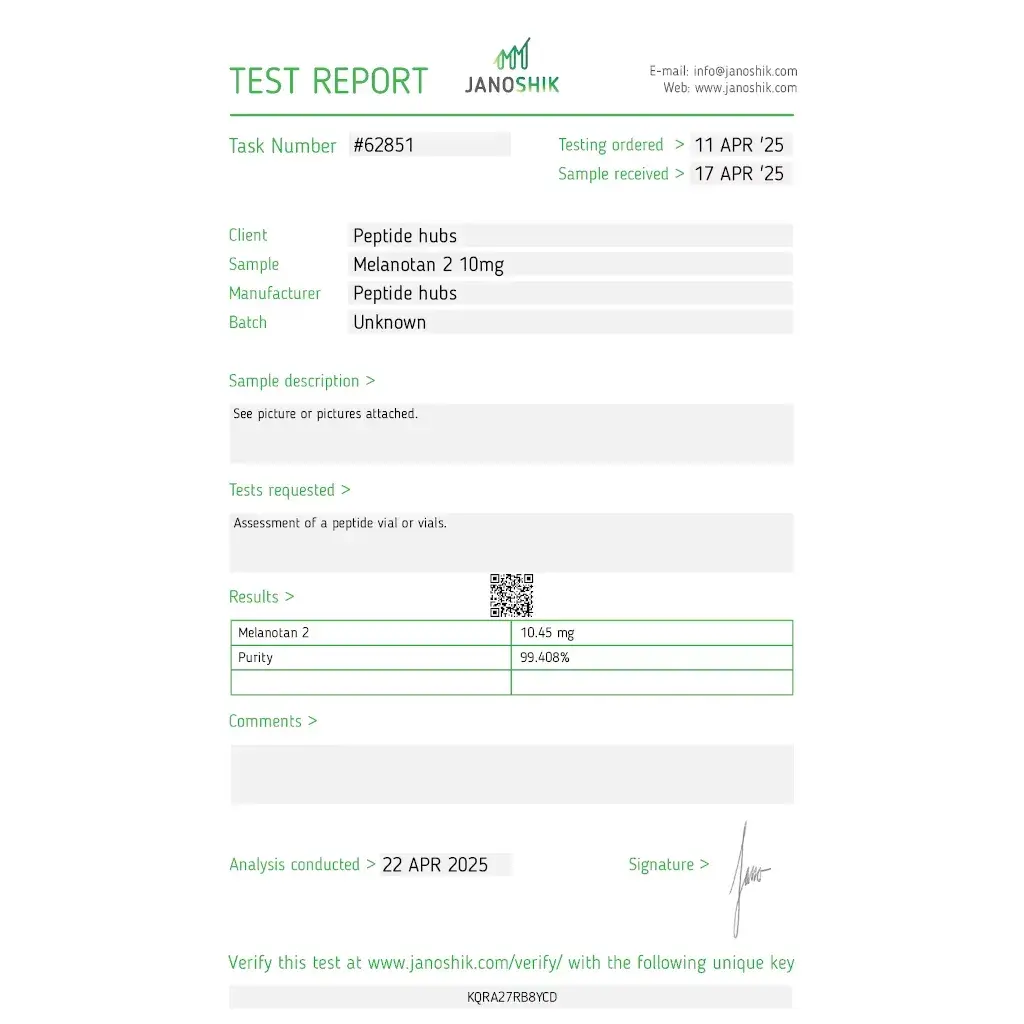 View Report
Laboratory results apply to the specific tested sample represented in each published report and should not be interpreted as a measurement of every vial or production batch.
The information below is provided for educational reference only. Melanotan II is not an FDA-approved human drug and its sale is illegal in the United States. Its use for any purpose falls outside approved indications, and no established human dosing regimen exists.
Because Melanotan II lacks FDA approval and published human dose-finding trials, there is no medically established dosage range. Non-medical community protocols reference weight-based dosing, though these are anecdotal and not evidence-based. A commonly referenced conservative approach starts at 0.0125 mg/kg as a true starting dose, escalating to 0.025 mg/kg after observing initial response.
| Use Case | Common Reference Range | Injection Frequency |
|---|---|---|
| Conservative start (community) | 50–75 mcg | Every other day, only on tanning days |
| Weight-based start (community) | 0.0125 mg/kg | Every other day |
| Full calculated dose (community) | 0.025 mg/kg | Every other day |
Community protocols emphasize starting at very low doses (50–75 mcg) and tapering slowly, with administration only on days when UV exposure will follow within an hour. Higher doses (500 mcg–1 mg) are associated with significantly increased risk of nausea, freckling, and new moles.
Melanotan 2 10 mg is supplied as a lyophilized powder and requires reconstitution before use. A 10 mg vial reconstituted with 3 mL of bacteriostatic water yields a concentration of approximately 3.33 mg/mL (3,333 mcg/mL). At this concentration, a 250 mcg dose would require drawing approximately 7.5 units on a U-100 insulin syringe.
Reconstituted solution should be stored refrigerated at 2–8°C and protected from light. Avoid vigorous shaking during reconstitution to reduce foaming.
Melanotan II is not typically stacked with other peptides in non-medical contexts. Community protocols emphasize administration only on days of UV exposure, within an hour before tanning. Administration without concurrent UV exposure is reported to increase the risk of uneven pigmentation and side effects in areas with high natural melanocyte activity, such as genitals and existing freckles.
There is no established cycling protocol for Melanotan II. Non-medical use is generally discontinued when the desired tan is achieved, with some users maintaining with occasional low-dose injections.
No human dose-response data for therapeutic outcomes exists for Melanotan II. All dosage information is derived from community convention and should not be interpreted as medical guidance.
Melanotan II is not FDA-approved for any human use and its sale is illegal in all 50 U.S. states, as well as in the United Kingdom and Australia. It is associated with serious and potentially life-threatening health risks.
Melanotan II is completely synthetic and is not approved by the FDA. Because the FDA does not regulate Melanotan II products, users cannot be sure what is in them regardless of label claims. One study found that the actual amount of Melanotan II in vials ranged from 4.32 to 8.84 mg, although sellers claimed each vial contained 10 mg.
Melanotan II products are sometimes marketed as a way to protect from skin cancer, but the opposite is true: they increase sun sensitivity and exposure, and are associated with melanoma.
Melanotan II is sold as a research chemical but is not approved for any human indication. Non-medical use falls outside approved indications and carries documented serious risks including priapism, renal infarction, and rhabdomyolysis.
Melanotan II comes with a long list of possible side effects, including: acne, decreased appetite, gastrointestinal issues including diarrhea and vomiting, nausea, facial flushing (redness), and spontaneous erections.
More serious risks include: priapism (painful, sustained erections that can cause scarring and permanent erectile dysfunction), renal infarction (a rare but life-threatening condition that causes reduced blood flow to the kidneys), and rhabdomyolysis (a condition in which muscle cells disintegrate, which can lead to acute kidney injury and even death). Melanotan II can cause a sudden increase in moles and freckles, and it is associated with melanoma, an invasive skin cancer with a high risk of death.
Given the serious and potentially life-threatening risks associated with Melanotan II, any consideration of its use should involve consultation with a qualified healthcare professional. Individuals with a history of melanoma or skin cancer, cardiovascular conditions, or kidney disease should exercise extreme caution.
No established monitoring protocol exists for non-medical Melanotan II use. Any adverse reactions should be documented and reported to appropriate authorities.
Store lyophilized powder at -20°C, sealed, dry, and protected from light. Once reconstituted, store refrigerated at 2–8°C and use within the recommended timeframe. Avoid vigorous shaking during reconstitution. Keep out of reach of children.
Melanotan 2 10 mg is supplied through the official Peptide Hubs distribution chain and shipped in original manufacturer packaging with discreet handling.
The outer shipping package remains discreet, with privacy-focused handling. Products are supplied through the official Peptide Hubs distribution chain.
To verify your Melanotan 2 10 mg product, use the security code on the vial label and cross-check it on the Peptide Hubs official site. Original packaging and manufacturer presentation help reinforce product legitimacy.
For complete delivery details, tracking policy, and reshipment terms, please see our Shipping Info page.
Proper storage conditions help preserve peptide stability and integrity throughout shelf life.
Store lyophilized powder at -20°C, sealed, dry, and protected from light. Under these conditions, the dry powder is stable for extended periods.
Once reconstituted, store refrigerated at 2–8°C and protected from light. Avoid repeated freeze-thaw cycles to maintain peptide integrity.
Keep out of reach of children. Follow proper handling practices.
Answers to common questions about Melanotan 2 10 mg, Melanotan II, and research peptide handling.
Melanotan 2 10 mg contains Melanotan II, a synthetic α-MSH analog studied in research for its effects on melanocortin receptors. In non-medical contexts, it is used for tanning purposes, though such use is illegal in the United States and associated with serious health risks.
No established human dosing schedule exists. Community protocols emphasize administration only on days of UV exposure, within an hour before tanning, typically every other day. This is based on convention, not clinical data.
Melanotan II does not suppress endogenous testosterone production and does not require post-cycle therapy in the way anabolic steroids do. However, any non-medical peptide use should be approached with extreme caution given the documented serious risks including priapism, renal infarction, and rhabdomyolysis.
Melanotan II is a non-selective melanocortin receptor agonist that activates MC1R (melanin synthesis), MC3R, MC4R (appetite suppression and sexual function), and MC5R. Its tanning effects require concurrent UV exposure to work.
The tanning effect only lasts as long as Melanotan II is used. When use stops, melanin levels decrease and the tan fades. Community reports suggest visible darkening within 1–3 weeks with regular administration and UV exposure.
There is no universally “best” tanning peptide, and Melanotan II is not FDA-approved for any use. It is illegal to sell in the United States and is associated with serious health risks including melanoma.
Melanotan II and PT-141 (bremelanotide) are both melanocortin agonists, but PT-141 is an active metabolite of Melanotan II with reduced impact on pigmentation and more selectivity toward MC3R and MC4R. They are not interchangeable.
Melanotan II targets melanocortin receptors for pigmentation and related effects, while BPC 157 is a tissue-repair peptide studied for angiogenic and cytoprotective effects. They operate through entirely different mechanisms and address different biological goals.
500 mcg is considered a high dose in community discussions and is associated with significantly increased risk of nausea, freckling, and new moles. Conservative protocols recommend starting at 50–75 mcg and tapering slowly.
Melanotan 2 10 mg is labeled at 10 mg of Melanotan II per vial. It is supplied as a lyophilized powder in a 2 mL vial.
Yes. A published laboratory report dated April 22, 2025 measured Melanotan 2 10 mg at 10.45 mg, equivalent to 104.5% of its 10 mg label claim. However, because Melanotan II products are not FDA-regulated, users cannot be sure what is in them regardless of label claims.
Store the lyophilized powder at -20°C, sealed, dry, and protected from light. Once reconstituted, refrigerate at 2–8°C and protect from light. Avoid repeated freeze-thaw cycles.