
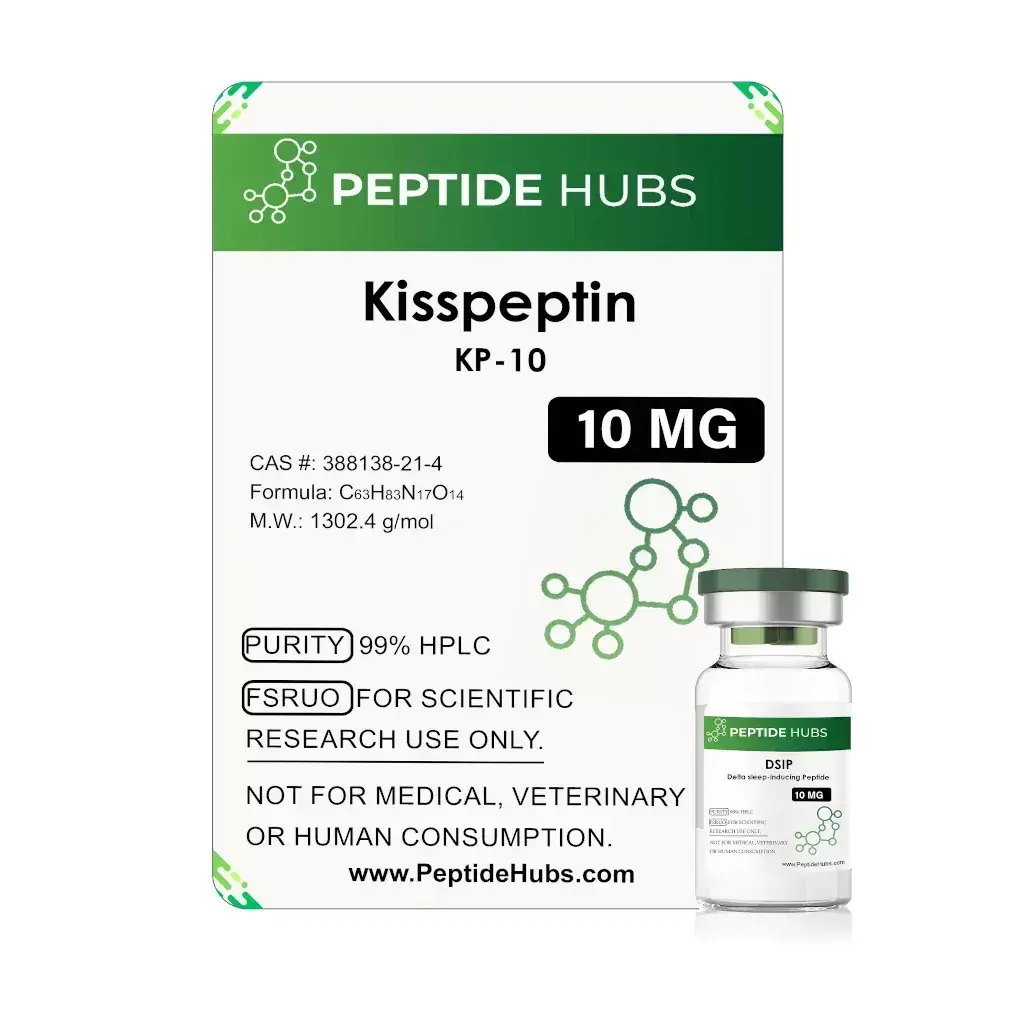
Kisspeptin 10 mg is a lyophilized kisspeptin-10 research product manufactured by Peptide Hubs and supplied as a 10 mg/vial powder in a 2 mL vial.
Kisspeptin 10 mg contains kisspeptin-10 (Kp-10), the minimal active decapeptide fragment of the kisspeptin family. Kisspeptins are encoded by the KISS1 gene and act as the endogenous ligands for the KISS1R/GPR54 receptor, playing a central role in the regulation of the hypothalamic-pituitary-gonadal (HPG) axis. Kisspeptin-10 is the shortest of the four naturally occurring isoforms (Kp-54, Kp-14, Kp-13, Kp-10), all of which share the common C-terminal decapeptide sequence and RF-amide motif.
Kisspeptin neurons in the arcuate nucleus and anteroventral periventricular nucleus of the hypothalamus release kisspeptin, which activates KISS1R on GnRH neurons, stimulating GnRH secretion into the hypothalamic-pituitary portal circulation. This upstream action drives pituitary LH and FSH release, which in turn stimulate gonadal steroidogenesis and gametogenesis. This hierarchical position makes kisspeptin the most upstream intervention point for HPG axis stimulation, acting above GnRH and far above downstream agents like hCG that act directly on gonadal receptors.
Kisspeptin-10 is not FDA-approved for any human use. The FDA evaluated kisspeptin-10 for inclusion on the 503A bulk drug substances list and concluded that available data weigh against inclusion, citing insufficient evidence of effectiveness, lack of characterization data, and unanswered questions about safety and immunogenicity. In non-medical bodybuilding contexts, kisspeptin-10 is referenced for potential post-cycle LH stimulation, though such use is empirical and not supported by controlled trials.
Kisspeptin 10 mg is supplied as a lyophilized (freeze-dried) powder in a 2 mL vial. Reconstitution with an appropriate solvent is required before use in research contexts.
Kisspeptin-10 is a decapeptide with the sequence YNWNSFGLRF-NH2 and a molecular weight of approximately 1,302 Da (amide form).
Kisspeptin-10 belongs to the class of RF-amide neuropeptides and acts as the minimal active fragment of the kisspeptin family. All kisspeptin isoforms are proteolytically cleaved from a 145-amino-acid precursor encoded by the KISS1 gene. Kp-10 comprises only the conserved C-terminal decapeptide, which is sufficient to activate KISS1R to its full functional potential.
Receptor binding triggers Gq-dependent signaling via phospholipase C (PLC) activation and phosphatidylinositol 4,5-bisphosphate (PIP2) hydrolysis, leading to intracellular calcium rise and GnRH neuron depolarization. Kisspeptin also activates beta-arrestin-dependent signaling, resulting in ERK1/2 phosphorylation. The peptide also has roles outside the HPG axis, including in cancer metastasis suppression, bone resorption regulation, and glucose homeostasis.
Kisspeptin-10 has a very short plasma half-life, estimated at under 4 minutes for intravenous administration in humans based on rapid LH pulse decay after bolus injection. Continuous administration causes KISS1R desensitization and paradoxical LH suppression, necessitating pulsatile or intermittent dosing for sustained gonadotropin stimulation.
Kisspeptin-10 is distinguished by its short sequence (decapeptide), rapid plasma clearance (under 4 minutes IV), and requirement for pulsatile dosing to avoid receptor desensitization. This contrasts with the longer kisspeptin-54 isoform, which has a longer half-life and has been the workhorse of most clinical trials.
Peptide Hubs offers several research peptides targeting endocrine pathways. Within this lineup, Ipamorelin and CJC-1295 No DAC target growth hormone secretion through ghrelin and GHRH receptor pathways, respectively, representing a different endocrine axis entirely.
For research focused on testicular function directly, Tesamorelin and Sermorelin are GHRH analogs with different targets. Kisspeptin-10 is unique in this lineup for its upstream HPG axis action, acting at the hypothalamus rather than the pituitary or gonads.
The information below is provided for educational reference only. Kisspeptin-10 is not FDA-approved for any human use. Its use for any non-medical purpose falls outside approved indications, and no established human dosing regimen exists for bodybuilding or performance contexts.
Because kisspeptin-10 lacks FDA approval and published human dose-finding trials for non-medical applications, there is no medically established dosage range for research or bodybuilding contexts. In non-medical research communities, reference ranges are derived from clinical trial protocols and community convention. Clinical studies have used intravenous doses ranging from 0.01 to 3 mcg/kg as bolus and infusion rates of 1.5–10 nmol/kg/h.
| Use Case | Common Reference Range | Injection Frequency |
|---|---|---|
| Clinical research (IV bolus) | 0.01–3 mcg/kg | Single bolus |
| Clinical research (IV infusion) | 1.5–10 nmol/kg/h | Continuous infusion |
| Non-medical community protocol (SC) | 50–100 mcg | Once daily (empirical) |
Community protocols reference subcutaneous doses of 50–100 mcg for post-cycle LH stimulation, though these are empirical and not derived from controlled trials. Subcutaneous bioavailability is lower than intravenous, with research groups using roughly 3–5 times higher SC doses to achieve comparable LH responses.
Kisspeptin 10 mg is supplied as a lyophilized powder and requires reconstitution before use. A 10 mg vial reconstituted with 10 mL of bacteriostatic water yields a concentration of 1 mg/mL (1,000 mcg/mL), meaning a 100 mcg dose would require drawing 0.1 mL (10 units on a U-100 insulin syringe).
Reconstituted solution should be stored refrigerated at 2–8°C and used within a few days. Methionine-adjacent aromatic residues are oxidation-sensitive, so prolonged room-temperature exposure should be avoided.
In non-medical bodybuilding contexts, kisspeptin-10 is sometimes discussed for post-cycle therapy protocols, though no clinical evidence supports this use. Some community protocols reference 8- to 12-week cycles with daily dosing, followed by a rest period to maintain receptor sensitivity.
Continuous kisspeptin-10 infusion causes receptor desensitization and paradoxical LH suppression, mirroring tachyphylaxis seen with continuous GnRH agonist dosing. Pulsatile or intermittent dosing is required to preserve receptor sensitivity.
No human dose-response data for therapeutic outcomes exists for kisspeptin-10 in non-medical contexts. All dosage information is derived from clinical research protocols or community convention and should not be interpreted as medical guidance.
Kisspeptin-10 is not FDA-approved for any human use. The FDA evaluated kisspeptin-10 for inclusion on the 503A bulk drug substances list and concluded that available data weigh against inclusion, citing insufficient evidence of effectiveness, lack of characterization data, and unanswered questions about safety and immunogenicity.
The FDA’s Pharmacy Compounding Advisory Committee unanimously agreed that kisspeptin-10 should not be included on the 503A Bulks List due to lack of convincing safety and efficacy data. The FDA evaluation noted that kisspeptin-10 is not well characterized from a physicochemical perspective, there is a lack of information about whether it can be safely used in the intended population, and immunogenicity risks remain unaddressed.
The committee also noted that there are several FDA-approved treatments available for secondary hypogonadism, the condition for which kisspeptin-10 was nominated for compounding.
Kisspeptin-10 is marketed as a research peptide, but it is not FDA-approved for any human indication. Non-medical use falls outside approved indications and should be approached with caution.
Published human trials report kisspeptin-10 is generally well tolerated at doses up to 10 nmol/kg IV. Transient LH and testosterone surges are pharmacological effects, not adverse events. Mild injection-site reactions occur with subcutaneous administration. No serious adverse events attributable to kisspeptin-10 were reported in published Phase I/II studies.
Continuous administration causes KISS1R desensitization and tachyphylaxis, disrupting pulsatile GnRH release and potentially suppressing LH output. This is a pharmacological effect rather than an adverse reaction, but it has implications for dosing strategy.
Given the absence of comprehensive human safety data and the FDA’s negative evaluation for compounding, any consideration of kisspeptin-10 use should involve consultation with a qualified healthcare professional. Individuals with reproductive disorders, hormone-sensitive conditions, or those taking medications affecting the HPG axis should exercise particular caution.
No established monitoring protocol exists for non-medical kisspeptin-10 use. In research contexts, any adverse reactions should be documented and reported to appropriate authorities. Clinical studies have monitored LH, FSH, and testosterone levels as markers of HPG axis stimulation.
Store lyophilized powder at -20°C, sealed, dry, and protected from light. Once reconstituted, store refrigerated at 2–8°C and use within a few days. Avoid prolonged room-temperature exposure due to oxidation sensitivity. Keep out of reach of children.
Kisspeptin 10 mg is supplied through the official Peptide Hubs distribution chain and shipped in original manufacturer packaging with discreet handling.
The outer shipping package remains discreet, with privacy-focused handling. Products are supplied through the official Peptide Hubs distribution chain.
To verify your Kisspeptin 10 mg product, use the security code on the vial label and cross-check it on the Peptide Hubs official site. Original packaging and manufacturer presentation help reinforce product legitimacy.
For complete delivery details, tracking policy, and reshipment terms, please see our Shipping Info page.
Proper storage conditions help preserve peptide stability and integrity throughout shelf life.
Store lyophilized powder at -20°C, sealed, dry, and protected from light. Under these conditions, the dry powder is stable for extended periods.
Once reconstituted, store refrigerated at 2–8°C and use within a few days. Methionine-adjacent aromatic residues are oxidation-sensitive, so avoid prolonged room-temperature exposure.
Keep out of reach of children. Follow proper handling practices.
Answers to common questions about Kisspeptin 10 mg, kisspeptin-10, and research peptide handling.
Kisspeptin 10 mg contains kisspeptin-10, a research peptide studied for its role in stimulating the HPG axis through KISS1R/GPR54 receptor activation. It is used in clinical research to probe GnRH neuron function and in non-medical contexts is referenced for potential LH stimulation, though such use is empirical and not supported by controlled trials.
No established human dosing schedule exists for non-medical use. Clinical research has used both single IV boluses and continuous infusions. Continuous administration causes receptor desensitization, so pulsatile or intermittent dosing is required for sustained LH stimulation.
Kisspeptin-10 does not suppress endogenous testosterone production and does not require post-cycle therapy in the way anabolic steroids do. However, the FDA has evaluated kisspeptin-10 negatively for compounding due to insufficient safety and efficacy data.
Kisspeptin is a neuropeptide that activates KISS1R/GPR54 receptors on GnRH neurons in the hypothalamus, stimulating GnRH secretion. This drives pituitary LH and FSH release, which in turn stimulate gonadal function. It is the most upstream regulator of the HPG axis.
Kisspeptin-10 has a very short plasma half-life, estimated at under 4 minutes for IV administration in humans. LH pulse induction occurs rapidly after bolus injection, with peak LH levels observed within 15–30 minutes in clinical studies.
There is no universally “best” HPG axis peptide. Kisspeptin-10 acts furthest upstream but has the shortest half-life, making sustained effects hardest to achieve. hCG acts directly on gonadal receptors and has the largest clinical evidence base for testosterone stimulation.
Kisspeptin acts at the hypothalamus, driving the entire HPG cascade from the top. hCG acts as an LH-receptor agonist directly on the gonads, bypassing the upstream axis. Kisspeptin is furthest upstream and has the shortest half-life; hCG has the largest clinical evidence base.
Kisspeptin targets the HPG axis through KISS1R/GPR54 to stimulate GnRH and LH/FSH release, while Ipamorelin targets growth hormone secretion through the ghrelin receptor. They operate on entirely different endocrine axes.
100 mcg is within the range commonly referenced in non-medical community protocols for subcutaneous administration, though these doses are empirical and not derived from controlled trials. Clinical research has used IV doses ranging from 0.01 to 3 mcg/kg.
Kisspeptin 10 mg is labeled at 10 mg of kisspeptin-10 per vial. It is supplied as a lyophilized powder in a 2 mL vial.
Store the lyophilized powder at -20°C, sealed, dry, and protected from light. Once reconstituted, refrigerate at 2–8°C and use within a few days. Avoid prolonged room-temperature exposure due to oxidation sensitivity.
Laboratory testing information for this Kisspeptin 10 mg product is not currently available. The FDA has noted that kisspeptin-10 is not well characterized from a physicochemical perspective, highlighting the importance of independent verification.