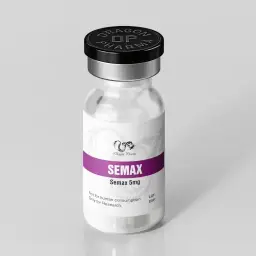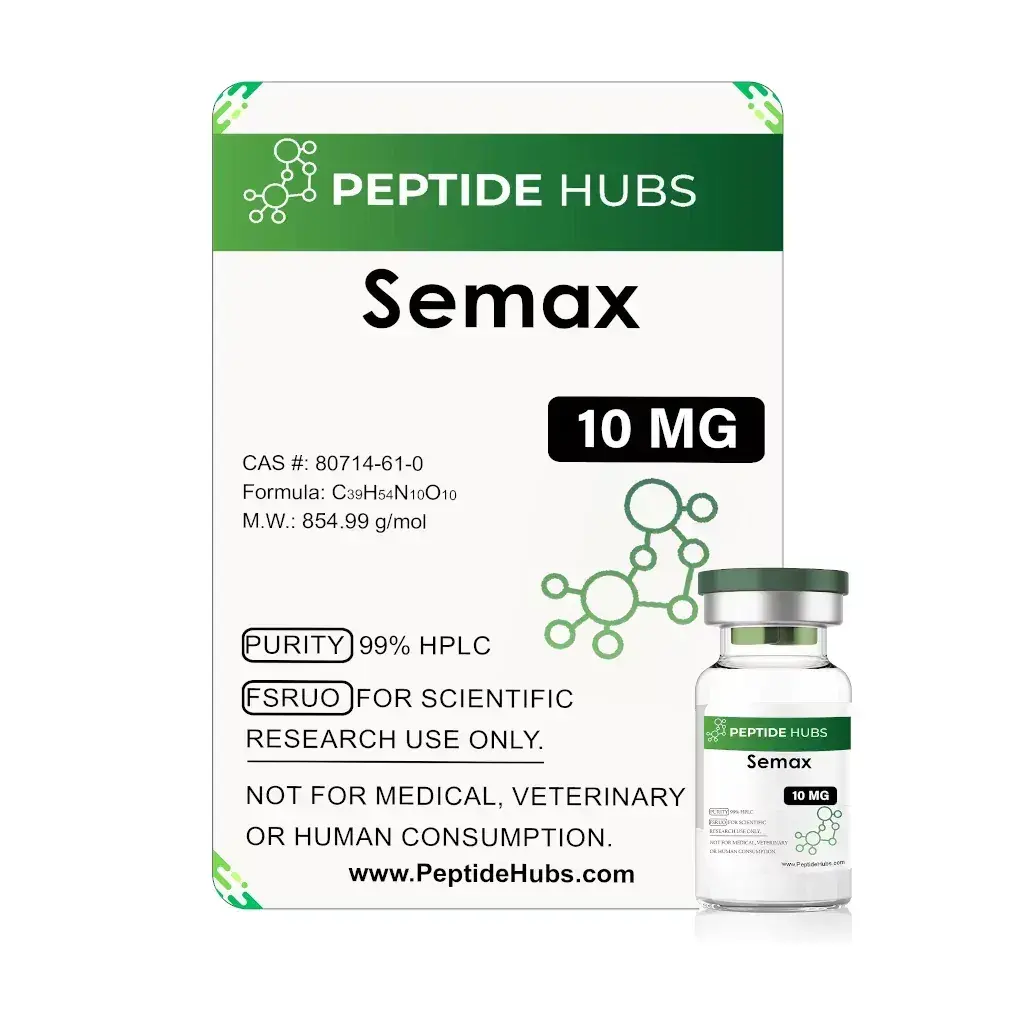
Semax 10 mg is a lyophilized research peptide manufactured by Peptide Hubs and supplied in a 2 mL vial containing 10 mg of Semax.
Semax 10 mg contains Semax, a synthetic heptapeptide analogue of the adrenocorticotropic hormone (ACTH) fragment ACTH(4–10). The peptide is structurally stabilized by a C-terminal Pro-Gly-Pro tripeptide extension, which confers greater resistance to enzymatic degradation compared to the native ACTH fragment.
In Russian clinical practice, Semax has been studied for cerebrovascular and neurological applications, including ischemic stroke recovery and cognitive support. Its proposed mechanisms involve modulation of neurotrophic factors such as BDNF and NGF, as well as effects on dopaminergic and serotonergic neurotransmission. In non-medical research settings, Semax is commonly referenced for its potential nootropic and neuroprotective properties.
As a research peptide, Semax falls outside FDA-approved medical indications in the United States. Its use in bodybuilding contexts is not established, and the compound is primarily of interest in neurological and cognitive research rather than anabolic or performance-enhancement applications.
Semax 10 mg is supplied as a lyophilized powder, a freeze-dried format designed to preserve peptide integrity during storage. Reconstitution is required before research use.
Semax is a synthetic heptapeptide with the sequence Met-Glu-His-Phe-Pro-Gly-Pro, representing a stabilized analogue of the ACTH(4–10) fragment. Its design incorporates a C-terminal Pro-Gly-Pro extension to resist enzymatic degradation.
Semax differs from native ACTH in that it lacks hormonal activity while retaining neurotrophic and neuromodulatory effects. The peptide is reported to cross the blood-brain barrier and has been studied for its effects on BDNF and NGF expression in the central nervous system.
Unlike anabolic-androgenic steroids or growth hormone secretagogues, Semax is not associated with muscle-building or performance-enhancement mechanisms. Its research profile is centered on neurological function, cognitive processes, and neuroprotection.
The peptide's C-terminal Pro-Gly-Pro tripeptide provides metabolic stability, distinguishing it from the rapidly degraded native ACTH fragment.
Semax retains the neurotrophic properties associated with ACTH fragments while being devoid of corticosteroidogenic activity, making it a subject of interest in neurological research rather than endocrine or anabolic applications.
Peptide Hubs offers Semax in a 10 mg lyophilized powder format, providing a research-scale quantity suitable for laboratory investigation. The 10 mg vial is appropriate for studies requiring multiple reconstituted aliquots or extended experimental protocols.
Related research peptides available from Peptide Hubs include Selank 10 mg, a synthetic tuftsin analogue with anxiolytic research applications, and BPC 157 5 mg, a pentadecapeptide studied for tissue repair mechanisms. For neuropeptide research, DSIP 10 mg represents another peptide with reported effects on sleep architecture and neuroendocrine regulation.
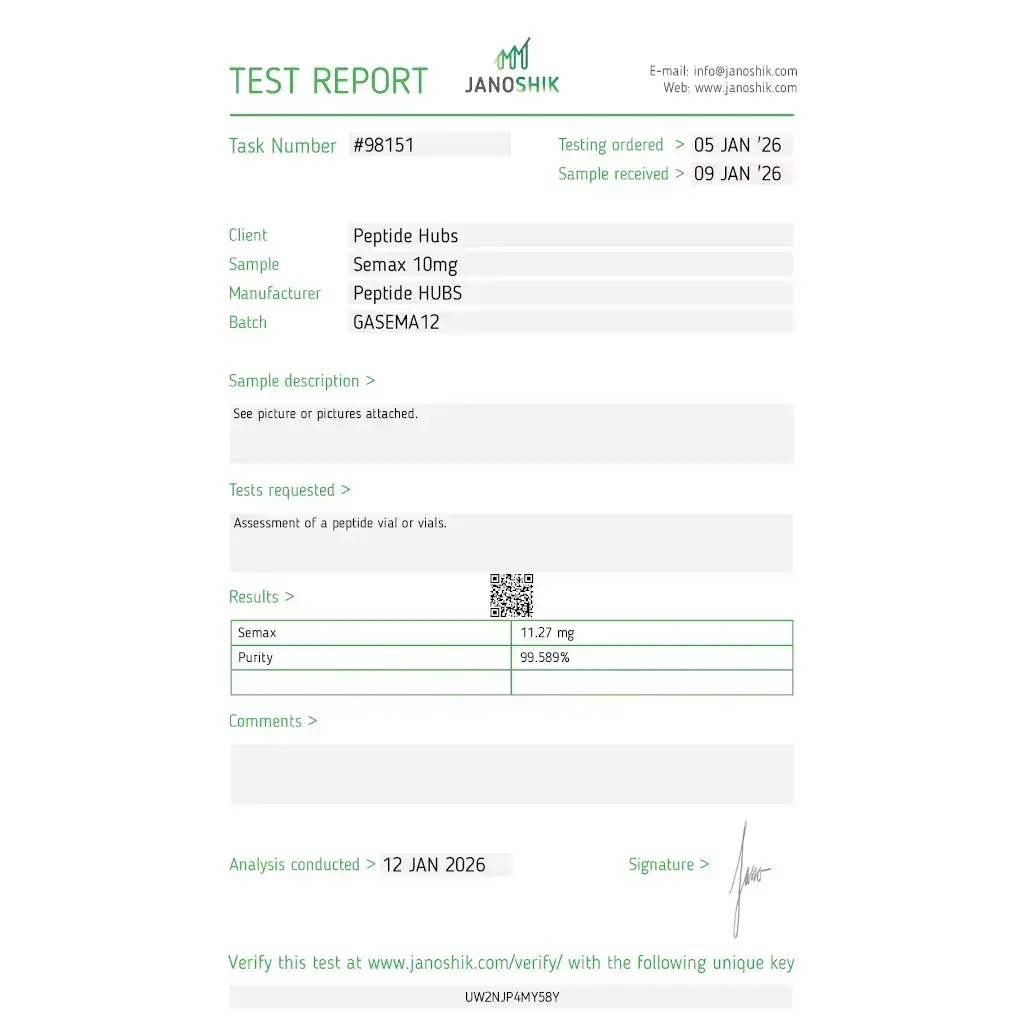
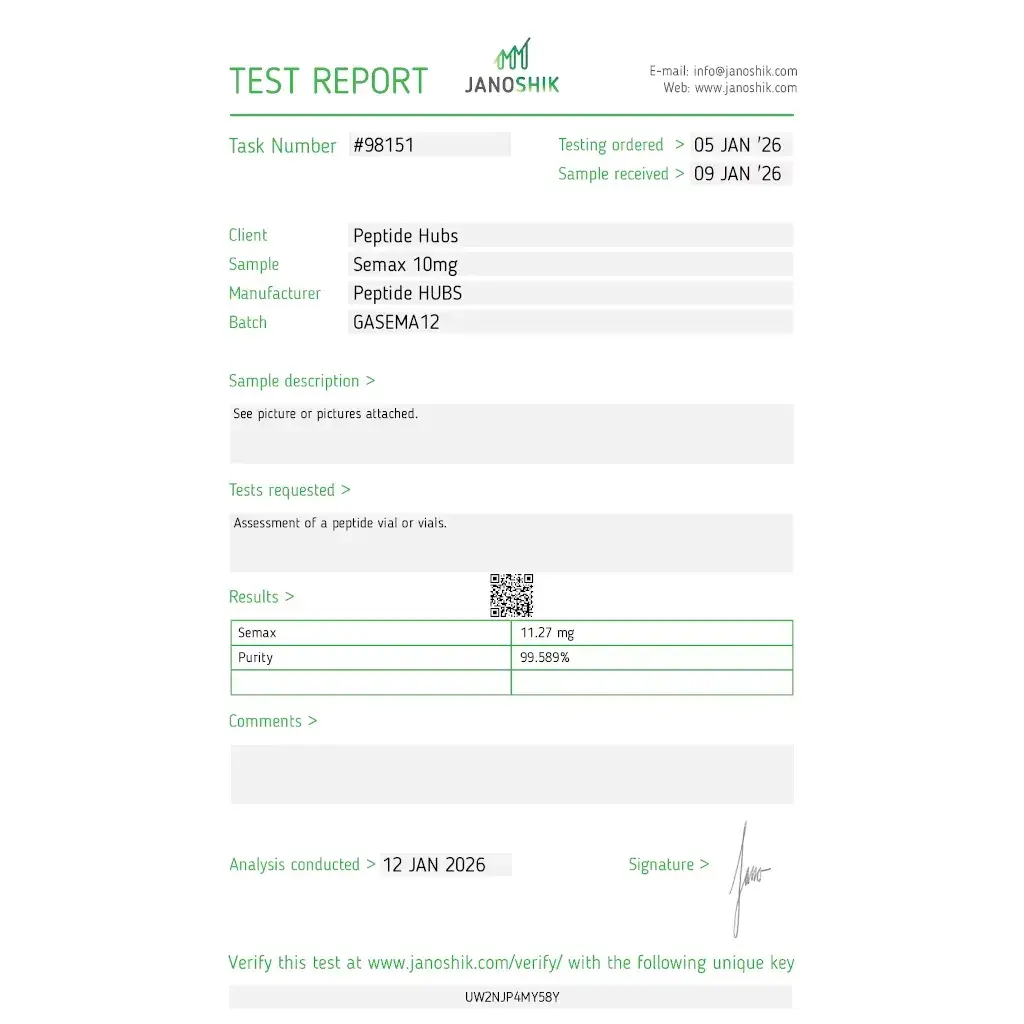
Published laboratory reports for Semax 10 mg by Peptide Hubs are shown below with the test date, measured content, and percentage of the product's 10 mg label claim.
 View Report
Laboratory results apply to the specific tested sample represented in each published report and should not be interpreted as a measurement of every vial or production batch.
The information below is provided for educational reference only. Semax is a research peptide that has not been evaluated or approved by the FDA for medical use. Any non-medical use falls outside approved indications and should not be undertaken without appropriate supervision.
In Russian clinical literature, Semax has been studied primarily via intranasal administration at doses ranging from 300 mcg to 900 mcg per day, often in divided doses. Research protocols have typically used courses of 10–14 days. In non-medical research contexts, reference ranges vary, and no standardized protocol exists for the lyophilized injectable format.
| Use Case | Common Reference Range | Frequency |
|---|---|---|
| Clinical research (intranasal) | 300–900 mcg / day | Divided doses, 10–14 day courses |
| Non-medical research (injectable) | Not well characterized | No standardized protocol |
| Reconstituted solution | Depends on dilution volume | Per experimental design |
Note: Common reference ranges for injectable Semax in bodybuilding or performance contexts are not well characterized in publicly available resources. The intranasal clinical data does not directly translate to reconstituted lyophilized powder protocols.
Semax is not a compound typically stacked in anabolic or bodybuilding cycles. Its research profile centers on neurotrophic and cognitive mechanisms rather than muscle protein synthesis or hormonal pathways. In research contexts, Semax may be studied alongside other neuroactive peptides such as Selank 10 mg, though combination protocols are not well established.
Reported side effects in clinical literature include transient headache, nasal irritation (with intranasal use), and occasional restlessness. The FDA has noted concerns regarding the safety profile of Semax in compounded injectable forms, including potential immunogenicity risks. No specific management protocols for injectable research use are established.
Post-cycle therapy is not applicable to Semax, as the peptide does not suppress endogenous testosterone production or alter hormonal axes in the manner of anabolic steroids.
Research peptide protocols should be based on published study designs and appropriate institutional oversight. The information above is for educational reference and does not constitute medical advice or a recommendation for use.
Semax is not FDA-approved for any indication in the United States. The FDA has evaluated Semax-related bulk drug substances and identified insufficient clinical information to characterize their safety profile for compounded use.
Semax has been studied in Russian clinical settings primarily via intranasal administration. The FDA has stated that there are no safety data for Semax administered by subcutaneous injection, and concerns exist regarding potential immunogenicity when peptides are administered via injectable routes.
Clinical information on Semax is predominantly from Russian research institutions, with limited independent Western replication. The safety and efficacy of Semax have not been established through adequate and well-controlled clinical trials under FDA standards.
Semax is not approved for human use in the United States outside of specific compounding arrangements. Non-medical use of research peptides falls outside approved indications and carries unknown risks.
Reported adverse effects from clinical literature include nasal irritation with intranasal administration, transient headache, and occasional restlessness. The FDA has noted that most references did not discuss safety, and there is insufficient clinical information to fully characterize the safety profile.
One reference discussed possible antithrombotic properties of Semax, raising theoretical concerns about bleeding risk, particularly in individuals already at risk for bleeding or using medications that increase bleeding risk.
Semax has not been evaluated for use in pregnancy, breastfeeding, or pediatric populations. Individuals with known hypersensitivity to Semax or formulation components should avoid exposure. The FDA has not identified sufficient data to rule out immunogenicity risks with injectable administration.
Research use of Semax should be conducted under appropriate institutional oversight with defined protocols for monitoring and adverse event reporting. Clinical monitoring parameters for Semax have not been established in FDA-reviewed literature.
Keep the vial securely stored and protected from conditions that could compromise the product. Inspect the vial before use and do not use a product that appears damaged or compromised.
Semax 10 mg is supplied through the Peptide Hubs distribution chain and shipped with discreet, privacy-focused handling.
The outer shipping package remains discreet, with privacy-focused handling. Products are supplied through the official Peptide Hubs distribution chain.
To verify your Semax 10 mg product, use the security code on the vial label and cross-check it on the Peptide Hubs official site. Original packaging and batch-linked laboratory documentation help reinforce product legitimacy.
For complete delivery details, tracking policy, and reshipment terms, please see our Shipping Info page.
Proper storage conditions help preserve peptide integrity and stability throughout the product's shelf life.
Store the lyophilized powder at controlled room temperature or refrigerated conditions, protected from excessive heat, moisture, and direct light. For long-term storage, freezing at -20°C is commonly recommended for lyophilized peptides. Keep the vial in its original packaging until use.
After reconstitution, store the solution refrigerated and use within the period specified by your research protocol. Avoid repeated freeze-thaw cycles, which can compromise peptide integrity.
Answers to common questions about Semax 10 mg, the Semax peptide, laboratory testing, and research applications.
Semax 10 mg is a research peptide supplied as lyophilized powder. Semax has been studied in Russian clinical settings for neurological applications including ischemic stroke recovery and cognitive support. In non-medical research contexts, it is investigated for potential neurotrophic effects. It is not approved by the FDA for any medical use in the United States.
Clinical literature describes Semax primarily via intranasal administration. The lyophilized powder format of Semax 10 mg requires reconstitution for research use. No standardized injectable protocol for Semax has been established in FDA-reviewed literature.
No. Post-cycle therapy is not applicable to Semax, as the peptide does not suppress endogenous testosterone production or affect hormonal axes in the manner of anabolic steroids. Semax lacks hormonal activity entirely.
Semax is a synthetic analogue of the ACTH(4–10) fragment that lacks hormonal activity but demonstrates neurotrophic properties in research. Studies suggest it may modulate BDNF and NGF expression and affect dopaminergic and serotonergic neurotransmission. Its mechanisms are not fully understood.
Onset and duration depend on the route of administration and research protocol. Clinical studies using intranasal Semax have reported effects within days to weeks, but these findings are from specific study designs and do not directly translate to reconstituted lyophilized powder research.
No. As of 2026, Semax is not FDA-approved for any indication in the United States. The FDA has evaluated Semax-related bulk drug substances and identified insufficient clinical information to characterize their safety profile for compounded use.
Semax and Selank are both synthetic peptides studied for neurological effects, but they derive from different molecular origins. Semax is an ACTH(4–10) analogue, while Selank is a synthetic analogue of tuftsin. Both are available as research peptides from Peptide Hubs.
Semax and BPC 157 have entirely different structures and research profiles. Semax is a heptapeptide studied for neurotrophic effects, while BPC 157 is a pentadecapeptide studied primarily for tissue repair mechanisms. They are not comparable in mechanism or application.
A 10 mg vial of Semax is a research-scale quantity. Clinical studies have typically used microgram doses (300–900 mcg per day intranasally). The 10 mg vial provides sufficient material for multiple reconstituted aliquots in laboratory research settings.
Semax 10 mg by Peptide Hubs is labeled at 10 mg per vial. The product is supplied as lyophilized powder in a 2 mL vial.
Yes. A published laboratory report dated January 12, 2026 measured Semax 10 mg at 11.27 mg, equivalent to 112.70% of its 10 mg label claim. The complete report with batch number GASEMA12 can be viewed in the Lab Reports tab.
Lyophilized peptides are typically reconstituted with bacteriostatic water or sterile saline. The appropriate diluent volume depends on your desired concentration for research. Bacteriostatic Water is commonly used for peptide reconstitution to maintain sterility over multiple draws.