
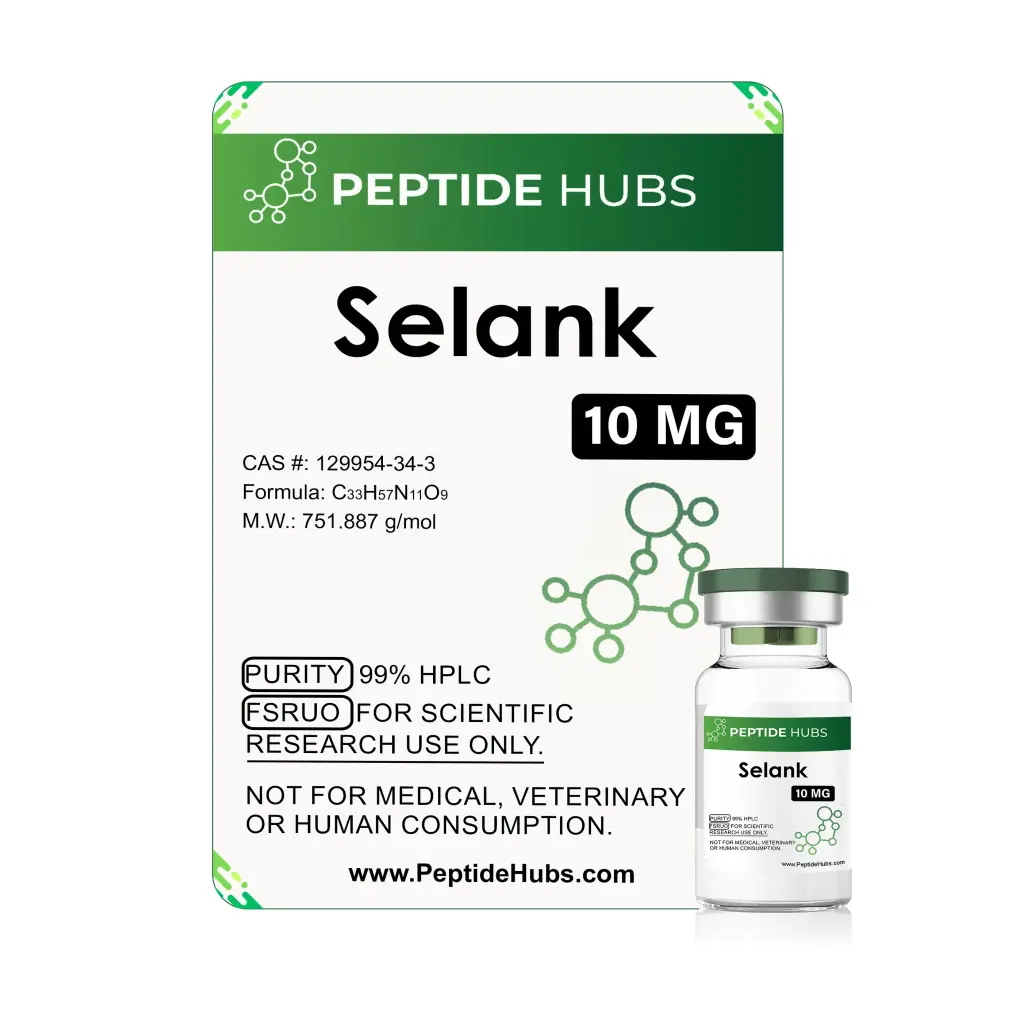
Selank 10 mg is a lyophilized powder peptide manufactured by Peptide Hubs containing Selank at 10 mg per vial, supplied in a 2 mL vial.
Selank is a synthetic heptapeptide with the sequence Thr-Lys-Pro-Arg-Pro-Gly-Pro. It is an analog of tuftsin, a naturally occurring immunomodulatory peptide fragment. Research on Selank has focused primarily on its potential anxiolytic and nootropic properties, with proposed mechanisms involving modulation of GABAergic signaling and inhibition of enkephalin-degrading enzymes.
In Russia, a 0.15% intranasal formulation of Selank has been registered for medical use as an anxiolytic. International regulatory agencies, including the FDA, have not approved Selank for any indication. Studies examining Selank's effects have been limited in scope, with small sample sizes and short durations. In non-medical contexts, Selank is sometimes referenced for anxiety management and cognitive support, though such use falls outside any approved indication.
The peptide is supplied as a lyophilized powder, a format that supports stability before reconstitution. Research on Selank's mechanisms has explored its interactions with neurotransmitter systems and its potential influence on neurotrophic factor expression. However, the evidence base remains preliminary, and clinical data from well-controlled international trials are lacking.
Selank 10 mg is supplied as a lyophilized (freeze-dried) powder requiring reconstitution with a suitable diluent before use. This format supports extended shelf stability compared to liquid preparations. The product is presented in a 2 mL vial.
Selank is a synthetic peptide developed from the tuftsin sequence, with research interests centered on neuropeptide signaling and potential anxiolytic activity. Its proposed mechanisms distinguish it from conventional anxiolytic medications.
Selank (Thr-Lys-Pro-Arg-Pro-Gly-Pro) is a synthetic analog of tuftsin, a tetrapeptide fragment of immunoglobulin G. The addition of a Pro-Gly-Pro tripeptide to the tuftsin sequence is designed to enhance stability and prolong activity. Research has explored Selank's interaction with GABA receptors, with evidence suggesting it acts as a positive allosteric modulator.
Another proposed mechanism involves inhibition of enkephalin-degrading enzymes, potentially increasing endogenous enkephalin levels and influencing opioid receptor signaling. These pathways are associated with mood, stress response, and pain regulation. Selank has also been studied for effects on neurotrophic factor expression in the hippocampus.
Unlike benzodiazepines, Selank is not reported to cause sedation, dependence, or withdrawal symptoms in Russian clinical literature, though independent international data are limited.
Selank's distinguishing feature in research contexts is its proposed mechanism of modulating endogenous neuropeptide systems rather than directly activating GABA receptors like benzodiazepines. This mechanism is hypothesized to produce anxiolytic effects without the sedation and dependence associated with conventional anxiolytics.
Peptide Hubs offers a range of research peptides targeting different physiological systems. Selank's focus on neuropeptide signaling and potential anxiolytic activity distinguishes it from compounds that act on growth hormone pathways, such as Ipamorelin or CJC-1295 No DAC. For cognitive and neurological research, Semax is a related synthetic peptide studied for nootropic effects through different proposed mechanisms.
Other Peptide Hubs products address tissue repair, such as BPC 157 and TB 500, or sleep regulation, such as DSIP. These compounds operate through pathways unrelated to Selank's proposed neuropeptide modulation.
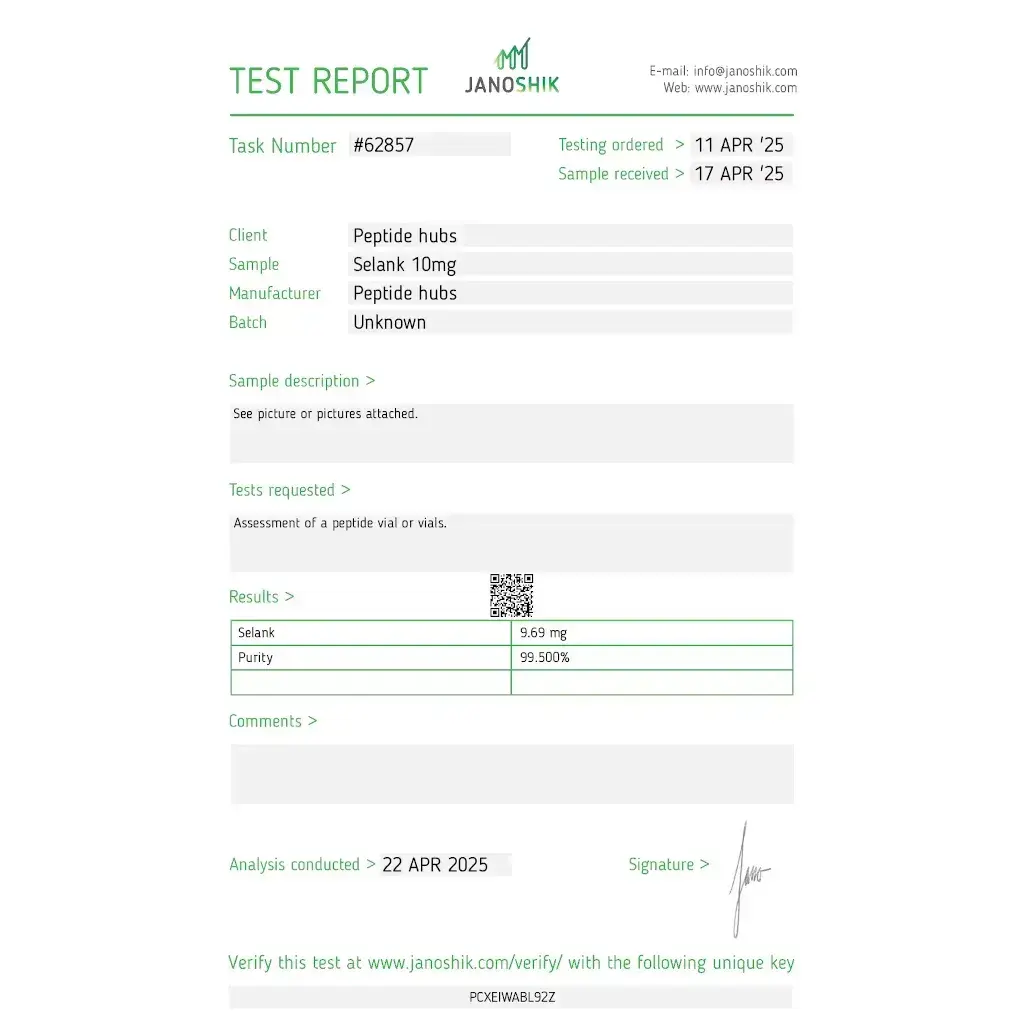
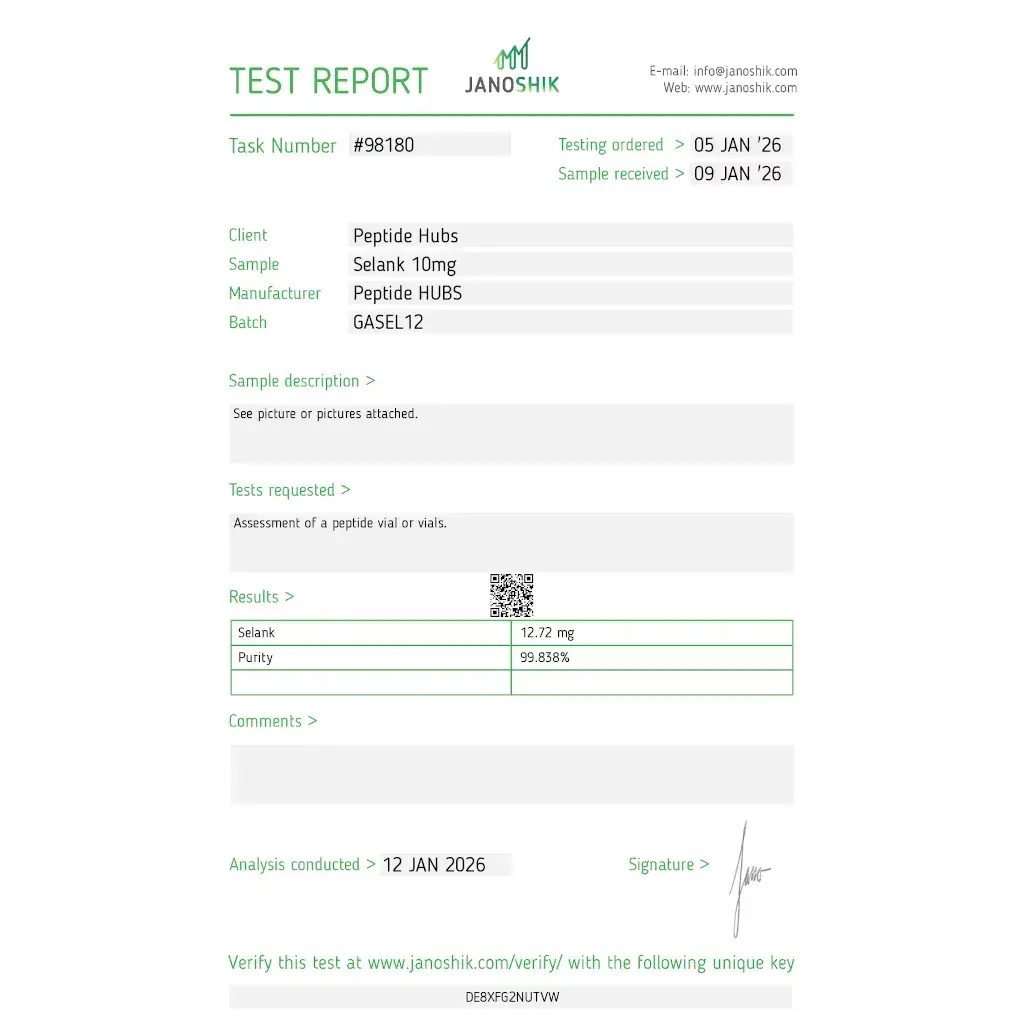
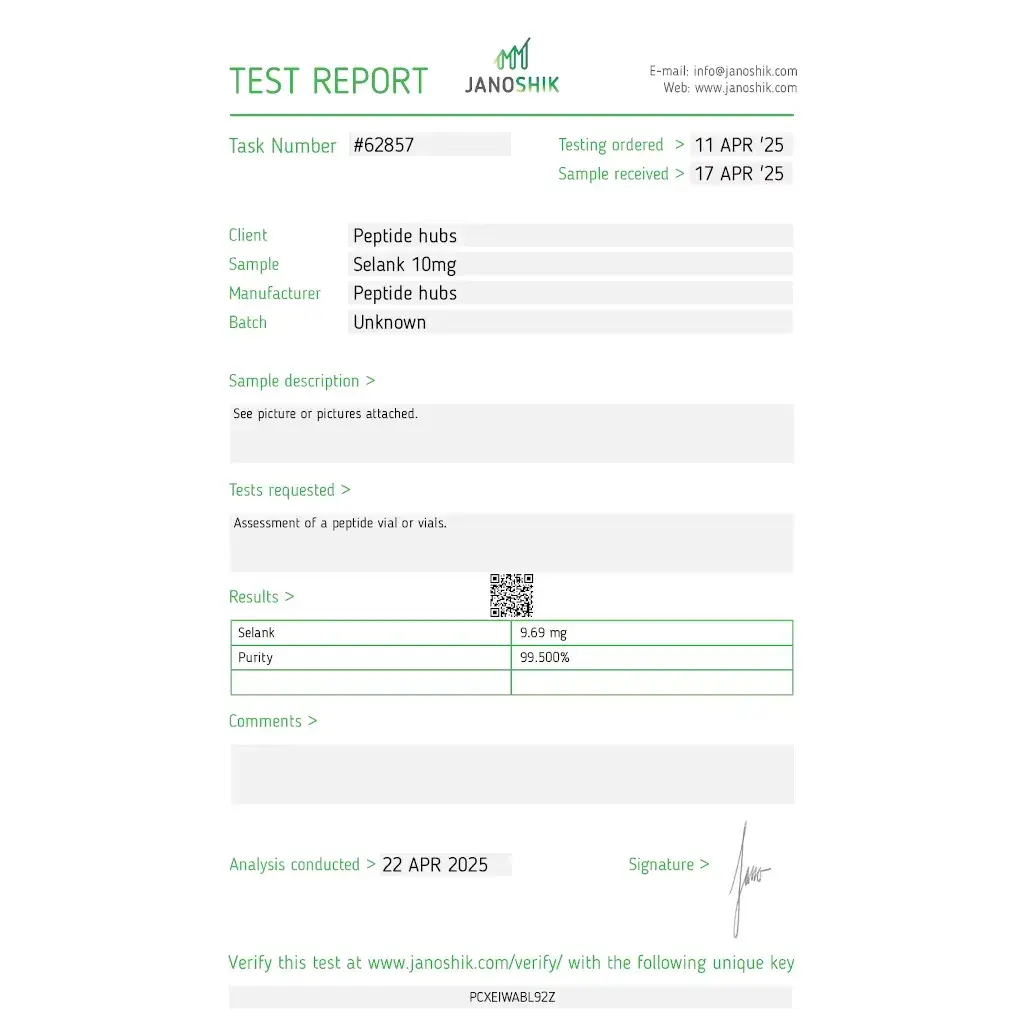
Published laboratory reports for Selank 10 mg are shown below with the test date, measured content and percentage of the product's 10 mg label claim.
 View Report
 View Report
Laboratory results apply to the specific tested sample represented in each published report and should not be interpreted as a measurement of every vial or production batch.
The information below is provided for educational reference only. Selank is not approved by the FDA for any indication. Medical use in Russia requires prescription and supervision. Non-medical use falls outside approved indications.
The registered Russian protocol for Selank specifies 300 mcg per dose, administered intranasally three times daily for a total of 900 mcg per day, in courses of 10 to 14 days. In non-medical research contexts, subcutaneous administration is sometimes referenced at 250 to 500 mcg per injection, once or twice daily, though this route has no clinical precedent in human studies.
| Use Case | Common Reference Range | Frequency |
|---|---|---|
| Registered Russian protocol (intranasal) | 300 mcg per dose | Three times daily, 10–14 day course |
| Non-medical (subcutaneous reference) | 250–500 mcg per injection | Once or twice daily |
No established stacking protocols exist for Selank in clinical literature. In research contexts, Selank is studied as a standalone intervention. The Russian label recommends courses of 10 to 14 days with breaks of 2 to 4 months between cycles, though longer or continuous use is sometimes referenced in non-medical communities without clinical evidence.
Reconstitution should be performed with Bacteriostatic Water following standard sterile technique. There is no loading phase established for this peptide.
Common adverse effects reported in Russian clinical literature include nasal mucosa irritation (for intranasal use) and rare allergic reactions. Independent international data on safety are lacking, and long-term effects of non-medical use are not characterized.
Dosing strategies should be considered in the context of individual factors. The information above is for educational reference and does not constitute medical advice.
Selank is not FDA-approved for any indication. Safety data come primarily from Russian clinical literature, and international regulatory assessments are limited.
Selank is registered in Russia as a prescription anxiolytic for intranasal use. It is not approved by the FDA, EMA, or other major international regulatory agencies. The evidence base for its efficacy consists of small, predominantly Russian studies with limited independent replication.
No well-controlled international clinical trials have established the safety or efficacy of Selank outside of Russian clinical practice.
Selank is not approved for human use in the United States. Non-medical use is not supported by safety data and occurs without the monitoring present in clinical settings.
Russian clinical literature reports nasal mucosa irritation as a common effect with intranasal use. Allergic reactions are listed as rare. Independent data on serious adverse events are unavailable.
Because clinical trials have been small and short-term, long-term side effects and any potential for dependence or withdrawal have not been established. Unlike benzodiazepines, Selank has not been associated with sedation or rebound anxiety in Russian post-marketing reports.
Per Russian labeling, Selank is contraindicated in pregnancy, breastfeeding, individuals under 18 years of age, and those with hypersensitivity to the peptide. These contraindications reflect the limited safety data rather than identified severe risks.
No specific monitoring protocols exist for Selank outside Russian clinical practice. The lack of international regulatory approval means no standardized safety monitoring guidelines are available.
Store lyophilized powder under recommended conditions and protect from light and moisture. After reconstitution, follow appropriate storage guidelines and inspect the solution before use. Do not use if the solution appears cloudy, discolored, or contains particulate matter.
Keep out of reach of children.
Selank 10 mg by Peptide Hubs is shipped with discretion and privacy-focused handling.
The outer shipping package remains discreet with no external product details. Products are supplied in original manufacturer packaging.
To verify your Selank 10 mg product, check the vial label for security features and cross-reference with Peptide Hubs official presentation. The published laboratory reports provide batch-specific analytical confirmation for the tested samples.
For complete delivery details, tracking policy, and reshipment terms, please see our Shipping Info page.
Proper storage conditions help preserve peptide stability and product integrity.
Store lyophilized Selank 10 mg in a cool, dry place protected from light and moisture. For long-term storage, refrigeration or freezing may be recommended depending on the specific product guidelines. Keep the vial in its original packaging until reconstitution.
After reconstitution, store according to appropriate guidelines and inspect the solution before each use. Do not use if the solution appears cloudy, discolored, or contains particulate matter.
Keep out of reach of children.
Answers to common questions about Selank 10 mg, its proposed mechanisms, dosing, and laboratory testing.
Selank 10 mg contains Selank, a synthetic heptapeptide studied for potential anxiolytic and nootropic properties. In Russia, an intranasal formulation is registered for medical use. In the United States, it is not approved for any indication, and non-medical use falls outside approved labeling.
The registered Russian protocol specifies 300 mcg intranasally three times daily for 10 to 14 days. In non-medical contexts, subcutaneous doses of 250 to 500 mcg once or twice daily are sometimes referenced, though this route lacks clinical precedent.
No. Selank is not a hormonal compound and does not suppress endogenous testosterone production. Post-cycle therapy is not applicable. Russian clinical literature reports no withdrawal symptoms or rebound anxiety upon discontinuation.
Research suggests Selank may act as a positive allosteric modulator of GABA receptors and inhibit enkephalin-degrading enzymes, potentially increasing endogenous enkephalin levels. These mechanisms are hypothesized to produce anxiolytic effects without sedation.
In Russian clinical reports, anxiolytic effects are described as building over the first 3 to 5 days of a course, with the most pronounced effects in the second week. Individual response varies, and no onset timeline is established in international trials.
There is no universal "best" compound. Selank's evidence base is limited to small, predominantly Russian studies. International guidelines for anxiety disorders do not include Selank, and well-controlled trials are lacking.
Both are synthetic peptides developed in Russia for neurological applications. Semax is studied primarily for nootropic and neuroprotective effects, while Selank is studied primarily for anxiolytic effects. Their amino acid sequences and proposed mechanisms differ.
Selank is a heptapeptide studied for neurological and anxiolytic effects. BPC 157 is a pentadecapeptide studied primarily for tissue repair and healing. Their mechanisms and research applications are distinct.
300 mcg is the per-dose amount specified in the registered Russian protocol for intranasal administration, given three times daily. Whether a dose is appropriate depends on context and individual factors, and no FDA-approved dosing exists.
Selank 10 mg contains 10 mg of Selank per vial as a lyophilized powder, supplied in a 2 mL vial.
Yes. A published laboratory report dated January 12, 2026 measured Selank 10 mg at 12.72 mg, equivalent to 127.2% of the 10 mg label claim. A previous report from April 22, 2025 measured 9.69 mg. Both reports are available in the Lab Reports tab.
Yes. Selank 10 mg is supplied as a lyophilized powder requiring reconstitution with a suitable diluent such as Bacteriostatic Water before use. Follow appropriate sterile technique and storage guidelines after reconstitution.