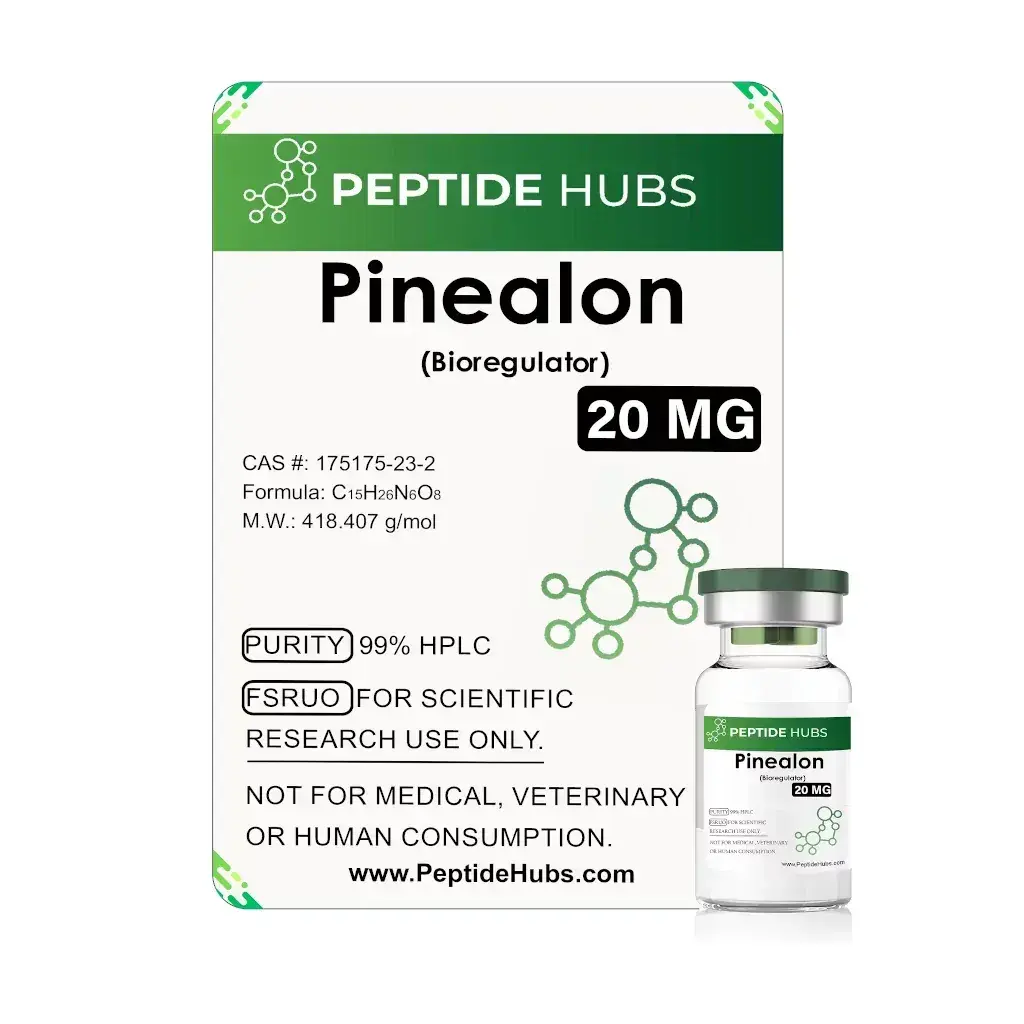
Pinealon Injectable
Pinealon 20 mg contains Pinealon, a synthetic tripeptide with the amino acid sequence Glu-Asp-Arg (EDR), also known as T-33 peptide. It belongs to the Khavinson family of short-peptide bioregulators, a class of synthetic peptides typically two to four amino acids long that are proposed to interact with DNA and histones to epigenetically modulate tissue-specific gene expression.
Research on Pinealon has focused on its potential neuroprotective and cytoprotective effects. A MeSH record describes it as a synthetic tripeptide that increases cell viability by suppression of free radical levels and activating proliferative processes. In vitro studies suggest it inhibits reactive oxygen species (ROS) buildup and blocks ERK 1/2 activation, while enhancing the functional activity of key brain tissue cellular components and decreasing spontaneous cell death rates.
Pinealon is not FDA-approved for any human indication, and there is no official dosing guideline from any US health authority. As of 2026, a PubMed search for Pinealon returns limited results, predominantly from a single Russian research group. The peptide is sold strictly as a research chemical for laboratory use only, and non-medical use falls outside approved indications.
Key Benefits of Pinealon 20 mg
- Synthetic tripeptide (Glu-Asp-Arg) bioregulator
- Lyophilized powder format for reconstitution flexibility
- Studied in preclinical models for neuroprotective and antioxidant effects
- 20 mg per vial for research protocols
- Manufactured by Peptide Hubs
Tripeptide Bioregulator
Pinealon belongs to the class of short-peptide bioregulators, a family of synthetic peptides developed by the Khavinson group at the Saint Petersburg Institute of Bioregulation and Gerontology. These peptides are proposed to act through epigenetic mechanisms, interacting with DNA and histones to influence gene expression in a tissue-specific manner. Unlike longer peptides that bind cell-surface receptors, Pinealon is theorized to cross cell and nuclear membranes to exert its effects.
Preclinical research on Pinealon has primarily focused on its neuroprotective properties. Studies have demonstrated dose-dependent effects on the maintenance of previously acquired skills in rats and protection against prenatal hyperhomocysteinemia in rat offspring. A published clinical study examined the geroprophylactic effects of Pinealon and Vesugen in patients with chronic polymorbidity and organic brain syndrome, reporting significant anabolic effects and improvements in central nervous system activity.
In non-medical bodybuilding and cognitive research contexts, Pinealon is commonly referenced for its potential neuroprotective and sleep-related effects. The peptide is sold strictly as a research chemical, and no human dosing regimen has been established by any regulatory authority.
Defining Characteristic
Tripeptide Structure
Pinealon is distinguished by its very short three-amino-acid sequence (Glu-Asp-Arg) and its proposed epigenetic mechanism. This contrasts with longer peptides that act through conventional receptor-mediated signaling pathways.
Pinealon 20 mg vs Other Peptide Hubs Preparations
Peptide Hubs offers several research peptides targeting different biological systems. Within this lineup, Epitalon is commonly discussed alongside Pinealon as another Khavinson bioregulator, though Epitalon is a tetrapeptide (Ala-Glu-Asp-Gly) studied for telomerase activation rather than Pinealon's neuroprotective focus.
For research focused on sleep and circadian rhythms, DSIP represents a different approach entirely, operating through delta sleep-inducing mechanisms. For research requiring a reconstitution solution, Bacteriostatic Water is the standard diluent for preparing lyophilized peptides like Pinealon 20 mg.
Typical Dosage Ranges
Because Pinealon lacks FDA approval and published human dose-finding trials, there is no medically established dosage range. In non-medical research communities, reference ranges are derived from community convention and the Khavinson group's framework of pulsed bioregulator dosing. Commonly referenced ranges are 1–2 mg per day for 10–20 consecutive days, with cycles repeated 2–3 times per year.
| Use Case |
Common Reference Range |
Administration |
| Conservative start (community) |
200–400 mcg |
Once daily, subcutaneous |
| Standard protocol (community) |
1–2 mg |
Once daily, subcutaneous |
| Cyclic course (community) |
1–2 mg |
10–20 days on, then break |
These ranges are community conventions, not evidence-based medical recommendations. No human pharmacokinetic or dose-response data exists for Pinealon, and the cyclic-course structure reflects the Khavinson framework's theory of pulsed bioregulator dosing rather than an independently established protocol.
Reconstitution & Handling
Pinealon 20 mg is supplied as a lyophilized powder and requires reconstitution before use. In non-medical contexts, bacteriostatic water is commonly used as the solvent. A 20 mg vial reconstituted with 2 mL of solvent yields a concentration of 10 mg/mL, meaning a 1 mg dose would require drawing 0.1 mL (10 units on a U-100 insulin syringe).
Reconstituted solution should be stored refrigerated at 2–8°C and protected from light. The lyophilized powder should be stored at -20°C for long-term storage.
Stacking & Cycle Considerations
In non-medical research contexts, Pinealon is sometimes discussed alongside other Khavinson bioregulators such as Epitalon, though no clinical evidence supports combinations. The cyclic dosing pattern—short courses followed by breaks—is a theory-driven design choice from the originating research group, not a conclusion from controlled trials.
For research focused on sleep rather than neuroprotection, some users reference combining Pinealon with DSIP, though this represents an unstudied combination.
Important
Individual Response Varies
No human safety or efficacy data exists for Pinealon. All dosage information is derived from community convention or the Khavinson framework and should not be interpreted as medical guidance.
Important Safety Information
Pinealon has not received FDA approval and has never been tested in large controlled human trials. The Khavinson group reports a favorable safety picture for its peptides, but without broad outside trials, side effect rates and long-term effects are not reliably established.
Because Pinealon is proposed to influence gene expression in the brain, the long-term implications of that mechanism, if real, are unknown. Research peptides vary in purity and can be underdosed, mislabeled, or contaminated, so the amount in the vial may not match the label.
Important
Non-Medical Use
Pinealon is sold strictly as a research chemical for laboratory use only. It is not intended for human consumption, medical treatment, or veterinary applications. Non-medical use falls outside approved indications.
Potential Adverse Effects
No rodent toxicology data specific to Pinealon is publicly available in peer-reviewed form. Injection-related risks apply at any dose: site redness, swelling, irritation, and infection from non-sterile technique. Allergic reactions are possible.
Community reports from PeptIQ observational data indicate injection site irritation as the most commonly logged side effect among users.
Conditions Requiring Medical Evaluation
Given the absence of comprehensive human safety data, any consideration of Pinealon use should involve consultation with a qualified healthcare professional. The proposed epigenetic mechanism and its long-term implications remain uncharacterized.
Monitoring During Use
No established monitoring protocol exists for Pinealon. In research contexts, any adverse reactions should be documented and reported to appropriate authorities.
Product Care
Storage & Handling
Store lyophilized powder at or below -20°C, protected from light and moisture. Once reconstituted, store refrigerated at 2–8°C and use within the recommended timeframe. Keep out of reach of children.
Further Safety Information
USA Domestic 3–5 business days
International 10–15 business days
Order Processing 24–48 business hours
Tracking Provided after dispatch
Direct Supply
Discreet Delivery & Original Packaging
The outer shipping package remains discreet, with privacy-focused handling. Products are supplied through the official Peptide Hubs distribution chain.
What to Expect
- Orders are processed after payment confirmation
- USA Domestic shipping is typically faster when local stock is selected
- International orders include tracking, though update frequency may vary
- Multiple warehouses may result in separate shipments when applicable
Authenticity Verification
To verify your Pinealon 20 mg product, use the security code on the vial label and cross-check it on the Peptide Hubs official site. Original packaging and manufacturer presentation help reinforce product legitimacy.
For complete delivery details, tracking policy, and reshipment terms, please see our Shipping Info page.
Recommended Conditions
Store lyophilized powder at or below -20°C, protected from light and moisture. Under these conditions, the dry powder is stable for extended periods.
Once reconstituted, store refrigerated at 2–8°C and use within the recommended timeframe for peptide solutions. Avoid repeated freeze-thaw cycles.
Keep out of reach of children. Follow proper handling practices.
Quick Reference
Do & Don't
- Do store powder at -20°C, protected from light and moisture
- Do keep in original packaging until use
- Do refrigerate reconstituted solution at 2–8°C
- Don't expose to excessive heat or moisture
- Don't subject to repeated freeze-thaw cycles
- Don't use if solution appears cloudy or contains particles
What is Pinealon 20 mg used for?
Pinealon 20 mg is a research peptide studied in preclinical settings for its potential neuroprotective and cytoprotective effects. It is classified as a short-peptide bioregulator and is sold strictly for laboratory research use. It is not approved for any human indication.
How often should Pinealon 20 mg be injected?
No established human dosing schedule exists. Community protocols commonly reference once-daily subcutaneous administration at 1–2 mg for 10–20 consecutive days, with cycles repeated 2–3 times per year.
Does Pinealon 20 mg require PCT?
Pinealon does not suppress endogenous testosterone production and does not require post-cycle therapy in the way anabolic steroids do. However, any non-medical peptide use should be approached with caution given the absence of comprehensive human safety data.
What does Pinealon do?
Pinealon is a synthetic tripeptide proposed to act through epigenetic regulation of gene expression in brain tissue. In vitro research suggests it inhibits reactive oxygen species buildup and blocks ERK 1/2 activation while decreasing spontaneous cell death rates.
How long does Pinealon take to work?
No human data establishes a timeline for effects. The proposed epigenetic mechanism suggests effects might accumulate over the course of a 10–20 day cycle, but this remains speculative.
Is Pinealon the best bioregulator peptide?
There is no universally “best” bioregulator peptide. Pinealon is one of several Khavinson peptides, each proposed to target different tissues. Comparative human data is absent.
What is the difference between Pinealon 20 mg and Epitalon?
Pinealon is a tripeptide (Glu-Asp-Arg) studied for neuroprotective effects, while Epitalon is a tetrapeptide (Ala-Glu-Asp-Gly) studied for telomerase activation. They target different biological mechanisms.
What is the difference between Pinealon 20 mg and DSIP?
Pinealon targets neuroprotection and gene expression through a proposed epigenetic mechanism, while DSIP is a nonapeptide studied for sleep architecture modulation. They operate through different biological systems.
Is 2 mg of Pinealon a lot?
Without human dose-response data, it is impossible to characterize any amount as appropriate or excessive. Community protocols commonly reference 1–2 mg per day, but this is convention, not evidence.
What strength is Pinealon 20 mg?
Pinealon 20 mg is labeled at 20 mg of Pinealon per vial. It is supplied as a lyophilized powder in a 2 mL vial.
How should Pinealon 20 mg be stored?
Store the lyophilized powder at or below -20°C, protected from light and moisture. Once reconstituted, refrigerate at 2–8°C and use within the recommended timeframe for peptide solutions.
No reviews found
Please log in to write Pinealon 20 mg review.