Epithalon Injectable
Epithalon (also spelled Epitalon or Epithalone) is a synthetic tetrapeptide with the amino acid sequence Ala-Glu-Asp-Gly (AEDG). It was synthesized based on the amino acid composition of Epithalamin, a bovine pineal gland extract, by Professor Vladimir Khavinson and colleagues at the St. Petersburg Institute of Bioregulation and Gerontology. The majority of research on Epithalon originates from this single institution, with limited independent replication.
Epithalon is proposed to act through several mechanisms, most prominently the activation of telomerase, an enzyme that maintains telomere length and supports cellular longevity. In vitro studies have demonstrated that Epithalon induces expression of the telomerase catalytic subunit, increases enzymatic activity, and elongates telomeres in human somatic cells. The peptide is also believed to modulate melatonin production through its action on the pineal gland, influencing sleep and circadian rhythms. Additional proposed effects include antioxidant activity and immune modulation.
Epithalon is not FDA-approved for any human indication. No New Drug Application or Investigational New Drug application has been filed in the United States, and no DailyMed prescribing information exists. The peptide is sold as a research chemical and is not subject to FDA oversight for identity, purity, sterility, or potency. Athletes should note that Epithalon may fall under WADA S0 (non-approved substances prohibited at all times).
Key Benefits of Epithalon
- Synthetic AEDG tetrapeptide associated with telomerase activation research
- Lyophilized powder format for reconstitution flexibility
- Studied in preclinical models for effects on telomere length and circadian rhythms
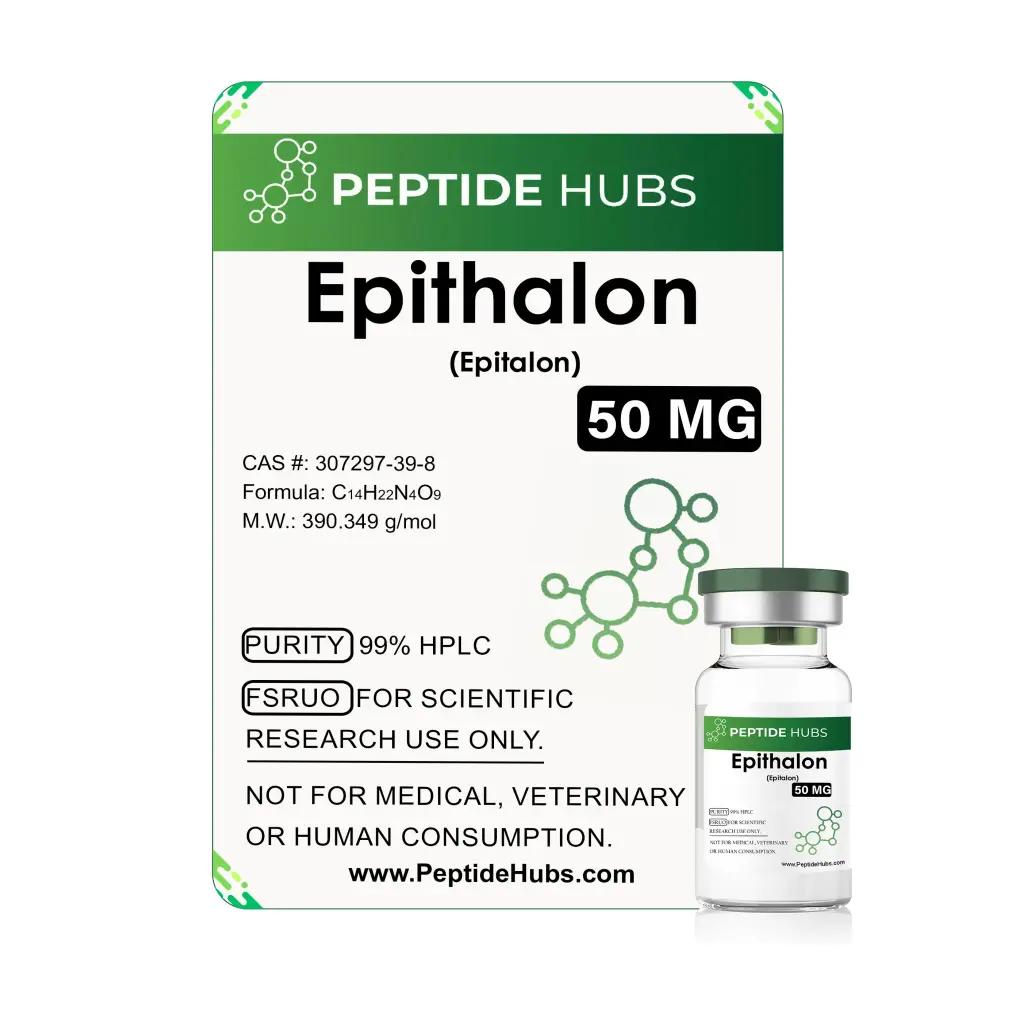
- Available in 25 mg and 50 mg vial strengths for research protocols
- Manufactured by Peptide Hubs
Synthetic Tetrapeptide Bioregulator
Epithalon belongs to the class of short-peptide bioregulators, which are synthetic peptides typically two to four amino acids long. Unlike longer peptides that bind cell-surface receptors, Epithalon is proposed to cross cell and nuclear membranes, interact with DNA and histones, and influence gene expression in tissue-specific ways. The proposed mechanism involves interaction with the promoter regions of the hTERT (human telomerase reverse transcriptase) gene, making the gene more accessible for activation.
In vitro research has demonstrated that Epithalon treatment of normal human diploid fibroblasts induces telomerase activity and telomere elongation, allowing the cells to overcome the Hayflick limit and undergo additional divisions. Animal studies have reported lifespan extension in rodents and Drosophila, restoration of age-related disturbances in pineal and pancreatic hormone function in monkeys, and improved circadian rhythms of cortisol and melatonin in elderly rhesus monkeys.
In non-medical research contexts, Epithalon is commonly referenced for its potential role in cellular longevity and circadian rhythm support. However, the human evidence base is thin: there are no Western randomized controlled trials, and the often-cited Saint Petersburg cohort work measured Thymalin combined with Epithalamin (the crude pineal extract), not Epithalon itself, using non-randomized comparison groups.
Defining Characteristic
Tetrapeptide Structure
Epithalon is distinguished by its very short four-amino-acid sequence (Ala-Glu-Asp-Gly) and its proposed epigenetic mechanism involving telomerase gene regulation. This contrasts with longer peptides that act through conventional receptor-mediated signaling.
Epithalon vs Other Peptide Hubs Preparations
Peptide Hubs offers a range of research peptides targeting different biological systems. Within this lineup, DSIP is commonly discussed alongside Epithalon for its effects on sleep and circadian rhythms, though DSIP operates through different proposed mechanisms and has a distinct nonapeptide structure.
For research focused on tissue repair rather than longevity pathways, BPC 157 represents a different approach entirely, operating through angiogenic and cytoprotective mechanisms. Similarly, GHK-CU addresses skin and wound-healing research through copper-binding peptide activity. These peptides are not interchangeable and target distinct biological pathways.
Typical Dosage Ranges
Because Epithalon lacks FDA approval and published human dose-finding trials, there is no medically established dosage range. Commonly cited protocols from limited research and practitioner reports reference 5–10 mg per day by subcutaneous injection for 10–20 consecutive days, repeated once or twice per year. Some protocols use lower doses of 1 mg twice daily (total 2 mg/day) for 10–14 days per cycle.
| Use Case |
Common Reference Range |
Injection Frequency |
| Low-dose protocol (research) |
1 mg twice daily (2 mg/day) |
10–14 days per cycle |
| Standard protocol (research) |
5 mg once daily |
10–20 days per cycle |
| Higher-dose protocol (research) |
10 mg daily (divided) |
10–20 days per cycle |
These ranges are community conventions or extrapolations from limited pilot studies, not evidence-based medical recommendations. No consensus recommends doses above 10 mg per day.
Reconstitution & Handling
Epithalon is supplied as a lyophilized powder and requires reconstitution before use. A 50 mg vial reconstituted with 1 mL of solvent yields a concentration of 50 mg/mL, meaning a 5 mg dose would require drawing 0.1 mL (10 units on a U-100 insulin syringe).
Reconstituted solution should be stored refrigerated at 2–8°C and protected from light. The powder is stable at -20°C for up to 3 years, and reconstituted solution should be used within the recommended timeframe.
Stacking & Cycle Considerations
In non-medical research contexts, Epithalon is sometimes discussed alongside other Khavinson bioregulators such as Chonluten, though no clinical evidence supports combinations. Most protocols recommend cycling Epithalon rather than continuous use, with cycles of 10–20 days repeated 2–4 times per year.
Some users reference combining Epithalon with DSIP for sleep-related research, based on the rationale that both peptides influence circadian rhythms, though this represents an unstudied combination.
Important
Individual Response Varies
No human dose-response data for therapeutic outcomes exists for Epithalon. All dosage information is derived from community convention or limited pilot studies and should not be interpreted as medical guidance.
Important Safety Information
Epithalon has not received FDA approval, and no New Drug Application or Investigational New Drug application has been filed in the United States. The FDA has not placed Epithalon on Category 2 of the 503A prohibited list, but it has also not been placed on the Category 1 permitted list; its compounding status remains unsettled. In April 2026, the FDA announced that Epithalon would be removed from Category 2 and reviewed by the Pharmacy Compounding Advisory Committee.
Mechanistic considerations of particular relevance include active or suspected malignancy (telomerase activation is a theoretical concern for tumor biology), pregnancy or breastfeeding (no reproductive/developmental data), and minors (no pediatric safety data).
Important
Non-Medical Use
Epithalon is sold strictly as a research chemical for laboratory use only. Products sold online as Epithalon are marketed as research chemicals and are not subject to FDA oversight for identity, purity, sterility, or potency.
Potential Adverse Effects
No adequately powered human safety trials have been conducted, so any adverse event profile must be considered unknown. Mild side effects reported in limited studies may include local irritation at injection sites, headaches, or temporary changes in sleep patterns.
The theoretical mechanism of telomerase activation has unknown long-term consequences for cell proliferation, including in tissues with malignant or pre-malignant changes. One study suggests Epithalon may increase telomere length in cancer cells through telomerase upregulation or ALT activity, raising theoretical concerns about tumor biology.
Conditions Requiring Medical Evaluation
Given the absence of comprehensive human safety data, any consideration of Epithalon use outside laboratory research should involve consultation with a qualified healthcare professional. Individuals with active or suspected malignancy, those who are pregnant or breastfeeding, and minors should exercise particular caution.
Monitoring During Use
No established monitoring protocol exists for non-medical Epithalon use. In research contexts, any adverse reactions should be documented and reported to appropriate authorities.
Product Care
Storage & Handling
Store lyophilized powder at -20°C for up to 3 years, or at 4°C for up to 2 years. Protect from moisture and light. Once reconstituted, store refrigerated and use within the recommended timeframe. Keep out of reach of children.
Further Safety Information
USA Domestic 3–5 business days
International 10–15 business days
Order Processing 24–48 business hours
Tracking Provided after dispatch
Direct Supply
Discreet Delivery & Original Packaging
The outer shipping package remains discreet, with privacy-focused handling. Products are supplied through the official Peptide Hubs distribution chain.
What to Expect
- Orders are processed after payment confirmation
- USA Domestic shipping is typically faster when local stock is selected
- International orders include tracking, though update frequency may vary
- Multiple warehouses may result in separate shipments when applicable
Authenticity Verification
To verify your Epithalon product, use the security code on the vial label and cross-check it on the Peptide Hubs official site. Original packaging and manufacturer presentation help reinforce product legitimacy.
For complete delivery details, tracking policy, and reshipment terms, please see our Shipping Info page.
Recommended Conditions
Store lyophilized powder at -20°C for up to 3 years, or at 4°C for up to 2 years. Protect from moisture and light. The powder is stable at ambient temperature for a few days during shipping, which is why it can be shipped without refrigeration.
Once reconstituted, store refrigerated and use within the recommended timeframe. Avoid repeated freeze-thaw cycles to maintain peptide integrity.
Keep out of reach of children. Follow proper handling practices.
Quick Reference
Do & Don't
- Do store powder at -20°C for long-term storage
- Do protect from moisture and light
- Do refrigerate reconstituted solution
- Don't expose to excessive heat
- Don't subject to repeated freeze-thaw cycles
- Don't use if solution appears cloudy or contains particles
What is Epithalon used for?
Epithalon is a synthetic tetrapeptide studied in preclinical research for its potential effects on telomerase activation and circadian rhythm modulation. It is sold strictly as a research chemical and is not approved for any human indication.
How often should Epithalon be injected?
No established human dosing schedule exists. Commonly cited protocols reference 5–10 mg per day for 10–20 consecutive days, repeated once or twice per year. Timing may matter less than consistency, cycle length, and delivery method.
Does Epithalon require PCT?
Epithalon does not suppress endogenous testosterone production and does not require post-cycle therapy in the way anabolic steroids do. However, any non-medical peptide use should be approached with caution given the absence of comprehensive human safety data.
What does Epithalon do?
Epithalon is proposed to activate telomerase, the enzyme that maintains telomere length, and to modulate melatonin production through its action on the pineal gland. In vitro studies have demonstrated telomerase induction and telomere elongation in human somatic cells.
How long does Epithalon take to work?
No human data establishes a timeline for effects. In vitro telomerase activation has been observed in cell culture studies, but translation to human timelines is speculative.
Is Epithalon the best telomerase activator?
There is no universally “best” telomerase activator. Epithalon is one of the most studied synthetic peptides in this category, but the human evidence base consists primarily of reports from a single Russian research group with limited independent replication.
What is the difference between Epithalon and DSIP?
Epithalon is a tetrapeptide studied for telomerase activation and circadian rhythm modulation, while DSIP is a nonapeptide studied for sleep architecture. Both are commonly referenced in sleep-related research contexts, but they operate through different proposed mechanisms.
What is the difference between Epithalon and BPC 157?
Epithalon targets longevity and circadian pathways, while BPC 157 is a larger pentadecapeptide studied for tissue repair through angiogenic mechanisms. They have different sequences and proposed mechanisms.
Is 10 mg of Epithalon a lot?
10 mg is at the upper end of the range commonly referenced in research protocols (5–10 mg per day). No consensus recommends doses above 10 mg per day, and higher doses have not been shown to provide additional benefit.
What strength is Epithalon?
Epithalon is available in 25 mg and 50 mg per vial strengths from Peptide Hubs. It is supplied as a lyophilized powder in a 2 mL vial.
How should Epithalon be stored?
Store the lyophilized powder at -20°C for up to 3 years, or at 4°C for up to 2 years. Protect from moisture and light. Once reconstituted, refrigerate and use within the recommended timeframe.
Is Epithalon lab tested?
Laboratory testing information for this Epithalon product is not currently available. Products sold online as Epithalon are marketed as research chemicals and are not subject to FDA oversight for identity, purity, sterility, or potency.
No reviews found
Please log in to write Epithalon review.