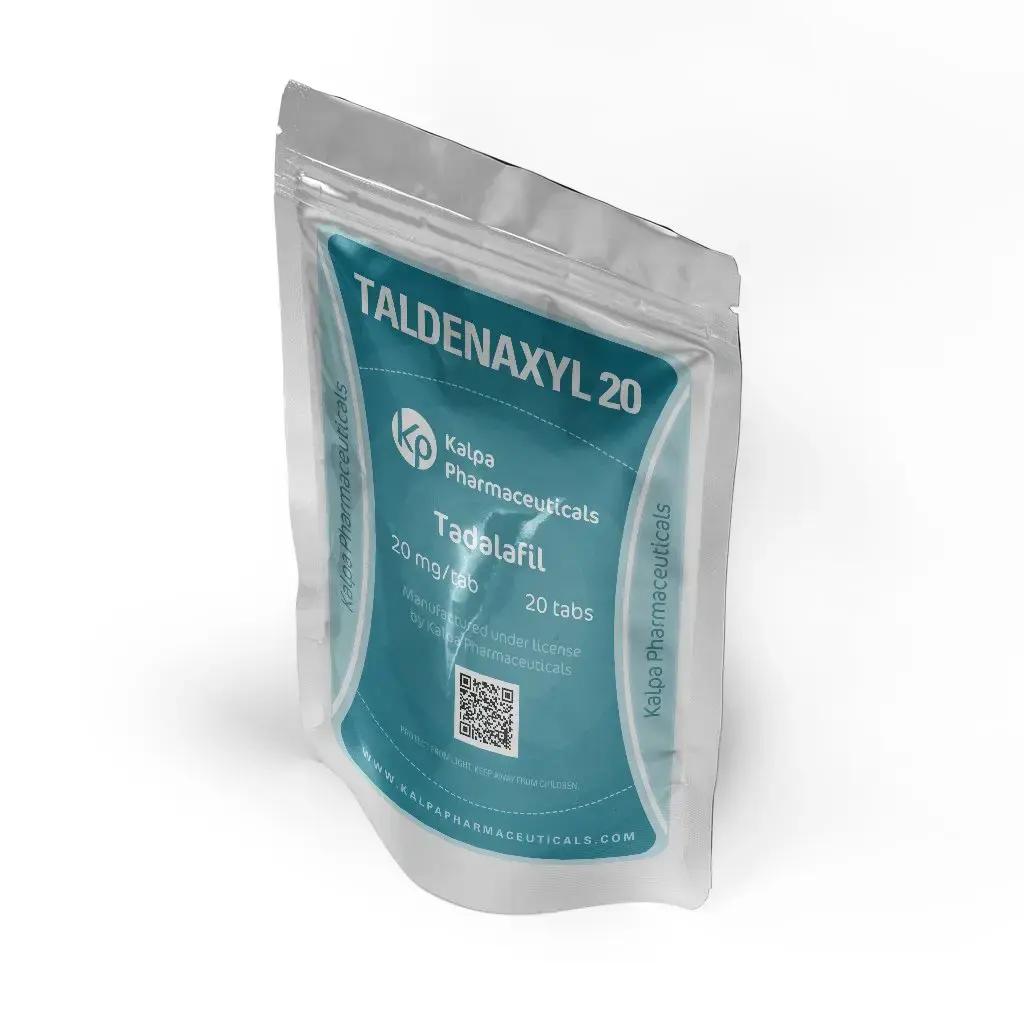
Taldenaxyl 20 mg is an oral tadalafil citrate tablet manufactured by Kalpa Pharmaceuticals and dosed at 20 mg per tablet, available in packs of 20 or 100 tablets.
Taldenaxyl 20 mg contains tadalafil citrate, a selective inhibitor of cyclic guanosine monophosphate (cGMP)-specific phosphodiesterase type 5 (PDE5) . Tadalafil is FDA-approved for the treatment of erectile dysfunction (ED), the signs and symptoms of benign prostatic hyperplasia (BPH), and pulmonary arterial hypertension (PAH) . In order for tadalafil to be effective for ED, sexual stimulation is required .
The mechanism of action involves inhibition of PDE5, which is responsible for degradation of cGMP in the corpus cavernosum. When sexual stimulation causes local release of nitric oxide, tadalafil inhibits PDE5 and increases cGMP levels, resulting in smooth muscle relaxation and increased blood flow to the penis . Tadalafil is rapidly absorbed, with a median time to maximum plasma concentration of 2 hours and a mean absolute bioavailability of 41% .
The recommended starting dose for use as needed in most patients is 10 mg, taken prior to anticipated sexual activity. The dose may be increased to 20 mg or decreased to 5 mg, based on individual efficacy and tolerability . The maximum recommended dosing frequency is once per day . Tadalafil is contraindicated in patients taking any form of organic nitrates due to the risk of potentially fatal hypotension .
Taldenaxyl 20 mg is supplied as an oral compressed tablet containing 20 mg of tadalafil citrate per unit, packaged in 20-tablet or 100-tablet formats by Kalpa Pharmaceuticals.
Tadalafil citrate is a long-acting selective PDE5 inhibitor characterized by rapid absorption, a half-life of approximately 17.5 hours, and a duration of action of up to 36 hours. Its profile distinguishes it from shorter-acting PDE5 inhibitors such as sildenafil.
Tadalafil is a selective inhibitor of cGMP-specific phosphodiesterase type 5 (PDE5), the enzyme responsible for degradation of cGMP in the corpus cavernosum . Inhibition of PDE5 increases cGMP levels, which leads to smooth muscle relaxation and increased blood flow to the penis during sexual stimulation . Tadalafil is more selective for PDE5 than for other phosphodiesterases, with greater selectivity against PDE6 compared to sildenafil, which may result in fewer visual side effects .
Tadalafil is rapidly absorbed after oral administration, with a mean absolute bioavailability of 41%. Maximum observed plasma concentrations are reached within 30 minutes to 6 hours (median 2 hours) after oral dosing in the fasted state . The terminal half-life is approximately 17.5 hours in healthy subjects . Tadalafil is extensively metabolized in the liver, primarily by CYP3A4, with its major metabolite being methylcatechol glucuronide, which is at least 13,000-fold less potent than tadalafil .
A head-to-head comparison study of over 130,000 patients found that tadalafil at medium (10 mg) and high (20 mg) doses improved patient satisfaction and sexual performance, though the effect size was somewhat lower than that observed with sildenafil at 50 mg and 100 mg. Tadalafil was associated with a lower incidence of flushing (2.3% vs 7.3%) and headache compared to sildenafil.
Tadalafil has a terminal half-life of approximately 17.5 hours . The effects can last up to 36 hours following dosing, providing a wider window of opportunity for sexual activity compared to shorter-acting PDE5 inhibitors .
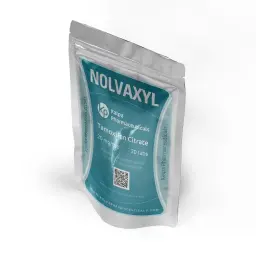
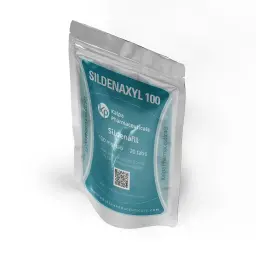
Kalpa Pharmaceuticals offers a range of compounds for men's health. For those comparing erectile dysfunction treatments, Sildenaxyl (sildenafil citrate) is a shorter-acting PDE5 inhibitor with a more rapid onset for planned sexual activity. Other products such as Arimixyl 1 mg (anastrozole) and Nolvaxyl 20 mg (tamoxifen) are not intended for erectile dysfunction but are sometimes referenced in non-medical bodybuilding contexts for managing hormonal side effects associated with anabolic steroid use.
The information below is provided for educational reference only. Tadalafil citrate is a prescription medication; medical use requires appropriate diagnosis, clinical supervision, and ongoing monitoring. Non-medical use falls outside approved indications.
In FDA-approved medical use for erectile dysfunction, the recommended starting dose of tadalafil for use as needed in most patients is 10 mg, taken prior to anticipated sexual activity . The dose may be increased to 20 mg or decreased to 5 mg, based on individual efficacy and tolerability . The maximum recommended dosing frequency is once per day . For once-daily use for erectile dysfunction, the recommended dose is 2.5 mg to 5 mg, taken at approximately the same time every day . For benign prostatic hyperplasia, the recommended dose is 5 mg once daily . For patients with hepatic impairment or those taking certain CYP3A4 inhibitors, dose adjustments are required .
| Use Case | Common Reference Range | Frequency |
|---|---|---|
| Medical (ED, as needed, starting dose) | 10 mg per dose | Prior to anticipated sexual activity |
| Medical (ED, as needed, maximum dose) | 20 mg per dose | Once daily maximum |
| Medical (ED, once daily) | 2.5–5 mg per day | Once daily at same time |
| Medical (BPH) | 5 mg per day | Once daily |
| Non-medical (bodybuilding) | 2.5–5 mg per day or 10 mg EOD | Daily or every other day |
Tadalafil is not typically used in cycles or stacked with other compounds in the way anabolic steroids are. It is used on an as-needed basis or daily for erectile dysfunction or benign prostatic hyperplasia . In non-medical bodybuilding contexts, tadalafil is sometimes referenced for its effects on muscle pumps and vascularity during training, with forum discussions citing daily doses of 2.5 to 5 mg. However, the FDA has not approved tadalafil for this purpose, and the risks associated with non-medical use remain.
Tadalafil is contraindicated with organic nitrates. Patients should inform their healthcare provider about all medications they are taking, including prescription and non-prescription medicines, vitamins, and herbal products .
The most common adverse reactions (occurring in ≥2% of patients) include headache, dyspepsia, back pain, myalgia, nasal congestion, flushing, and pain in limb . A head-to-head study of over 130,000 patients found that nasal congestion was the most common adverse event across all PDE5 inhibitors, and tadalafil was less associated with flushing (2.3%) compared to sildenafil (7.3%).
Serious but rare adverse effects include non-arteritic anterior ischemic optic neuropathy (NAION), a cause of decreased vision including permanent loss of vision, and sudden decrease or loss of hearing . Priapism (erections lasting more than 4 hours) requires immediate medical attention .
Dosing strategies should be adjusted based on individual response and medical guidance. The information above is for educational reference and does not constitute medical advice.
Tadalafil citrate is a prescription medication with vasodilatory effects, potential cardiovascular interactions, and specific contraindications. Medical use requires appropriate diagnosis, clinical supervision, and ongoing monitoring.
Tadalafil is contraindicated in patients taking organic nitrates in any form (e.g., nitroglycerin, isosorbide dinitrate, isosorbide mononitrate) due to the risk of potentially fatal hypotension . In a patient who has taken tadalafil, where nitrate administration is deemed medically necessary in a life-threatening situation, at least 48 hours should elapse after the last dose of tadalafil before nitrate administration is considered .
Before prescribing tadalafil, healthcare providers should carefully consider whether patients with underlying conditions could be adversely affected by the vasodilatory effects, including patients on antihypertensive therapy or with resting hypotension (blood pressure less than 90/50), fluid depletion, severe left ventricular outflow obstruction, or autonomic dysfunction .
Tadalafil is a prescription medication. Non-medical use for performance enhancement or muscle pumps is not approved by the FDA and may be associated with serious health risks, particularly in individuals with underlying cardiovascular conditions or those taking nitrate medications.
The most common adverse reactions (occurring in ≥2% of patients) include headache, dyspepsia, back pain, myalgia, nasal congestion, flushing, and pain in limb . A head-to-head study of over 130,000 patients found that tadalafil was associated with a lower incidence of flushing (2.3%) compared to sildenafil (7.3%).
Serious adverse events reported post-marketing include serious cardiovascular events (including myocardial infarction, sudden cardiac death, stroke, and transient ischemic attack), non-arteritic anterior ischemic optic neuropathy (NAION), sudden decrease or loss of hearing, and priapism . Most, but not all, of the cardiovascular events occurred in patients with preexisting cardiovascular risk factors .
Tadalafil may potentiate the hypotensive effects of nitrates and alpha-blockers. When co-administered with an alpha-blocker, patients should be stable on alpha-blocker therapy prior to initiating tadalafil, and tadalafil should be initiated at the lowest dose . In animal studies, non-reversible degeneration and atrophy of the seminiferous tubular epithelium in the testes resulting in decreased spermatogenesis was observed in dogs at high doses .
Patients with anatomical deformation of the penis (such as angulation, cavernosal fibrosis, or Peyronie's disease) or conditions that may predispose them to priapism (such as sickle cell anemia, multiple myeloma, or leukemia) should use tadalafil with caution .
Use of tadalafil in patients with retinitis pigmentosa is not recommended due to a minority of patients having genetic disorders of retinal phosphodiesterases . The safety of tadalafil is unknown in patients with bleeding disorders or active peptic ulceration .
Patients should be advised to seek immediate medical attention in the event of a sudden loss of vision in one or both eyes or sudden decrease or loss of hearing while taking tadalafil . If an erection persists longer than 4 hours, the patient should seek immediate medical assistance to prevent penile tissue damage and permanent loss of potency .
Blood pressure should be monitored when co-administering blood pressure-lowering drugs with tadalafil .
Store in a cool, dry place away from direct light and moisture. Keep tablets in the original packaging until use. Keep out of reach of children.
Taldenaxyl 20 mg is supplied through the official Kalpa Pharmaceuticals distribution chain and shipped in original manufacturer packaging with discreet, privacy-focused handling.
The outer shipping package remains discreet, with privacy-focused handling and no unnecessary external product details. Products are supplied through the official Kalpa Pharmaceuticals distribution chain.
To verify your Taldenaxyl 20 mg product, use the security code on the packaging and cross-check it on the Kalpa official site. Original Kalpa Pharmaceuticals presentation and packaging help reinforce product legitimacy and buyer confidence.
For complete delivery details, tracking policy, and reshipment terms, please see our Shipping Info page.
Proper storage conditions help preserve tablet integrity and stability throughout shelf life.
Store Taldenaxyl 20 mg in a cool, dry place away from excessive heat, moisture, and direct light. Maintaining stable conditions helps preserve the integrity of the tablets.
Keep the tablets in their original packaging until use. Do not use if the packaging is damaged or if the tablets appear abnormal in color or texture.
Keep out of reach of children. Follow proper handling practices for oral medications.
Answers to common questions about Taldenaxyl 20 mg, tadalafil citrate, dosing, side effects, and product specifications.
Taldenaxyl 20 mg contains tadalafil citrate, which is FDA-approved for the treatment of erectile dysfunction (ED), the signs and symptoms of benign prostatic hyperplasia (BPH), and pulmonary arterial hypertension (PAH) . In order for tadalafil to be effective for ED, sexual stimulation is required .
For use as needed for ED, the recommended starting dose is 10 mg taken prior to anticipated sexual activity, with the dose possibly increased to 20 mg or decreased to 5 mg based on effectiveness and toleration . The maximum recommended dosing frequency is once per day . For once-daily use, the recommended dose is 2.5 mg to 5 mg taken at approximately the same time every day .
Tadalafil is not a hormonal compound and does not suppress the hypothalamic-pituitary-gonadal axis. Therefore, post-cycle therapy (PCT) is not applicable. If tadalafil is used alongside suppressive anabolic compounds, standard PCT protocols should be followed for those compounds.
Tadalafil inhibits PDE5, which increases cGMP levels in the corpus cavernosum during sexual stimulation. This leads to smooth muscle relaxation and increased blood flow to the penis, facilitating erection . It does not cause erection without sexual stimulation .
Tadalafil has a terminal half-life of approximately 17.5 hours . The effects can last up to 36 hours following dosing, providing a wider window of opportunity for sexual activity compared to shorter-acting PDE5 inhibitors .
Tadalafil and sildenafil (Viagra) are both PDE5 inhibitors used for erectile dysfunction. A head-to-head comparison of over 130,000 patients found that sildenafil at medium and high doses improved patient satisfaction and sexual performance compared to similar doses of tadalafil. However, tadalafil has a longer duration of action and is associated with a lower incidence of flushing. The choice between them depends on individual needs and preferences.
Common side effects include headache, dyspepsia, back pain, myalgia, nasal congestion, and flushing . Serious but rare risks include non-arteritic anterior ischemic optic neuropathy (NAION), sudden hearing loss, and priapism . Tadalafil is contraindicated with organic nitrates due to the risk of severe hypotension .
Both tadalafil and sildenafil are PDE5 inhibitors used for erectile dysfunction. The main difference is duration of action: tadalafil has a half-life of approximately 17.5 hours with effects lasting up to 36 hours, while sildenafil has a half-life of approximately 4 hours . Tadalafil offers greater spontaneity due to its longer window of activity, while sildenafil has a more rapid onset for planned sexual activity. Sildenafil is available as Sildenaxyl.
A 20 mg tablet represents the maximum recommended single dose of tadalafil for use as needed . The recommended starting dose is 10 mg, and the dose may be increased to 20 mg or decreased to 5 mg based on effectiveness and toleration . For once-daily use, the recommended dose is 2.5 mg to 5 mg .
Taldenaxyl 20 mg is labeled at 20 mg of tadalafil citrate per tablet. It is supplied in packs of 20 or 100 tablets.
Tadalafil can be taken at any time of day, with or without food. For use as needed, it is typically taken prior to anticipated sexual activity . The effects can last up to 36 hours, providing flexibility in timing. For once-daily use, it should be taken at approximately the same time every day .
Laboratory testing information for Taldenaxyl 20 mg is not currently available in this product listing. Kalpa Pharmaceuticals products are manufactured under pharmaceutical-grade conditions, but independent lab reports are not published for this specific product at this time.