
Clomid 50 mg is an oral tablet containing clomiphene citrate manufactured by Stealth Labs, supplied as 50 mg per tablet in a 100-tablet package.
Clomid 50 mg contains clomiphene citrate, a nonsteroidal ovulatory stimulant and selective estrogen receptor modulator (SERM). It is FDA-approved only for the treatment of ovulatory dysfunction in women who are not pregnant, do not have ovarian cysts, do not have abnormal vaginal bleeding, and have normal liver function. The FDA label explicitly states that there are no adequate or well-controlled studies demonstrating effectiveness in the treatment of male infertility, and that testicular tumors and gynecomastia have been reported in males using clomiphene.
Clomiphene citrate works by competing with estrogen for estrogen-receptor binding sites in the hypothalamus and pituitary, which reduces the negative feedback of estrogen on gonadotropin release. This leads to increased secretion of follicle-stimulating hormone (FSH) and luteinizing hormone (LH), which in turn stimulates follicular development and ovulation in women. In non-medical bodybuilding contexts, clomiphene is commonly referenced as a post-cycle therapy (PCT) agent to help restore endogenous testosterone production after anabolic steroid cycles, though this use falls outside approved indications.
Clomiphene citrate has a biological half-life of approximately 5–7 days, with the cis-isomer (zuclomiphene) having a longer half-life than the trans-isomer (enclomiphene). The drug is excreted principally in the feces, with some radioactivity still present in feces 6 weeks after administration. As a research chemical product sold outside the pharmaceutical supply chain, this formulation has not undergone FDA review for purity, sterility, or actual content.
Clomid 50 mg is supplied as oral tablets. Each white scored tablet contains 50 mg clomiphene citrate USP.
Clomiphene citrate is a selective estrogen receptor modulator (SERM) approved only for specific female infertility indications, with no FDA-approved male indications.
Clomiphene citrate is a mixture of two geometric isomers, zuclomiphene (cis) and enclomiphene (trans), containing between 30% and 50% of the cis-isomer. It has both estrogenic and anti-estrogenic properties, and its precise mechanism of action has not been fully determined. The drug interacts with estrogen-receptor-containing tissues including the hypothalamus, pituitary, ovary, endometrium, vagina, and cervix.
The first endocrine event in response to clomiphene therapy is an increase in the release of pituitary gonadotropins, which initiates steroidogenesis and folliculogenesis. Both the estrogenic and antiestrogenic properties of clomiphene may participate in the initiation of ovulation, with the two isomers having mixed effects that may vary by species.
The FDA label notes that clomiphene has no apparent progestational, androgenic, or antiandrogenic effects and does not appear to interfere with pituitary-adrenal or pituitary-thyroid function.
Clomiphene citrate is FDA-approved only for ovulatory dysfunction in women. The FDA label explicitly states there are no adequate studies demonstrating effectiveness in male infertility, and testicular tumors and gynecomastia have been reported in males using clomiphene.
Stealth Labs offers Tamoxifen as another SERM commonly referenced in non-medical contexts. Unlike clomiphene, tamoxifen is FDA-approved for breast cancer treatment and risk reduction. Both are commonly referenced in post-cycle therapy contexts, though neither is FDA-approved for this purpose.
Compared to Arimidex (anastrozole), which is an aromatase inhibitor that reduces estrogen production, clomiphene works through a fundamentally different mechanism as a SERM that modulates estrogen receptor activity rather than inhibiting estrogen synthesis.
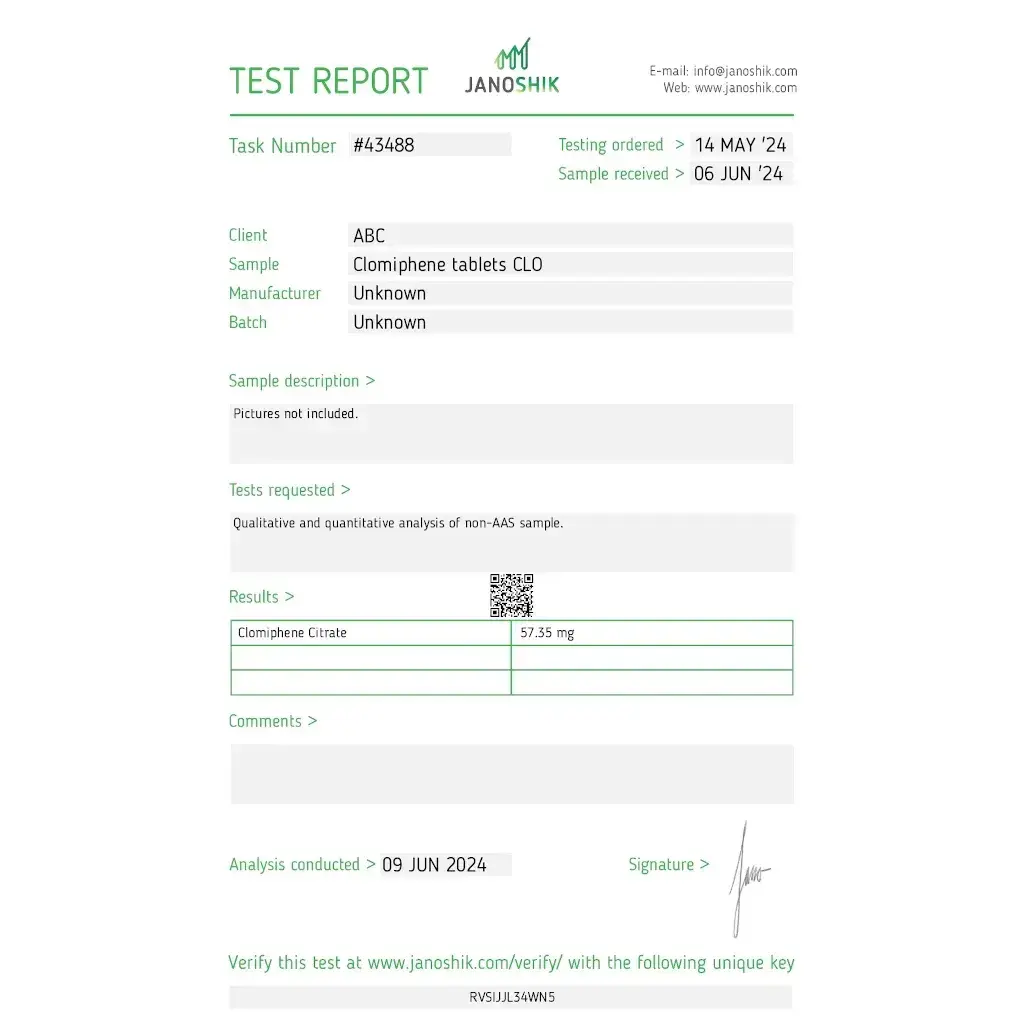
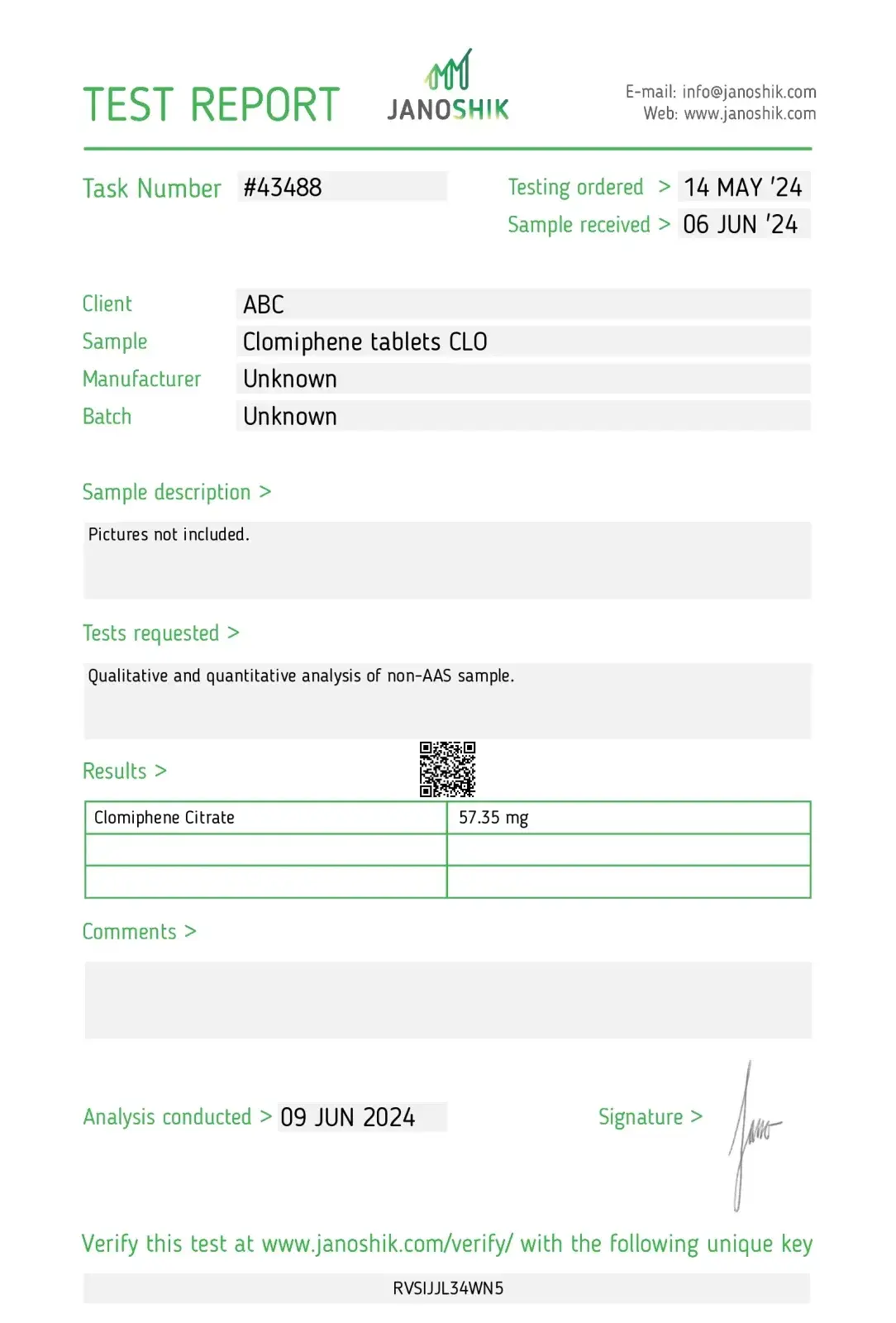
Published laboratory reports for Clomid 50 mg are shown below with the test date, measured concentration and percentage of the product's 50 mg label claim.
 View Report
Laboratory results apply to the specific tested sample represented in each published report and should not be interpreted as a measurement of every vial or production batch.
The information below is provided for educational reference only. Clomiphene citrate is a prescription medication; medical use requires appropriate diagnosis, clinical supervision and ongoing monitoring. This research chemical product is not for human use, and non-medical use falls outside approved indications.
The FDA-approved dose for ovulation induction is 50 mg daily for 5 days, starting on or about the fifth day of the menstrual cycle. If ovulation does not occur, the dose may be increased to 100 mg daily for 5 days in subsequent cycles. In non-medical bodybuilding contexts, clomiphene is commonly referenced at 50–100 mg per day for 30 days as part of post-cycle therapy, though this use is not FDA-approved and lacks clinical validation for this purpose.
| Use Case | Reference Range | Frequency |
|---|---|---|
| Ovulation induction (FDA-approved) | 50 mg daily | Once daily for 5 days |
| Non-medical PCT reference | 50–100 mg daily | Once daily for 30 days |
| Male infertility (not FDA-approved) | No adequate studies | Not established |
In non-medical bodybuilding contexts, clomiphene is sometimes used in combination with Tamoxifen as part of post-cycle therapy protocols. However, the FDA label notes that clomiphene has not been shown to be effective for male infertility, and testicular tumors and gynecomastia have been reported in males using clomiphene.
Clomiphene is not an anabolic steroid and is not used during a cycle for performance enhancement. Its non-medical use is primarily limited to post-cycle recovery contexts.
Clomiphene is associated with visual disturbances that may be prolonged and possibly irreversible, especially with increased dosage or duration of therapy. Patients should be warned that visual symptoms may render activities such as driving or operating machinery more hazardous than usual. If any visual symptoms occur, treatment should be discontinued and complete ophthalmologic evaluation performed.
Ovarian enlargement, with or without cyst formation, occurs in about 14% of patients treated with clomiphene. The most common side effects include hot flushes (10%), abdominal discomfort and bloating (7%), and nausea, vomiting, mammary discomfort, headache, fatigue, dizziness, nervous tension, polyuria, urticaria, allergic dermatitis, weight gain, reversible hair loss, and visual symptoms.
Clomiphene is itself commonly referenced as a post-cycle therapy agent in non-medical contexts, not a compound that requires PCT. However, in non-medical bodybuilding contexts, clomiphene may be used alongside other SERMs or support compounds. Any PCT protocol would be determined by the anabolic compounds used, not by clomiphene itself.
Dosing strategies, support compounds and recovery protocols should be adjusted based on medical supervision and bloodwork where possible. The information above is for educational reference and does not constitute medical advice. This research chemical is not for human use.
Clomiphene citrate is an FDA-approved prescription medication for female infertility. It is not approved for use in men. This research chemical product is not FDA-regulated and is not for human use.
Clomiphene citrate is contraindicated in pregnancy (Pregnancy Category X) and should not be used in patients with ovarian cysts (except those with polycystic ovary syndrome), abnormal vaginal bleeding, or abnormal liver function. Pelvic examination is necessary prior to the first and each subsequent course of treatment.
The FDA label states that clomiphene has not been shown to be effective for male infertility, and testicular tumors and gynecomastia have been reported in males using clomiphene. The cause and effect relationship between these reports and clomiphene administration is not known.
This product is sold as a research chemical and is not approved for human use. Products sold online under the name Clomid through research compound vendors are not FDA-regulated, have no verified manufacturing standards, and carry unknown contamination, dosing, and safety risks.
Visual symptoms are a known risk with clomiphene and may include blurred vision, reduced visual acuity, phosphenes, and scintillating scotomas. Rarely, optic neuritis, ischemic optic neuropathy, central retinal vein occlusion, retinal detachment, and vitreous detachment have been reported, in some cases leading to reversible or irreversible visual impairment including blindness.
Ovarian enlargement with or without cyst formation occurs in approximately 14% of treated patients, and hot flushes occur in about 10%. Other common side effects include abdominal discomfort, bloating, nausea, vomiting, breast discomfort, headache, fatigue, dizziness, and nervous tension.
Multiple pregnancy (primarily twins) occurs in about 7% of pregnancies following clomiphene therapy. Spontaneous abortion rates of 20–25% have been reported, comparable to rates in women with fertility problems.
Clomiphene should not be used in patients with ovarian cysts or tumors, abnormal vaginal bleeding, or abnormal liver function. Pelvic examination is necessary prior to treatment to exclude ovarian enlargement or cyst formation.
If visual symptoms occur, treatment should be discontinued and complete ophthalmologic evaluation performed. Patients with polycystic ovary syndrome who are unusually sensitive to gonadotropin may have an exaggerated response and should be started on the lowest recommended dose.
Pelvic examination is necessary prior to the first and each subsequent course of clomiphene citrate treatment. Patients should be evaluated carefully to exclude ovarian enlargement or ovarian cyst formation between each treatment cycle.
Laboratory testing of the product itself, such as the published potency report shown in the Lab Reports tab, is separate from clinical monitoring of the person using the medication.
Oral tablets should be stored at controlled room temperature (15–25°C) in the original packaging, protected from excessive heat, moisture, and direct light. Keep out of reach of children.
Clomid 50 mg is supplied through the official Stealth Labs distribution chain and shipped in original manufacturer packaging with discreet, privacy-focused handling.
The outer shipping package remains discreet, with privacy-focused handling and no unnecessary external product details. Products are supplied through the official Stealth Labs distribution chain.
To verify your Clomid 50 mg product, use the security code on the package label and cross-check it on the Stealth Labs official site. Official Stealth Labs presentation, batch-linked lab proof, and original packaging help reinforce product legitimacy and buyer confidence.
For complete delivery details, tracking policy, and reshipment terms, please see our Shipping Info page.
Proper storage conditions help preserve tablet stability and overall product integrity throughout shelf life.
Store at controlled room temperature (15–25°C) in the original packaging, protected from excessive heat, moisture, and direct light. Keep the container tightly closed when not in use.
Do not use if tablets appear discolored, crumbled, or otherwise abnormal. Keep out of reach of children.
Answers to common questions about Clomid 50 mg, its research status, clinical data, and laboratory testing.
Clomid 50 mg contains clomiphene citrate, which is FDA-approved only for ovulatory dysfunction in women who meet specific criteria. It is not approved for use in men, and the FDA label states there are no adequate studies demonstrating effectiveness in male infertility. In non-medical bodybuilding contexts, it is commonly referenced for post-cycle therapy, though this use falls outside approved indications.
FDA-approved dosing for ovulation induction is 50 mg daily for 5 days, starting on or about the fifth day of the menstrual cycle. If ovulation does not occur, the dose may be increased to 100 mg daily for 5 days in subsequent cycles. In non-medical bodybuilding contexts, clomiphene is commonly referenced at 50–100 mg per day for 30 days as part of PCT. No dosing recommendation can be made for this research chemical product, as it is not FDA-approved for human use in this context.
Clomiphene is itself commonly referenced as a post-cycle therapy agent in non-medical contexts, not a compound that requires PCT. However, in non-medical bodybuilding contexts, clomiphene may be used alongside other SERMs or support compounds. Any PCT protocol would be determined by the anabolic compounds used, not by clomiphene itself.
Clomiphene citrate is a selective estrogen receptor modulator (SERM) that competes with estrogen for estrogen-receptor binding sites in the hypothalamus and pituitary. This reduces the negative feedback of estrogen on gonadotropin release, leading to increased secretion of FSH and LH, which stimulates follicular development and ovulation in women.
Clomiphene citrate has a biological half-life of approximately 5–7 days, with the cis-isomer having a longer half-life than the trans-isomer. In ovulation induction, ovulation typically occurs 5–15 days after completion of treatment. The time required to notice effects depends on the individual and the specific outcome being evaluated.
There is no single SERM that is universally best. Clomiphene is FDA-approved for ovulation induction, while Tamoxifen is approved for breast cancer treatment and risk reduction. Both are commonly referenced in non-medical post-cycle therapy contexts, though neither is FDA-approved for this purpose.
Clomid (clomiphene citrate) and Nolvadex (tamoxifen citrate) are both SERMs used in non-medical post-cycle therapy contexts, but they have different FDA-approved indications. Clomiphene is approved for ovulation induction; tamoxifen is approved for breast cancer treatment and risk reduction. Both may have side effects, and neither is FDA-approved for PCT.
Clomid (clomiphene citrate) is a SERM that modulates estrogen receptor activity, while Arimidex (anastrozole) is an aromatase inhibitor that reduces estrogen production by inhibiting the aromatase enzyme. They have fundamentally different mechanisms of action and different approved indications.
The FDA-approved starting dose for ovulation induction is 50 mg daily for 5 days. It is important to distinguish a dose from a product's tablet strength. Clomid 50 mg indicates 50 mg per tablet; that strength does not by itself specify how much should be taken.
Clomid 50 mg is labeled at 50 mg of clomiphene citrate per tablet. It is supplied as oral tablets in a 100-tablet package.
Yes. A published laboratory report dated June 9, 2024 measured Clomid 50 mg at 57.35 mg, equivalent to 114.70% of its 50 mg label claim. The complete report can be viewed in the Lab Reports tab. Laboratory results apply to the tested sample represented by the individual report.
In non-medical bodybuilding contexts, clomiphene is sometimes used in combination with Tamoxifen as part of post-cycle therapy protocols. However, the FDA label notes that clomiphene has not been shown to be effective for male infertility, and testicular tumors and gynecomastia have been reported in males using clomiphene.