


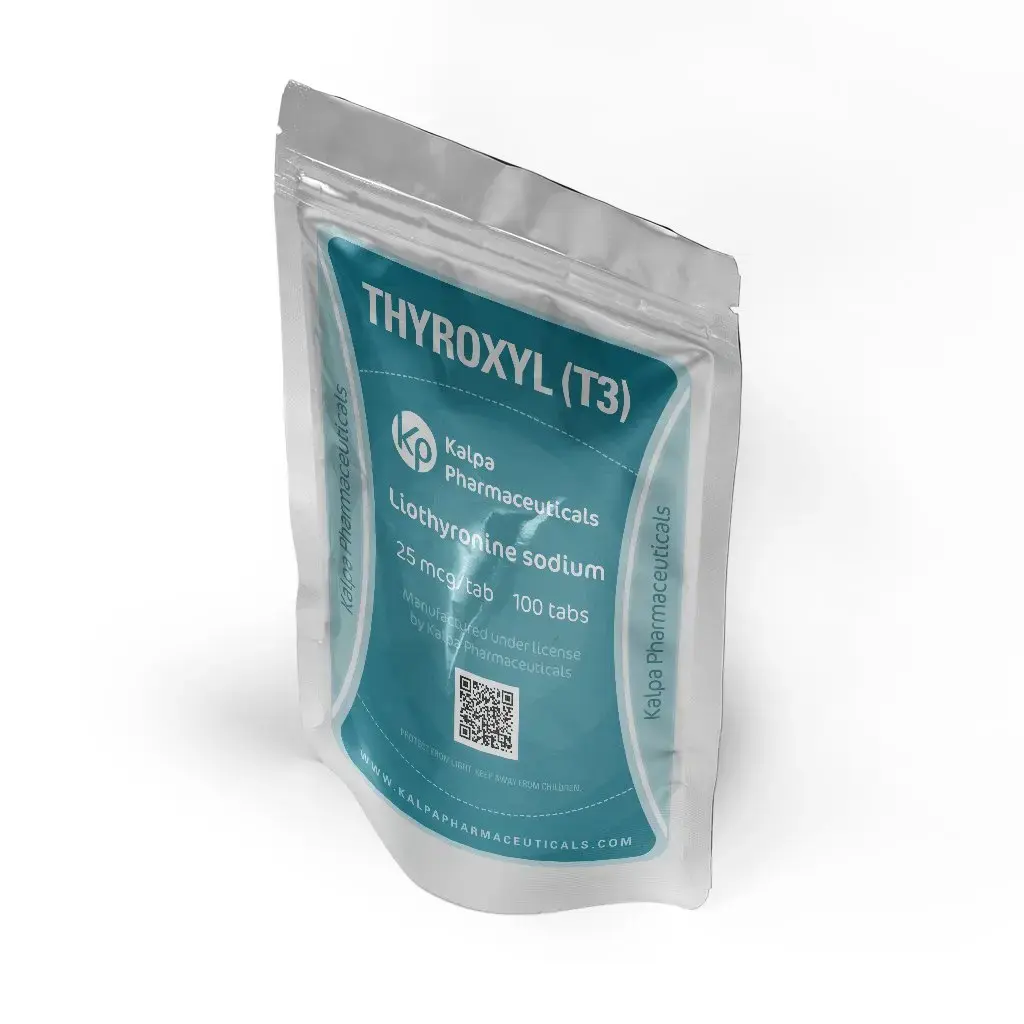
Thyroxyl (T3) 25 mcg is an oral liothyronine sodium tablet manufactured by Kalpa Pharmaceuticals and dosed at 25 mcg per tablet, supplied in packs of 100 tablets.
Thyroxyl (T3) 25 mcg contains liothyronine sodium, a synthetic form of the thyroid hormone triiodothyronine (T3). T3 is the biologically active thyroid hormone, with approximately 80% derived from peripheral conversion of thyroxine (T4) and the remainder secreted directly by the thyroid gland. Liothyronine sodium is FDA-approved as replacement therapy in primary, secondary, and tertiary hypothyroidism.
The FDA label explicitly states that liothyronine sodium should not be used for the treatment of obesity or for weight loss. In euthyroid patients, doses within the range of daily hormonal requirements are ineffective for weight reduction, and larger doses may produce serious or life-threatening manifestations of toxicity. In non-medical bodybuilding contexts, T3 is sometimes referenced for its metabolic effects during cutting phases, though such use falls outside approved medical indications and carries significant risks.
Liothyronine sodium has a rapid onset of action, with effects occurring within a few hours and maximum pharmacologic response within 2 to 3 days. The biological half-life is approximately 2.5 days. Thyroid hormones exert their effects through control of DNA transcription and protein synthesis, diffusing into the cell nucleus and binding to thyroid receptor proteins.
Thyroxyl (T3) 25 mcg is supplied as an oral compressed tablet containing 25 mcg of liothyronine sodium per unit, packaged in a 100-tablet format by Kalpa Pharmaceuticals.
Liothyronine sodium is a synthetic thyroid hormone identical to the naturally occurring T3. Its rapid onset and short half-life distinguish it from levothyroxine (T4) and make it a distinct clinical option for thyroid hormone replacement.
Liothyronine sodium is the sodium salt of L-triiodothyronine (T3), a synthetic form of the thyroid hormone normally produced by the thyroid gland and through peripheral conversion of T4. The compound is chemically designated as L-Tyrosine, O-(4-hydroxy-3-iodophenyl)-3,5-diiodo-, monosodium salt.
Thyroid hormones exert their physiologic actions through control of DNA transcription and protein synthesis. T3 diffuses into the cell nucleus and binds to thyroid receptor proteins attached to DNA, activating gene transcription and synthesis of messenger RNA and cytoplasmic proteins. The physiological actions of thyroid hormones are produced predominantly by T3.
Liothyronine sodium is not firmly bound to serum proteins, in contrast to T4. This characteristic contributes to its rapid onset and shorter duration of action compared to levothyroxine.
Liothyronine sodium has an onset of activity within a few hours and maximum pharmacologic response within 2 to 3 days. The biological half-life is approximately 2.5 days. T3 is almost totally absorbed, with 95% absorption within 4 hours.
Kalpa Pharmaceuticals offers several compounds referenced in non-medical bodybuilding contexts for weight management and cutting phases. The main distinctions involve mechanism of action, regulatory status, and intended application.
For those comparing weight management options, Clenbutaxyl (clenbuterol) is a beta-2 adrenergic agonist that works through a different mechanism. For lean muscle retention during cutting, Stanoxyl 10 (stanozolol) and Oxandroxyl 10 (oxandrolone) are non-aromatizing oral anabolics commonly referenced in this context.
The information below is provided for educational reference only. Liothyronine sodium is a prescription medication; medical use requires appropriate diagnosis, clinical supervision, and ongoing monitoring. The FDA label explicitly states that liothyronine sodium should not be used for obesity or weight loss. Non-medical use falls outside approved indications.
In medically supervised therapy, the recommended starting dosage for adult hypothyroidism is 25 mcg orally once daily, with increases of 25 mcg daily every 1 to 2 weeks as needed. The usual maintenance dose is 25 mcg to 75 mcg once daily. For elderly patients or those with underlying cardiac disease, the starting dose is 5 mcg once daily with 5 mcg increments.
| Use Case | Common Reference Range | Frequency |
|---|---|---|
| Medical (adult hypothyroidism) | 25–75 mcg per day | Once daily |
| Medical (elderly/cardiac) | 5–25 mcg per day | Once daily |
| Medical (suppression test) | 75–100 mcg per day | Once daily for 7 days |
| Non-medical (cutting, anecdotal) | 25–75 mcg per day | Once or split daily |
In non-medical bodybuilding contexts, T3 is sometimes referenced during cutting phases, often alongside anabolic compounds to help preserve lean muscle. The theoretical rationale involves T3's ability to increase metabolic rate, but this also increases the risk of muscle catabolism if caloric intake and anabolic support are insufficient.
Non-medical discussion of T3 typically emphasizes tapering both up and down to avoid thyroid axis disruption. Abrupt cessation after prolonged supraphysiologic use may result in temporary hypothyroid symptoms. Cycle duration and dosing strategies vary widely in non-medical contexts.
At supraphysiologic doses, liothyronine sodium can produce signs and symptoms of hyperthyroidism, including headache, irritability, nervousness, sweating, arrhythmia, increased bowel motility, and menstrual irregularities. Angina pectoris or congestive heart failure may be induced or aggravated, and chronic excessive dosage can produce signs and symptoms of hyperthyroidism.
Blood pressure, heart rate, and thyroid function tests should be monitored during any use. Aromatase inhibitors such as Arimixyl 1 mg are not relevant for T3.
Liothyronine sodium does not suppress the hypothalamic-pituitary-gonadal axis, so standard anabolic steroid PCT is not applicable. The thyroid axis typically recovers on its own after cessation, though tapering is commonly referenced to avoid rebound hypothyroid symptoms. If T3 is used alongside suppressive anabolic compounds, standard PCT protocols should be followed for those compounds.
Dosing strategies and support protocols should be adjusted based on experience level, health status, and bloodwork where possible. The information above is for educational reference and does not constitute medical advice.
Liothyronine sodium is a prescription thyroid hormone with significant cardiovascular, skeletal, and metabolic effects. Medical use requires appropriate diagnosis, clinical supervision, and ongoing monitoring.
The FDA label explicitly states that thyroid hormones, including liothyronine sodium, should not be used for the treatment of obesity or for weight loss. In euthyroid patients, doses within the range of daily hormonal requirements are ineffective for weight reduction, and larger doses may produce serious or even life-threatening manifestations of toxicity.
Liothyronine sodium is indicated for hypothyroidism and as a diagnostic agent in suppression tests. It is not indicated for suppression of benign thyroid nodules or nontoxic diffuse goiter in iodine-sufficient patients.
Liothyronine sodium is a prescription medication. Non-medical use for weight loss or physique enhancement is explicitly warned against by the FDA and is associated with serious cardiovascular, skeletal, and metabolic risks.
Signs and symptoms of overdosage include headache, irritability, nervousness, sweating, arrhythmia (including tachycardia), increased bowel motility, and menstrual irregularities. Angina pectoris or congestive heart failure may be induced or aggravated. Massive overdosage may result in symptoms resembling thyroid storm.
Overtreatment with thyroid hormone is associated with craniosynostosis in infants, may adversely affect brain maturation, and may accelerate bone age and result in premature epiphyseal closure and compromised adult stature. Increased bone resorption and decreased bone mineral density may occur as a result of thyroid hormone over-replacement.
Liothyronine sodium is contraindicated in patients with untreated thyrotoxicosis, uncorrected adrenal insufficiency, or known hypersensitivity to liothyronine sodium.
Pre-existing cardiovascular disease, hypertension, and arrhythmias require careful evaluation and often lower starting doses. Elderly patients and those with underlying cardiac disease should start at 5 mcg once daily.
In adult patients with primary hypothyroidism, serum TSH should be monitored periodically after initiation of therapy or dose changes. In patients with secondary or tertiary hypothyroidism, serum TSH is not a reliable measure of dose adequacy, and serum T3 levels should be used to monitor therapy.
Any use of liothyronine sodium should be accompanied by appropriate monitoring and medical supervision where possible.
Store in a cool, dry place away from direct light and moisture. Keep tablets in the original packaging until use. Keep out of reach of children.
Thyroxyl (T3) 25 mcg is supplied through the official Kalpa Pharmaceuticals distribution chain and shipped in original manufacturer packaging with discreet, privacy-focused handling.
The outer shipping package remains discreet, with privacy-focused handling and no unnecessary external product details. Products are supplied through the official Kalpa Pharmaceuticals distribution chain.
To verify your Thyroxyl (T3) 25 mcg product, use the security code on the packaging and cross-check it on the Kalpa official site. Original Kalpa Pharmaceuticals presentation and packaging help reinforce product legitimacy and buyer confidence.
For complete delivery details, tracking policy, and reshipment terms, please see our Shipping Info page.
Proper storage conditions help preserve tablet integrity and stability throughout shelf life.
Store Thyroxyl (T3) 25 mcg in a cool, dry place away from excessive heat, moisture, and direct light. Maintaining stable conditions helps preserve the integrity of the tablets.
Keep the tablets in their original packaging until use. Do not use if the packaging is damaged or if the tablets appear abnormal in color or texture.
Keep out of reach of children. Follow proper handling practices for oral medications.
Answers to common questions about Thyroxyl (T3) 25 mcg, liothyronine sodium, dosing, side effects, and product specifications.
Thyroxyl (T3) 25 mcg contains liothyronine sodium, which is FDA-approved as replacement therapy in primary, secondary, and tertiary hypothyroidism. It is also indicated as a diagnostic agent in suppression tests to differentiate suspected mild hyperthyroidism. The FDA label explicitly states it should not be used for obesity or weight loss.
In medically supervised therapy, liothyronine sodium is administered orally once daily. The recommended starting dosage is 25 mcg once daily, with increases of 25 mcg every 1 to 2 weeks as needed. Non-medical use often involves split dosing, though such use falls outside approved indications.
Liothyronine sodium does not suppress the hypothalamic-pituitary-gonadal axis, so standard anabolic steroid PCT is not applicable. The thyroid axis typically recovers on its own after cessation, though tapering is commonly referenced in non-medical contexts to avoid rebound hypothyroid symptoms. If T3 is used alongside suppressive anabolic compounds, standard PCT protocols should be followed for those compounds.
T3 is the biologically active thyroid hormone that helps the body use energy, stay warm, and keep the brain, heart, muscles, and other organs working properly. It exerts its effects through control of DNA transcription and protein synthesis, diffusing into the cell nucleus and binding to thyroid receptor proteins. Approximately 80% of T3 is derived from peripheral conversion of T4, with the remainder secreted directly by the thyroid.
Liothyronine sodium has a rapid onset of action, with effects occurring within a few hours and maximum pharmacologic response within 2 to 3 days. The biological half-life is approximately 2.5 days. This rapid onset distinguishes it from levothyroxine (T4), which has a slower onset and longer half-life.
There is no single thyroid medication that is universally best. The American Thyroid Association notes that recent studies have generally found no clinical advantage in adding T3 to the usual T4 replacement regimen. T3 has a more rapid onset and shorter half-life than T4, which can be advantageous or disadvantageous depending on the clinical situation. The appropriate formulation depends on individual medical circumstances.
T4 (thyroxine) is the main hormone secreted by the thyroid gland and is converted to T3 in peripheral tissues. T3 is the biologically active form that exerts most of the effects of thyroid hormones. T3 has a more rapid onset and shorter half-life (approximately 2.5 days) compared to T4, which has a longer half-life and slower onset.
A single 25 mcg tablet represents the standard recommended starting dosage for adult hypothyroidism. The usual maintenance dose is 25 mcg to 75 mcg once daily. In non-medical contexts, doses above the normal physiologic range are associated with signs and symptoms of hyperthyroidism, including arrhythmia and increased bowel motility.
Thyroxyl (T3) 25 mcg is labeled at 25 mcg of liothyronine sodium per tablet. It is supplied in packs of 100 tablets, giving 2,500 mcg of total labeled liothyronine sodium content per pack.
The FDA label explicitly states that liothyronine sodium should not be used for the treatment of obesity or for weight loss. In euthyroid patients, doses within the range of daily hormonal requirements are ineffective for weight reduction, and larger doses may produce serious or even life-threatening manifestations of toxicity. Weight loss should be pursued through appropriate diet and exercise under medical guidance.
Low T3 levels can indicate hypothyroidism, though T3 testing is rarely helpful in the hypothyroid patient since it is the last test to become abnormal. Patients can be severely hypothyroid with a high TSH and low free T4 but have a normal T3. Low T3 should be evaluated by a qualified healthcare professional in the context of other thyroid function tests.
Laboratory testing information for Thyroxyl (T3) 25 mcg is not currently available in this product listing. Kalpa Pharmaceuticals products are manufactured under pharmaceutical-grade conditions, but independent lab reports are not published for this specific product at this time.
Great Price on this compound, really speeds up metabolism
Please log in to write Thyroxyl (T3) 25 mcg review.

June 5, 2019
Hair still a little thinner, body heat production still high and staying very lean without cardio. Very happy with the T3.