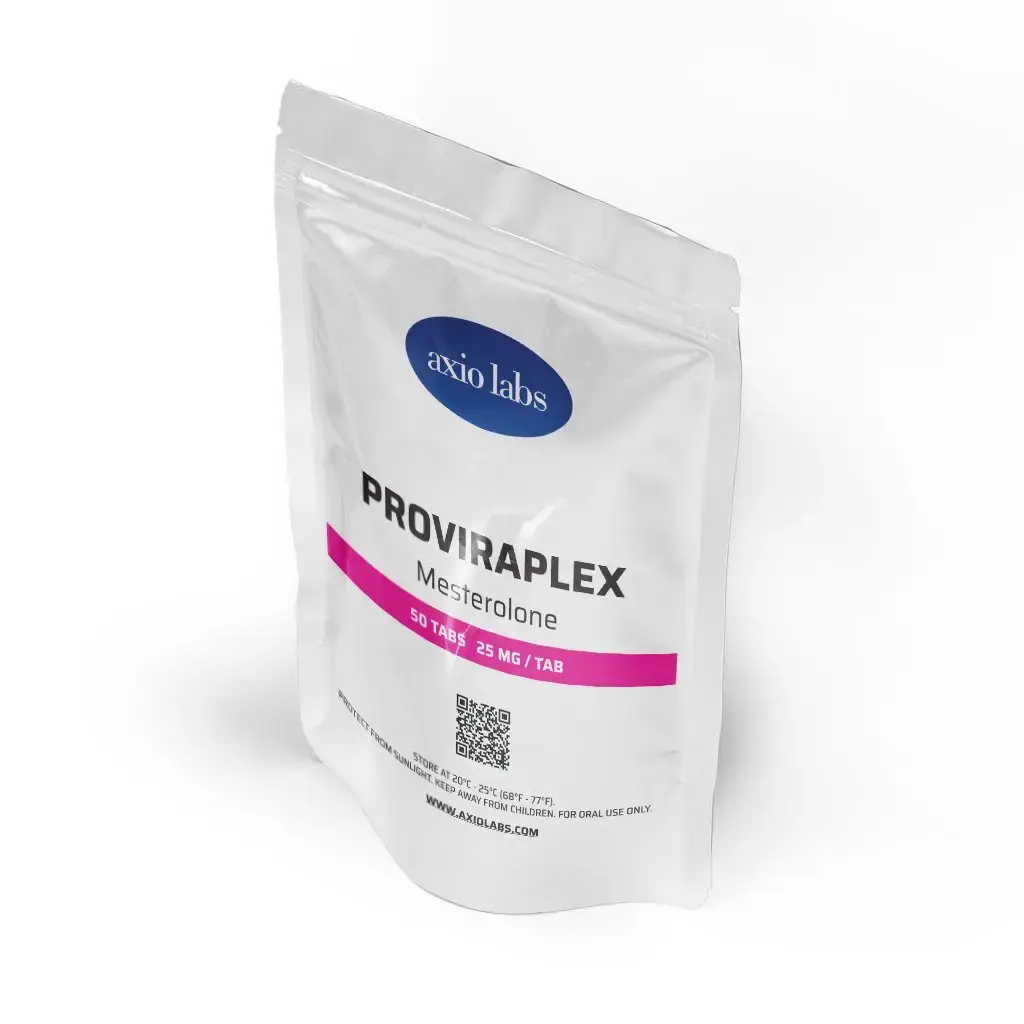
Proviraplex 25 mg is an oral mesterolone product manufactured by Axiolabs and supplied as 25 mg tablets in a 50-tablet package.
Proviraplex 25 mg contains mesterolone, a synthetic oral androgen derived from dihydrotestosterone (DHT). Mesterolone is structurally distinct from testosterone in that it is a 1-methylated DHT analogue, meaning it undergoes neither 5-alpha reduction nor aromatization to estrogen. This structural characteristic gives it a unique profile among oral androgens and distinguishes it from both testosterone-based compounds and 17-alpha-alkylated oral anabolic steroids.
In clinical medicine, mesterolone has been used primarily for the treatment of androgen deficiency in men, including conditions associated with deficient endogenous androgen formation such as decreased physical activity, libido disturbances, and hypogonadism. It has also been studied and used for male infertility associated with oligospermia and Leydig cell insufficiency, where it is proposed to improve sperm count and quality by increasing fructose concentration in the ejaculate. These medical applications are distinct from non-medical bodybuilding use, where mesterolone is commonly referenced for its ability to bind sex hormone-binding globulin (SHBG) and thereby increase free testosterone levels.
Mesterolone exerts its effects through binding to androgen receptors, but its practical utility in bodybuilding contexts is largely attributed to its high affinity for SHBG. By displacing testosterone from SHBG, mesterolone increases the proportion of unbound, biologically active testosterone in circulation. It is also sometimes referenced for its weak aromatase inhibition, though this effect is modest. Non-medical use of mesterolone falls outside approved medical indications and carries risks, particularly androgenic effects that are dose-dependent.
Mesterolone is an orally active DHT analogue with a distinctive profile: it does not aromatize, undergoes minimal hepatic metabolism compared to 17-alpha-alkylated orals, and is primarily valued in bodybuilding contexts for SHBG displacement rather than direct anabolic potency.
Mesterolone is structurally classified as a 1-methylated derivative of dihydrotestosterone. The 1-methyl group confers oral bioavailability and metabolic stability without the 17-alpha-alkylation that characterizes most oral anabolic steroids. As a result, mesterolone is described as being free of the hepatotoxicity typically associated with C17-alpha-alkylated compounds.
Because it is already a DHT derivative, mesterolone is not a substrate for 5-alpha reductase and cannot be amplified to a more potent androgen in tissues like the prostate or scalp. It also lacks the A-ring structure necessary for aromatization, meaning it does not convert to estrogen. These properties define its practical profile: a non-aromatizing, non-5-alpha-reducible oral androgen with relatively mild hepatic impact.
Clinical literature notes that mesterolone is not used for long-term androgen replacement due to the need for multiple daily dosing and suboptimal efficacy at standard doses, but it remains relevant in bodybuilding discussions for its SHBG-binding properties and effects on libido and free testosterone.
Mesterolone's primary practical effect in bodybuilding contexts is its ability to bind SHBG and increase free testosterone. Its inability to aromatize further distinguishes it from testosterone-based compounds and makes it unsuitable as a standalone mass-building agent.
Axiolabs produces several products that are referenced in different capacities within bodybuilding contexts. Proviraplex 25 mg is a mesterolone product, placing it in a distinct category from anabolic agents used for mass-building or cutting such as Oxandroplex and Methanoplex.
Mesterolone is also not an aromatase inhibitor in the conventional sense, distinguishing it from products like Arimiplex and Exeplex. While it may exert weak aromatase inhibition, its primary mechanism relevant to bodybuilding is SHBG binding rather than direct estrogen suppression. For post-cycle therapy and endogenous testosterone recovery, products such as Clomiplex and Tamoxiplex are commonly referenced.
The information below is provided for educational reference only. Mesterolone is a prescription medication in many jurisdictions; medical use requires appropriate diagnosis and clinical supervision. Non-medical use falls outside approved indications.
In non-medical bodybuilding contexts, mesterolone is commonly referenced in the range of 25–100 mg per day, with 50 mg per day split into two doses being frequently described as a practical midpoint. The compound has a relatively short half-life of approximately 12–13 hours, which supports split dosing for more stable serum levels. Doses at the lower end (25 mg/day) are typically referenced for SHBG management and libido support, while higher doses (75–100 mg/day) are associated with more pronounced androgenic effects and diminishing returns.
| Use Case | Common Reference Range | Frequency |
|---|---|---|
| SHBG management / libido support | 25–50 mg / day | Split AM/PM |
| On-cycle hardening (non-medical) | 50 mg / day | Split AM/PM |
| Advanced / pre-contest (non-medical) | 75–100 mg / day | 2–3 divided doses |
In non-medical bodybuilding contexts, mesterolone is commonly referenced as an ancillary compound during cycles involving aromatizing injectables or 19-nor compounds. It is sometimes included alongside testosterone preparations such as Testaplex C 250 or Testaplex E 250 to increase free testosterone availability. It is also referenced in stacks with nandrolone-based products like Decaplex 250 for managing libido-related concerns.
Mesterolone is not a cycle base and does not provide meaningful anabolic drive on its own. Cycle structure and duration should be considered in the context of the overall protocol and individual experience.
Mesterolone's androgenic side effects are dose-dependent and can include acne, scalp hair loss, and increased body hair. Because it is a DHT derivative, these effects may be more pronounced in individuals predisposed to androgenic alopecia. Unlike 17-alpha-alkylated orals, mesterolone is not associated with significant hepatotoxicity, but lipid profile monitoring remains relevant as androgens can affect HDL cholesterol.
Mesterolone does not aromatize, so aromatase inhibitors are not applicable for managing estrogenic side effects from this compound alone.
Mesterolone is not a substitute for post-cycle therapy and does not restore endogenous testosterone production. In non-medical bodybuilding contexts, standard PCT protocols using agents such as Clomiplex or Tamoxiplex are commonly referenced after cycles involving suppressive compounds. Mesterolone should not be relied upon for HPTA recovery.
Dosing strategies and support protocols should account for individual experience and health status. The information above is for educational reference and does not constitute medical advice.
Mesterolone is an androgen that can affect prostate tissue, lipid profiles, and reproductive function. Medical use requires appropriate diagnosis and ongoing clinical supervision.
Mesterolone is indicated for use in male patients with androgen deficiency. Clinical evaluation should demonstrate androgen/testosterone deficiency before initiating treatment, with other conditions that could explain symptoms excluded. Mesterolone is not indicated for use in women or children and should not be used to enhance muscle mass or physical performance in healthy individuals.
During treatment, periodic prostate examinations are recommended, as androgens can increase the growth rate of prostate cancer. Rare cases of benign and malignant liver tumors have been observed with hormonal substances including mesterolone, and in isolated cases these have caused life-threatening intra-abdominal hemorrhage.
Mesterolone is not approved for bodybuilding or athletic performance enhancement. Non-medical use falls outside approved indications and may carry additional health risks beyond those associated with supervised medical use.
Reported adverse effects include abdominal pain or stomach discomfort, acne, alopecia (hair loss), headache, and frequent or prolonged penile erections. Priapism, while uncommon, may require dose reduction or treatment interruption to avoid penile injury.
As a DHT-derived androgen, mesterolone can produce androgenic effects that are dose-dependent, including acne and scalp hair loss. Because it does not aromatize, estrogenic side effects are not expected from mesterolone alone. Mesterolone is suppressive to the hypothalamic-pituitary-gonadal axis at higher doses, which can affect endogenous testosterone production and spermatogenesis.
Liver tumors, while rare, have been reported with mesterolone use.
Mesterolone is contraindicated in women, particularly during pregnancy or breastfeeding, due to risk of virilization. It is also not indicated for children and adolescents. Medical evaluation is required before any consideration of therapeutic use, including assessment of prostate health and liver function.
Medically supervised mesterolone therapy typically involves periodic prostate examinations to monitor for any prostatic changes. Liver function should also be monitored given rare reports of hepatic tumors. These monitoring practices are relevant to medical use; non-medical use lacks the same clinical oversight.
Store tablets in a cool, dry place away from direct light and moisture. Keep in original packaging until use. Keep out of reach of children. Do not use if the product appears damaged or compromised.
Proviraplex 25 mg is shipped in original manufacturer packaging with discreet, privacy-focused handling.
Outer packaging remains discreet with no external product details. Products are supplied in original manufacturer presentation.
To verify product authenticity, examine the packaging for manufacturer security features and compare against official Axiolabs presentation. Original packaging and consistent labeling help confirm product legitimacy.
For complete delivery details, please see our Shipping Info page.
Proper storage conditions help preserve product integrity and tablet stability.
Store in a cool, dry place at controlled room temperature. Protect from excessive heat, moisture, and direct light. Keep tablets in their original packaging until use. Do not use if the product appears compromised or if tablets show signs of deterioration.
Keep out of reach of children. Follow proper handling practices.
Answers to common questions about Proviraplex 25 mg, mesterolone, dosing, and product characteristics.
Proviraplex 25 mg contains mesterolone, an oral androgen. In medical practice, it is used for androgen deficiency in men and for some cases of male infertility. In non-medical bodybuilding contexts, it is commonly referenced for SHBG management, libido support, and increasing free testosterone availability. Non-medical use falls outside approved indications.
Mesterolone has a relatively short half-life of approximately 12–13 hours, so in bodybuilding contexts it is typically referenced as being taken in 2 divided doses per day at 50 mg/day, or 2–3 doses at higher daily totals. Medical dosing is individualized by a clinician based on the condition being treated.
Mesterolone is not a replacement for post-cycle therapy and does not restore endogenous testosterone production. In non-medical bodybuilding contexts, standard PCT protocols using agents such as Clomiplex or Tamoxiplex are commonly referenced after cycles involving suppressive compounds.
Mesterolone is a DHT-derived oral androgen. Its primary practical effect in bodybuilding contexts is binding to SHBG, which displaces testosterone and increases free testosterone availability. It does not aromatize to estrogen and is not a substrate for 5-alpha reductase. It is not a potent anabolic agent on its own.
In bodybuilding discussions, subjective effects on libido and morning erections are sometimes reported within the first week of use at 50 mg/day. Objective SHBG reduction is typically observed within 2–4 weeks on bloodwork. Individual response varies, and these timelines are based on non-medical user reports rather than controlled clinical data for this specific use case.
There is no universally "best" compound for libido. Mesterolone is commonly referenced for this purpose due to its SHBG-binding effects and androgenic activity, but individual response varies considerably. Other factors including overall hormonal balance, cycle composition, and individual physiology also play significant roles.
Mesterolone and anastrozole work through different mechanisms. Anastrozole is a potent aromatase inhibitor that directly blocks estrogen conversion. Mesterolone is an androgen that binds SHBG and may exert weak aromatase inhibition, but its primary effect is on free testosterone availability rather than estrogen suppression. Axiolabs offers Arimiplex as its anastrozole product.
Exemestane is a steroidal aromatase inhibitor that irreversibly binds the aromatase enzyme, while mesterolone is an androgen with SHBG-binding properties. They serve different purposes: exemestane for estrogen control, mesterolone for free testosterone management. Axiolabs offers Exeplex as its exemestane product.
In bodybuilding contexts, 50 mg per day is frequently described as a practical midpoint for mesterolone use, with 25 mg/day at the lower end and 75–100 mg/day referenced by more experienced users. Proviraplex 25 mg contains 25 mg per tablet, so 50 mg would equal two tablets daily. Dosage appropriateness depends on individual factors and the overall cycle context.
Proviraplex 25 mg is supplied as 25 mg mesterolone tablets in a 50-tablet package, giving 1,250 mg of total labeled mesterolone content.
Mesterolone is not indicated for use in women and is contraindicated in pregnancy and breastfeeding due to risk of virilization. The manufacturer explicitly restricts its use to male patients. Women should not use this product.
Mesterolone is not a 17-alpha-alkylated anabolic steroid and is described as being free of the hepatotoxicity typically associated with that class. However, rare cases of benign and malignant liver tumors have been reported with hormonal substances including mesterolone. Liver function monitoring is part of medically supervised use.