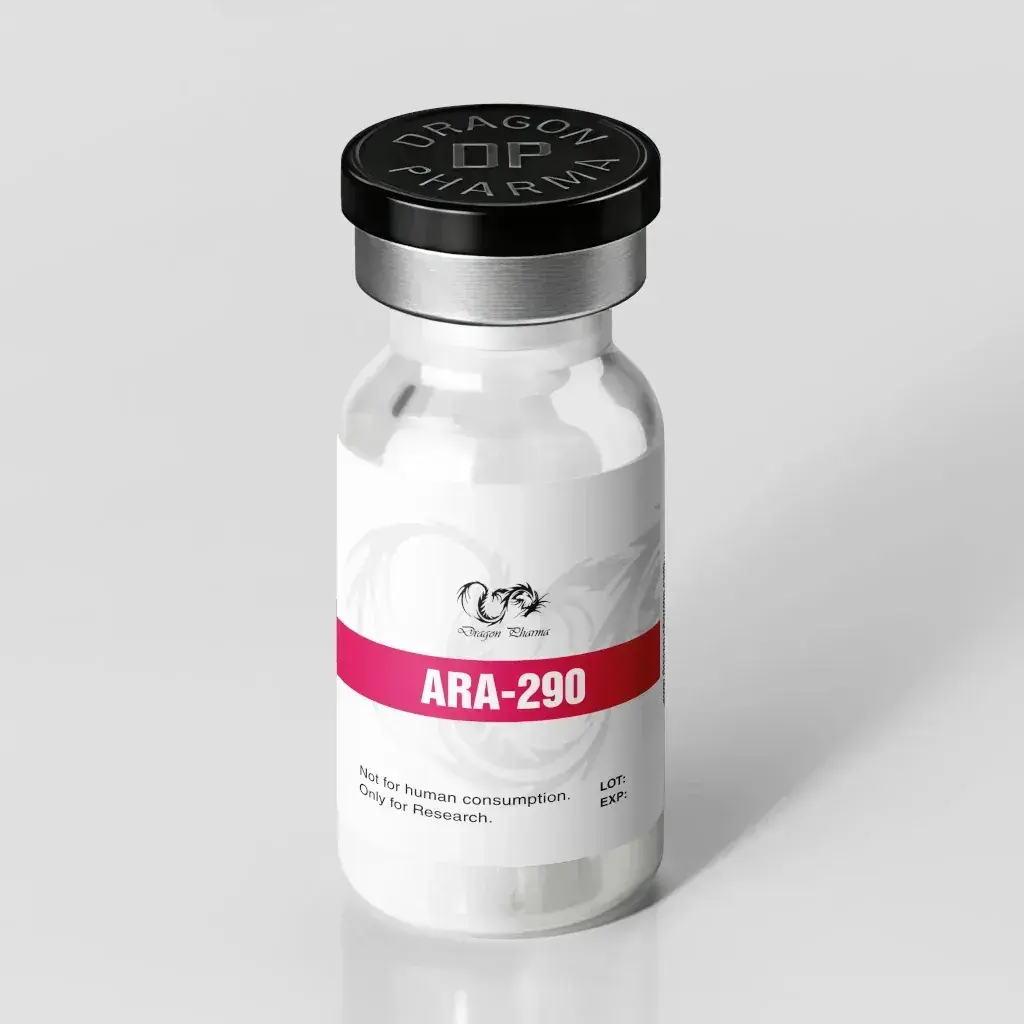
ARA-290 (Cibinetide) Injectable
ARA-290 16 mg contains cibinetide (also known as ARA-290), an 11-amino-acid peptide engineered from the tertiary structure of the helix B surface domain of erythropoietin (EPO). The sequence pGlu-Glu-Gln-Leu-Glu-Arg-Ala-Leu-Asn-Ser-Ser enables selective binding to the innate repair receptor (IRR), a heterodimer of EPOR and CD131, which is upregulated specifically on injured or inflamed tissue. Unlike recombinant EPO, ARA-290 does not activate the EPOR homodimer responsible for erythropoiesis, eliminating the risk of hematocrit elevation.
In clinical research, ARA-290 has completed multiple Phase 2 trials. A randomized, double-blind study in sarcoidosis-associated small fiber neuropathy demonstrated significant improvement in neuropathic symptoms, increased corneal nerve fiber density, and improved 6-minute walk test performance after 28 days of daily subcutaneous administration. A separate Phase 2 trial in type 2 diabetes with painful neuropathy reported improved metabolic control and neuropathic symptoms. Preclinical studies have also demonstrated cardiac anti-inflammatory effects, reduced fibrosis, and preserved healthspan in aged mice.
In bodybuilding and recovery contexts, ARA-290 is referenced anecdotally for nerve repair, reduction of neuropathic pain, and tissue protection during injury recovery. However, no FDA-approved therapeutic indication exists for ARA-290, and all human data comes from investigational clinical trials. Community protocols are extrapolated from these trials and are not validated for non-medical use. Such use falls outside approved indications.
Research Properties of ARA-290 16 mg
- 11-amino-acid non-hematopoietic EPO mimetic peptide
- Selective agonist of the innate repair receptor (EPOR/CD131 heterodimer)
- Demonstrated efficacy in sarcoidosis-associated small fiber neuropathy trials
- Investigated for neuropathic pain and metabolic control in type 2 diabetes
- Preclinical evidence for anti-inflammatory and cardioprotective effects
Non-Hematopoietic EPO Mimetic Peptide
ARA-290 belongs to the class of innate repair receptor (IRR) agonists, a family of peptides derived from the tissue-protective domain of erythropoietin. The IRR is a heterodimer of the erythropoietin receptor (EPOR) and CD131 (β common receptor), which is expressed on injured and inflamed tissues but not on erythroid precursors. This selective expression pattern means ARA-290 concentrates its activity at sites of damage while avoiding the erythropoietic effects of native EPO.
The peptide's pharmacokinetic profile and pharmacodynamics have been characterized in multiple Phase 2 clinical trials. A 28-day daily subcutaneous dosing regimen at 2–4 mg produced sustained improvements in neuropathic symptoms and corneal nerve fiber density in sarcoidosis patients. The receptor is upregulated on damaged tissue from the first dose, and downstream signaling persists for days after each administration, which is why community protocols favor cycling rather than continuous use.
Preclinical research has demonstrated ARA-290's anti-inflammatory and tissue-protective effects across multiple organ systems. In aged mice, chronic ARA-290 treatment reduced cardiac inflammation, mitigated age-associated declines in heart function, and prolonged healthspan. In retinal ischemia models, systemic ARA-290 treatment reduced pro-inflammatory cytokines (IL-1β, TNF-α) and enhanced the vasoreparative function of transplanted endothelial colony-forming cells.
Defining Characteristic
Selective Innate Repair Receptor Activation
ARA-290's defining characteristic is its selectivity for the EPOR/CD131 heterodimer (IRR) over the EPOR homodimer. This eliminates erythropoietic activity while preserving tissue-protective and anti-inflammatory signaling.
ARA-290 16 mg vs Other Dragon Pharma Preparations
Dragon Pharma offers several peptides referenced in nerve repair and inflammation research. BPC 157 is a gastric pentadecapeptide studied for angiogenesis and tissue repair through VEGF and NO pathways. TB 500 is a thymosin beta-4 fragment investigated for cell migration. LL-37 is a cathelicidin antimicrobial peptide with immunomodulatory activity. ARA-290's mechanism of innate repair receptor activation and selective targeting of injured tissue is distinct from these compounds.
Typical Dosage Ranges
Clinical trial protocols for ARA-290 have used daily subcutaneous administration of 1–8 mg for 28 days, with 2–4 mg being the most commonly studied range. A Phase 2 trial in type 2 diabetes used 4 mg daily. Community protocols reference a titration approach starting at 0.5 mg and escalating to 2–4 mg over the first week, driven by injection-site tolerability.
| Use Case |
Common Reference Range |
Frequency |
| Clinical trial (sarcoidosis SFN) |
2–4 mg |
Daily, 28 days |
| Clinical trial (type 2 diabetes) |
4 mg |
Daily, 28 days |
| Community protocol (unverified) |
0.5–4 mg |
Daily, 4–8 week cycles |
Reconstitution & Handling
ARA-290 16 mg is supplied as a lyophilized powder requiring reconstitution. Bacteriostatic Water is commonly referenced for reconstituting research peptides. A 16 mg vial reconstituted with 2 mL yields a concentration of 8 mg/mL. A 4 mg dose would be 0.5 mL (50 units on a U-100 insulin syringe). Swirl gently to dissolve; do not shake. Store reconstituted vials refrigerated at 2–8°C.
Stacking & Research Considerations
In community research contexts, ARA-290 is sometimes referenced alongside BPC 157 or TB 500 for combined nerve and tissue repair support. However, no controlled studies have examined the safety or efficacy of these combinations. ARA-290's mechanism of innate repair receptor activation and anti-inflammatory signaling is distinct from BPC 157 and TB 500's pathways.
Important
Individual Response Varies
The information above is for educational reference and does not constitute medical advice. ARA-290 has not been approved by the FDA for any indication.
Important Safety Information
ARA-290 has been evaluated in multiple Phase 2 clinical trials with generally favorable tolerability. In the sarcoidosis-associated small fiber neuropathy trial, adverse event rates were comparable between ARA-290 and placebo arms. No hematocrit elevation or blood pressure changes have been observed, consistent with the peptide's non-hematopoietic mechanism. The most commonly reported effects are injection-site reactions and transient gastrointestinal symptoms.
Important
Non-Medical Use
Non-medical use of ARA-290 falls outside any approved indication. Product purity does not establish that non-medical use is safe or appropriate for an individual. Community protocols are extrapolated from clinical trial data and are not validated for non-medical use.
Potential Adverse Effects
In clinical trials, adverse events occurring at similar or lower rates than placebo included diarrhea, nausea, abdominal pain, and injection-site reactions. A single individual with a prior history of fainting experienced a syncopal episode shortly after intravenous administration of 700 μg ARA-290 and recovered without intervention. No drug-related serious adverse events were reported in the sarcoidosis neuropathy trial.
Conditions Requiring Medical Evaluation
No formal contraindication list exists for ARA-290 because it has not received FDA approval. Individuals with active malignancy, severe cardiovascular disease, or known hypersensitivity to peptide products should exercise particular caution. Pregnancy and breastfeeding are contraindications due to lack of safety data.
Monitoring Considerations
If ARA-290 is used in any research context, monitoring of CBC to confirm absence of hematocrit elevation may be considered, given the theoretical concern of EPO contamination in gray-market products. Inflammatory markers such as hs-CRP may be tracked in inflammation-focused protocols. No hormonal panel is required, as ARA-290 does not affect testosterone, LH, FSH, or IGF-1.
Product Care
Storage & Handling
Store lyophilized powder at -20°C for long-term storage, protected from light and moisture. After reconstitution, store at 2–8°C and use within a reasonable timeframe. Do not freeze reconstituted solution. Discard if solution becomes cloudy or develops particulate matter.
Keep all research peptides and injectable products out of the reach of children.
Further Safety Information
USA Domestic 3–5 business days
International 10–15 business days
Order Processing 24–48 business hours
Tracking Provided after dispatch
Direct Supply
Discreet Delivery & Original Packaging
The outer shipping package remains discreet, with no external product details. Products are supplied through the official Dragon Pharma distribution chain.
What to Expect
- Orders are processed after payment confirmation
- USA Domestic shipping is typically faster when local stock is available
- International orders include tracking, though update frequency may vary by destination
- Multiple warehouses may result in separate shipments when applicable
Authenticity Verification
To verify your ARA-290 16 mg product, use the security code on the vial label and cross-check it on the official Dragon Pharma site. Verify that the labelled sequence corresponds to cibinetide (pGlu-Glu-Gln-Leu-Glu-Arg-Ala-Leu-Asn-Ser-Ser). Original packaging and batch documentation help reinforce product legitimacy.
For complete delivery details, tracking policy, and reshipment terms, please see our Shipping Info page.
Recommended Conditions
Store lyophilized powder at -20°C for long-term storage, protected from light and moisture. The unopened vial should be kept under conditions that preserve the peptide's structural integrity until reconstitution.
Once reconstituted, ARA-290 solution should be stored at 2–8°C and used within a reasonable timeframe. Do not freeze reconstituted solution. Discard if solution becomes cloudy or develops particulate matter.
Keep out of reach of children. Follow proper handling practices for research peptides and use appropriate sterile technique during reconstitution.
Quick Reference
Do & Don't
- Do store lyophilized powder at -20°C for long-term storage
- Do protect from light and moisture
- Do use reconstituted solution within a reasonable timeframe
- Don't freeze reconstituted solution
- Don't expose to excessive heat
- Don't use if powder appears discolored
What is ARA-290 16 mg used for?
ARA-290 16 mg is a research peptide supplied as a lyophilized powder. It contains cibinetide, a non-hematopoietic EPO mimetic that selectively activates the innate repair receptor for tissue protection and inflammation resolution. It has been investigated in clinical trials for sarcoidosis-associated small fiber neuropathy and type 2 diabetes.
How often should ARA-290 16 mg be administered?
Clinical trial protocols have used daily subcutaneous administration of 2–4 mg for 28 days. Community protocols reference a titration approach starting at 0.5 mg and escalating to 2–4 mg over the first week, driven by injection-site tolerability.
Does ARA-290 16 mg require PCT?
No PCT is required. ARA-290 is non-hormonal, does not engage the EPOR homodimer, does not suppress the HPG or HPT axis, and produces no rebound on cessation. The cycle simply ends.
What does ARA-290 do?
ARA-290 selectively activates the innate repair receptor (EPOR/CD131 heterodimer), which is upregulated on injured and inflamed tissue. This triggers tissue-protective and anti-inflammatory signaling, including reduction of TNF-α and IL-1β, without stimulating erythropoiesis.
How long does ARA-290 take to work?
Community reports describe earliest subjective effects on neuropathic pain within 3–7 days, with meaningful pain-score reductions at 2–3 weeks and structural nerve fiber changes at 4–8 weeks. Clinical trials assessed outcomes at 28 days.
Is ARA-290 the best nerve repair peptide?
No single peptide is universally superior. ARA-290 is distinctive for having completed Phase 2 clinical trials with demonstrated efficacy in small fiber neuropathy. Other peptides like BPC 157 have different mechanisms and less human clinical data.
What is the difference between ARA-290 and BPC 157?
BPC 157 is a gastric pentadecapeptide studied for angiogenesis and tissue repair through VEGF and NO pathways. ARA-290 is an EPO-derived peptide that activates the innate repair receptor for anti-inflammatory and neuroprotective effects. Their mechanisms and origins are fundamentally different.
What is the difference between ARA-290 and TB 500?
TB 500 is a thymosin beta-4 fragment investigated for cell migration and actin regulation. ARA-290 targets the innate repair receptor to reduce inflammation and protect injured tissue. These compounds operate through entirely different biological pathways.
Is 16 mg of ARA-290 a lot?
16 mg is the total labeled content of the ARA-290 16 mg vial. Clinical trial doses ranged from 1–8 mg daily. The vial provides sufficient material for multiple doses after reconstitution.
What strength is ARA-290 16 mg?
ARA-290 16 mg by Dragon Pharma contains 16 mg of ARA-290 per vial as a lyophilized powder. The vial size is 2 mL. This is a research presentation.
Can ARA-290 be stacked with other peptides?
There is no established research on combining ARA-290 with other peptides. In community contexts, it is sometimes referenced alongside BPC 157 or TB 500 for nerve and tissue repair support, but no controlled studies support these combinations.
No reviews found
Please log in to write ARA-290 16 mg review.