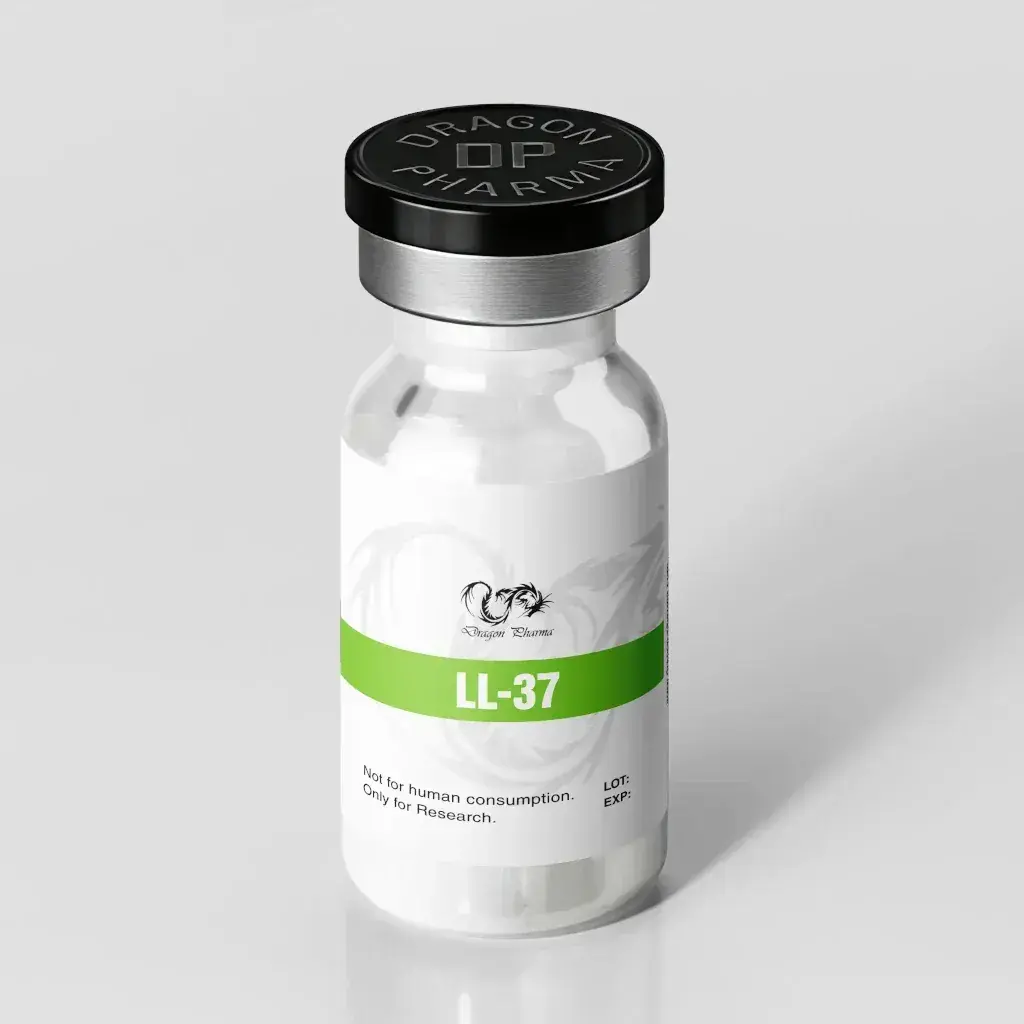
LL-37 Injectable
LL-37 5 mg contains the human cathelicidin antimicrobial peptide LL-37, a 37-amino-acid cationic amphipathic α-helical peptide. It is the only cathelicidin encoded in the human genome and is produced by neutrophils, epithelial cells, and various tissues upon injury or infection. The peptide sequence (LLGDFFRKSKEKIGKEFKRIVQRIKDFLRNLVPRTES) enables broad-spectrum antimicrobial activity through membrane disruption, as well as immunomodulatory functions including chemotaxis, angiogenesis, and tissue repair.
In research contexts, LL-37 is studied extensively for wound healing and innate immune modulation. Human clinical evidence is limited to topical applications: a phase IIb trial in venous leg ulcers found that the 0.5 mg/mL dose achieved 28.1% complete wound closure versus 8.1% for placebo in a subgroup with large wounds. A separate trial in diabetic foot ulcers reported significantly greater granulation index in the LL-37 group at multiple timepoints. However, **no completed human clinical trials have evaluated injectable LL-37**, and the safety profile for systemic administration is uncharacterized.
In bodybuilding and recovery contexts, LL-37 is referenced anecdotally for immune support and tissue repair during periods of intense training or stress. However, community protocols are extrapolated from topical clinical data and preclinical studies, not from injectable human trials. Caution is warranted because LL-37 is a known autoantigen in systemic lupus erythematosus and is elevated in psoriatic skin, making exogenous use theoretically contraindicated in autoimmune conditions. Such use falls outside any approved indication.
Research Properties of LL-37 5 mg
- Only human cathelicidin antimicrobial peptide
- Broad-spectrum antimicrobial activity via membrane disruption
- Investigated for wound healing and angiogenesis in topical clinical trials
- Lyophilized powder format for extended stability
- 5 mg per vial for research applications
Human Cathelicidin Antimicrobial Peptide
LL-37 belongs to the cathelicidin family of antimicrobial peptides, which share a conserved N-terminal cathelin domain and a variable C-terminal antimicrobial peptide. In humans, the hCAP-18 precursor is cleaved by proteinase 3 to release the mature LL-37 peptide. The peptide is 4.5 kDa, carries a net positive charge of +6, and adopts an amphipathic α-helical conformation that enables membrane interaction.
The proposed antimicrobial mechanism involves disruption of microbial membranes through electrostatic interaction with negatively charged phospholipids, followed by pore formation or membrane permeabilization. Beyond direct killing, LL-37 acts as a chemoattractant for mast cells, monocytes, T lymphocytes, and neutrophils through formyl peptide receptor-like 1 (FPRL1). It also promotes angiogenesis and arteriogenesis, contributing to wound healing.
Recombinant and synthetic LL-37 have demonstrated the ability to neutralize LPS-induced macrophage activation, induce endothelial cell proliferation and tubule formation, and improve wound healing through vascularization and re-epithelialization in animal models. These immunophysiological properties are preserved in recombinant preparations with an N-terminal proline.
Defining Characteristic
Dual Antimicrobial and Immunomodulatory Activity
LL-37's defining research characteristic is its ability to both directly kill microbes through membrane disruption and modulate host immune responses through chemotaxis, angiogenesis, and cytokine regulation. This dual function is shared by few other peptides.
LL-37 5 mg vs Other Dragon Pharma Preparations
Dragon Pharma offers several peptides referenced in immune and recovery research. Thymosin Alpha-1 is investigated for T-cell modulation and immune regulation. BPC 157 is a gastric pentadecapeptide studied for angiogenesis and gut health through VEGF and NO pathways. TB 500 is a thymosin beta-4 fragment for cell migration and actin regulation. LL-37's mechanism of membrane disruption and FPRL1-mediated chemotaxis is distinct from these compounds.
Typical Dosage Ranges
Common reference ranges for injectable LL-37 are not well characterized in publicly available research literature. No validated human dosing protocol exists for systemic administration. Community protocols reference 100–300 mcg subcutaneously daily to three times weekly, but these are anecdotal extrapolations from topical trial data and preclinical studies, not from injectable human trials. Topical clinical trials used 0.5–1.6 mg/mL applied twice weekly to wound sites, which does not translate to injectable dosing.
| Use Case |
Common Reference Range |
Frequency |
| Topical clinical trials |
0.5–1.6 mg/mL |
Twice weekly to wound |
| Community protocol (unverified) |
100–300 mcg |
Daily to 3× weekly |
Reconstitution & Handling
LL-37 5 mg is supplied as a lyophilized powder requiring reconstitution. Bacteriostatic Water is commonly referenced for reconstituting research peptides. A 5 mg vial reconstituted with 5 mL yields a concentration of 1 mg/mL; with 10 mL yields 500 mcg/mL. LL-37 is prone to aggregation and proteolytic degradation after reconstitution; store at 2–8°C and use within 2–4 weeks. Do not freeze reconstituted solution, as this risks peptide aggregation.
Stacking & Research Considerations
In community research contexts, LL-37 is sometimes referenced alongside other immune-modulating peptides such as Thymosin Alpha-1 or BPC 157. However, no controlled studies have examined the safety or efficacy of these combinations. Because LL-37 has potent immunomodulatory and potential cytotoxic effects, combination with other immune-active compounds requires particular caution.
Important
Individual Response Varies
The information above is for educational reference and does not constitute medical advice. LL-37 has not been evaluated by the FDA for safety or efficacy in injectable applications.
Important Safety Information
Injectable LL-37 has never been tested in human clinical trials. No Phase 1 safety data, no human pharmacokinetic studies, and no long-term safety follow-up exist for systemic administration. All human clinical evidence comes from topical applications in wound healing trials, which cannot be extrapolated to injectable use. LL-37 is sold as a research chemical and is not FDA-approved for human or animal consumption.
Important
Autoimmune Contraindication
LL-37 is a known autoantigen in systemic lupus erythematosus and is elevated in psoriatic skin. Exogenously administered LL-37 in individuals with these conditions is theoretically contraindicated. No clinical trial data exists on this risk, which means the uncertainty is high.
Potential Adverse Effects
At doses studied in small topical human trials, injection-site reactions (pain, redness, swelling) are the most commonly reported. At higher concentrations, LL-37 can be cytotoxic to host cells, including red blood cells and epithelial cells. This hemolytic potential is a genuine safety concern at supratherapeutic doses. Mast cell degranulation may contribute to injection-site reactions. The full safety profile for systemic administration is completely uncharacterized.
Conditions Requiring Medical Evaluation
Theoretical cautions include active autoimmune conditions (lupus, psoriasis, rosacea), mast cell disorders, and pregnancy or breastfeeding. No formal contraindication list exists for injectable use because no approved indication exists. Individuals with any immune-related condition should consult a healthcare provider before considering any research peptide.
Monitoring Considerations
No standardized monitoring protocol exists for injectable LL-37. If used in any research context, monitoring for injection-site reactions, systemic inflammatory responses, and hemolytic markers may be considered, though no reference ranges for non-medical contexts are established. Laboratory testing of the product itself is separate from clinical monitoring of the individual.
Product Care
Storage & Handling
Store lyophilized powder at -20°C for long-term storage, protected from light and moisture. After reconstitution, store at 2–8°C and use within 2–4 weeks. Do not freeze reconstituted solution, as this risks peptide aggregation. Discard if solution becomes cloudy or develops particulate matter.
Keep all research peptides and injectable products out of the reach of children.
Further Safety Information
USA Domestic 3–5 business days
International 10–15 business days
Order Processing 24–48 business hours
Tracking Provided after dispatch
Direct Supply
Discreet Delivery & Original Packaging
The outer shipping package remains discreet, with no external product details. Products are supplied through the official Dragon Pharma distribution chain.
What to Expect
- Orders are processed after payment confirmation
- USA Domestic shipping is typically faster when local stock is available
- International orders include tracking, though update frequency may vary by destination
- Multiple warehouses may result in separate shipments when applicable
Authenticity Verification
To verify your LL-37 5 mg product, use the security code on the vial label and cross-check it on the official Dragon Pharma site. A credible certificate of analysis should show HPLC purity above 95 percent and mass spectrometry confirmation of the correct molecular weight (approximately 4493 Da for human LL-37). Original packaging and batch documentation help reinforce product legitimacy.
For complete delivery details, tracking policy, and reshipment terms, please see our Shipping Info page.
Recommended Conditions
Store lyophilized powder at -20°C for long-term storage, protected from light and moisture. The unopened vial should be kept under conditions that preserve the peptide's structural integrity until reconstitution.
Once reconstituted, LL-37 solution should be stored at 2–8°C and used within 2–4 weeks. Do not freeze reconstituted solution, as this risks peptide aggregation. Discard if solution becomes cloudy or develops particulate matter.
Keep out of reach of children. Follow proper handling practices for research peptides and use appropriate sterile technique during reconstitution.
Quick Reference
Do & Don't
- Do store lyophilized powder at -20°C for long-term storage
- Do protect from light and moisture
- Do use reconstituted solution within 2–4 weeks
- Don't freeze reconstituted solution
- Don't expose to excessive heat
- Don't use if powder appears discolored
What is LL-37 5 mg used for?
LL-37 5 mg is a research peptide supplied as a lyophilized powder. It contains the human cathelicidin antimicrobial peptide LL-37, which is investigated for antimicrobial activity, wound healing, and innate immune modulation. There is no FDA-approved injectable human indication for LL-37.
How often should LL-37 5 mg be administered?
Common reference ranges for injectable LL-37 are not well characterized in publicly available research literature. No validated human dosing protocol exists. Community protocols reference 100–300 mcg subcutaneously daily to three times weekly, but these are anecdotal extrapolations from topical trial data.
Does LL-37 5 mg require PCT?
LL-37 is not an anabolic steroid and does not suppress endogenous testosterone production. Post-cycle therapy designed for steroid cycles is not applicable. Its mechanism involves antimicrobial membrane disruption and immunomodulatory signaling, not hormonal pathways.
What does LL-37 do?
LL-37 disrupts microbial membranes through electrostatic interaction with negatively charged phospholipids, leading to pore formation and cell death. It also acts as a chemoattractant for immune cells, promotes angiogenesis, and modulates inflammatory responses through FPRL1 receptor activation.
How long does LL-37 take to work?
No established onset timeline exists for injectable LL-37 in humans because no clinical trials have been completed. Topical wound healing trials assessed outcomes over 4–13 weeks. The peptide's direct antimicrobial effects would theoretically occur within hours, while tissue repair effects develop over days to weeks.
Is LL-37 the best antimicrobial peptide?
No single antimicrobial peptide is universally superior. LL-37 is the only human cathelicidin and has the most extensive research base among host defense peptides. However, its clinical translation is hindered by proteolytic instability, potential cytotoxicity, and high production costs.
What is the difference between LL-37 and Thymosin Alpha-1?
Thymosin Alpha-1 is a thymic peptide investigated for T-cell maturation and immune regulation. LL-37 is a cathelicidin that directly disrupts microbial membranes and modulates innate immunity through FPRL1. Their mechanisms and origins are fundamentally different.
What is the difference between LL-37 and BPC 157?
BPC 157 is a gastric pentadecapeptide studied for angiogenesis and gut health through VEGF and NO pathways. LL-37 is an antimicrobial peptide that disrupts microbial membranes and modulates immune responses. These compounds operate through entirely different biological mechanisms.
Is 5 mg of LL-37 a lot?
5 mg is the total labeled content of the LL-37 5 mg vial. Because no standardized injectable human dosage exists for this research peptide, the milligram amount cannot be classified as high or low relative to established protocols. Community protocols reference doses in the microgram range.
What strength is LL-37 5 mg?
LL-37 5 mg by Dragon Pharma contains 5 mg of LL-37 per vial as a lyophilized powder. The vial size is 2 mL. This is a research presentation.
Can LL-37 be stacked with other peptides?
There is no established research on combining LL-37 with other peptides. In community contexts, it is sometimes referenced alongside Thymosin Alpha-1 or BPC 157. However, no controlled studies support these combinations, and LL-37's potent immunomodulatory effects warrant caution.
Who should avoid LL-37?
Individuals with active autoimmune conditions (lupus, psoriasis, rosacea), mast cell disorders, or certain cancers should avoid LL-37, as it is a known autoantigen in lupus and may exacerbate these conditions. Pregnancy and breastfeeding are also contraindications due to lack of safety data.
No reviews found
Please log in to write LL-37 5 mg review.