
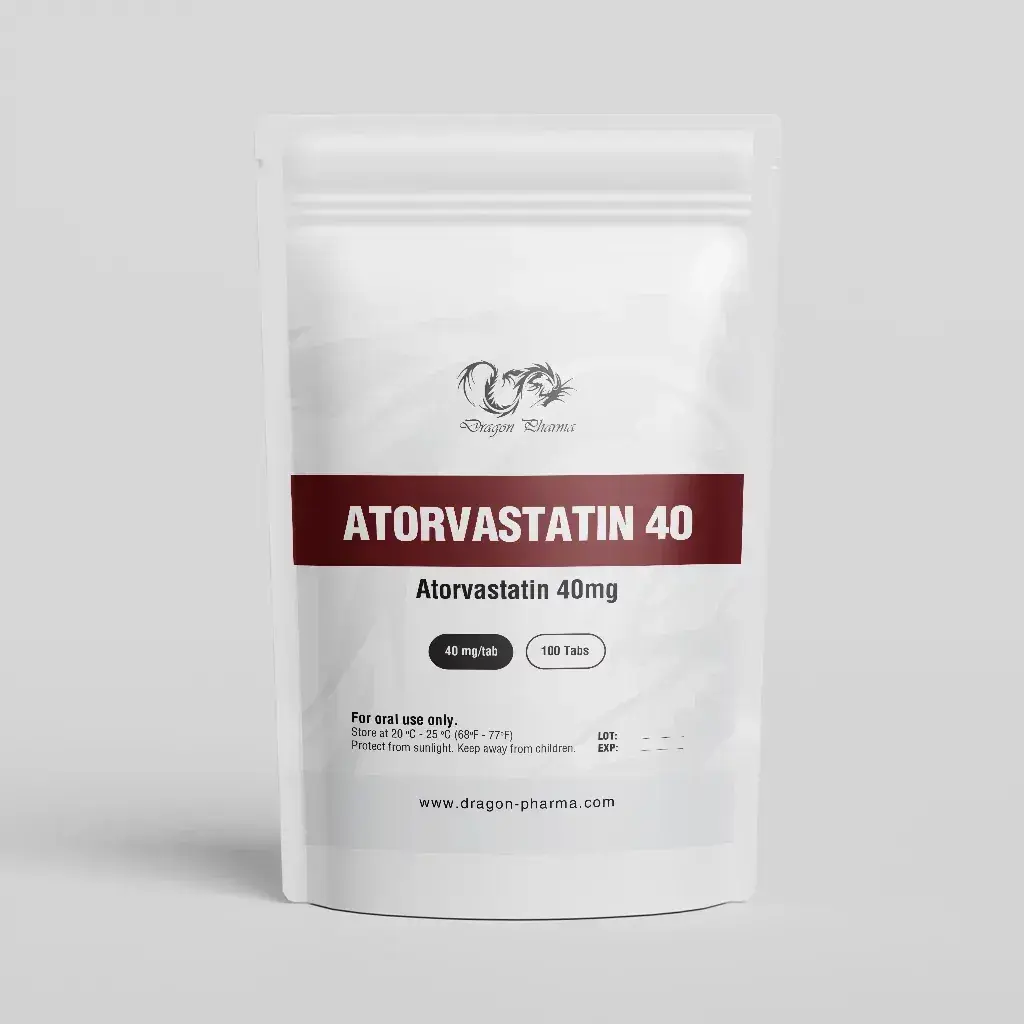
Atorvastatin 40 mg is an oral atorvastatin calcium tablet manufactured by Dragon Pharma and dosed at 40 mg per tablet in a 100-tablet package.
Atorvastatin 40 mg contains atorvastatin calcium, a synthetic lipid-lowering agent that belongs to the class of HMG-CoA reductase inhibitors, commonly known as statins . Atorvastatin works by inhibiting 3-hydroxy-3-methylglutaryl-coenzyme A (HMG-CoA) reductase, the enzyme responsible for the conversion of HMG-CoA to mevalonic acid, which is the rate-limiting step in cholesterol synthesis . This inhibition reduces cholesterol biosynthesis and upregulates LDL receptors on hepatocytes, leading to increased clearance of LDL cholesterol from the bloodstream .
Atorvastatin is FDA-approved for the prevention of cardiovascular disease and for the treatment of hyperlipidemia and mixed dyslipidemia . In adult patients without clinically evident coronary heart disease but with multiple risk factors, atorvastatin is indicated to reduce the risk of myocardial infarction, stroke, and revascularization procedures . It is also indicated as an adjunct to diet to reduce elevated total cholesterol, LDL-C, apolipoprotein B, and triglyceride levels, and to increase HDL-C in patients with primary hypercholesterolemia and mixed dyslipidemia .
Atorvastatin is a prescription medication that should only be used under the supervision of a qualified healthcare professional. Clinical guidelines recommend assessing LDL-C as early as 4 weeks after initiating therapy and adjusting the dosage if necessary . Non-medical use of atorvastatin for purposes other than its approved indications is not recommended and may carry health risks. The dosage range of atorvastatin is 10 to 80 mg once daily, with 40 mg representing a moderate-to-high intensity statin dose .
Atorvastatin is a synthetic HMG-CoA reductase inhibitor characterized by its long half-life, hepatic selectivity, and potent LDL-lowering effects. It is a substrate of hepatic transporters OATP1B1 and OATP1B3, and is metabolized primarily by CYP3A4 .
Atorvastatin binds to HMG-CoA reductase at the same site as the reduced HMG-CoA reaction intermediate that is formed during catalysis. Structure-activity relationship studies have demonstrated that atorvastatin is held in place by similar chemical interactions to this intermediate, effectively blocking the enzyme's activity . Cholesterol biosynthesis accounts for approximately 80% of cholesterol in the body, and inhibiting this process significantly lowers cholesterol levels .
The pharmacokinetics of atorvastatin are well characterized. Atorvastatin has a half-life of approximately 14 hours, though the half-life of inhibitory activity for HMG-CoA reductase is 20 to 30 hours due to the presence of active metabolites . It is a substrate of the hepatic transporters OATP1B1 and OATP1B3, as well as the efflux transporter BCRP, which may limit intestinal absorption and biliary clearance . Atorvastatin is metabolized by cytochrome P450 3A4 (CYP3A4) .
Atorvastatin has a unique structure and hepatic selectivity that explain its greater LDL-lowering potency compared to other HMG-CoA reductase inhibitors . In clinical trials, atorvastatin 10-80 mg/day lowered LDL-C by 35-61% and triglyceride concentrations by 14-45% . In comparative trials, atorvastatin showed greater reductions in total cholesterol, LDL-C, and triglycerides compared with pravastatin, simvastatin, or lovastatin .
Atorvastatin is distinguished by its long half-life and potent LDL-lowering effects. Its hepatic selectivity and unique structure contribute to its efficacy in reducing cardiovascular risk .
Dragon Pharma offers multiple compounds discussed in bodybuilding and health contexts. Atorvastatin's lipid-lowering mechanism contrasts with anabolic steroids such as Anavar 50 or Winstrol 50, which can adversely affect lipid profiles and may necessitate lipid management in some individuals. It is also distinct from ancillary compounds such as Arimidex or Aromasin, which are used for estrogen management rather than cholesterol reduction. Atorvastatin is a prescription medication for cardiovascular risk reduction and is not a performance-enhancing compound .
The distinction between Atorvastatin and these compounds is one of purpose: atorvastatin addresses lipid management, not muscle growth or hormonal regulation directly.
The information below is provided for educational reference only. Atorvastatin is a prescription medication; medical use requires appropriate diagnosis, clinical supervision, and ongoing monitoring. Non-medical use falls outside approved indications and is not recommended.
In medically supervised settings, the recommended starting dose of atorvastatin is 10 or 20 mg once daily. Patients who require a large reduction in LDL-C (more than 45%) may be started at 40 mg once daily . The dosage range of atorvastatin is 10 to 80 mg once daily, with 40 mg representing a moderate-to-high intensity statin dose . Atorvastatin 40 mg tablets allow for flexible dosing in accordance with clinical response and treatment goals.
| Use Case | Common Reference Range | Frequency |
|---|---|---|
| Primary hypercholesterolemia (medical) | 10–80 mg / day | Once daily |
| Patients requiring >45% LDL-C reduction | 40 mg / day starting dose | Once daily |
| Pediatric HeFH (10-17 years) | 10–20 mg / day | Once daily |
In clinical practice, atorvastatin is often used as part of a comprehensive lipid management strategy. The 2025 U.S. Department of Veterans Affairs and U.S. Department of Defense Clinical Practice Guideline for Lipid Management suggests high-dose statins for secondary prevention in higher-risk patients who are willing to intensify treatment, following a discussion of risks and benefits . Atorvastatin may be combined with other lipid-lowering therapies such as ezetimibe or PCSK9 inhibitors in patients who require additional LDL-C reduction .
When used in conjunction with certain other medications, dosage modifications of atorvastatin may be required. For example, in patients taking clarithromycin or itraconazole, the dose should not exceed 20 mg once daily .
Atorvastatin is generally well tolerated, but like all statins, it carries a risk of myopathy and rhabdomyolysis. The risk of statin-induced myopathy is dose-related, and symptoms typically resolve upon drug discontinuation . Persistent elevations in serum transaminases occurred in 0.7% of patients who received atorvastatin in clinical trials, and the incidence of these abnormalities was 0.2%, 0.2%, 0.6%, and 2.3% for 10, 20, 40, and 80 mg, respectively . Liver enzyme testing is recommended before initiating therapy and when clinically indicated thereafter .
Increases in HbA1c and fasting serum glucose levels have been reported with statin use . Patients should be instructed to promptly report any unexplained muscle pain, tenderness, or weakness, particularly if accompanied by malaise or fever .
Atorvastatin is a prescription medication. The information above is for educational reference and does not constitute medical advice. Any use of atorvastatin should be under the supervision of a qualified healthcare professional.
Atorvastatin is a prescription medication that can affect liver function, muscle tissue, and glucose metabolism. Medical use requires appropriate diagnosis and clinical supervision .
Atorvastatin is contraindicated in patients with acute liver failure or decompensated cirrhosis . It is also contraindicated in patients with hypersensitivity to atorvastatin or any of its excipients. Hypersensitivity reactions including anaphylaxis, angioneurotic edema, erythema multiforme, Stevens-Johnson syndrome, and toxic epidermal necrolysis have been reported .
Atorvastatin is contraindicated in women who are or may become pregnant. Statins may cause fetal harm when administered to a pregnant woman. Atorvastatin should be administered to women of childbearing potential only when such patients are highly unlikely to conceive and have been informed of the potential hazards .
Atorvastatin has no approved indication for bodybuilding or performance enhancement. Non-medical use falls outside approved indications and carries health risks including myopathy, hepatotoxicity, and potential drug interactions. Product strength and laboratory verification do not establish safety for non-medical use.
Myopathy and Rhabdomyolysis: Atorvastatin may cause myopathy (muscle pain, tenderness, or weakness associated with elevated creatine kinase) and rhabdomyolysis. Acute kidney injury secondary to myoglobinuria and rare fatalities have occurred as a result of rhabdomyolysis in patients treated with statins. Risk factors include age 65 years or greater, uncontrolled hypothyroidism, renal impairment, concomitant use with certain other drugs, and higher atorvastatin dosage .
Immune-Mediated Necrotizing Myopathy (IMNM): Rare reports of IMNM, an autoimmune myopathy, have been reported with statin use. IMNM is characterized by proximal muscle weakness and elevated serum creatine kinase that persists despite discontinuation of statin treatment .
Hepatic Dysfunction: Increases in serum transaminases have occurred, some persistent. Rare reports of fatal and non-fatal hepatic failure have occurred. Consider testing liver enzymes before initiating therapy and as clinically indicated thereafter .
Increases in HbA1c and Fasting Serum Glucose Levels: Increases in HbA1c and fasting serum glucose levels have been reported with statin use .
Common adverse reactions: Nasopharyngitis, arthralgia, diarrhea, pain in extremity, urinary tract infection, and nausea have been reported in clinical trials .
Atorvastatin should be used with caution in patients with a history of liver disease or significant alcohol intake. Liver function tests should be performed before initiating therapy and as clinically indicated thereafter. Patients who develop symptoms suggestive of liver injury should be evaluated, and if serious hepatic injury with clinical symptoms and/or hyperbilirubinemia or jaundice occurs, atorvastatin should be promptly discontinued .
Patients with risk factors for myopathy, including renal impairment, uncontrolled hypothyroidism, and advanced age, should be monitored closely .
Medically supervised atorvastatin therapy typically involves assessment of LDL-C as early as 4 weeks after initiating therapy, with dosage adjustment if necessary . Liver enzyme testing is recommended before initiation and when clinically indicated thereafter. Patients should be monitored for muscle symptoms, and creatine kinase levels should be assessed if myopathy is suspected .
Store at controlled room temperature (20° to 25°C) away from direct light and moisture. Keep the product in its original packaging and out of the reach of children.
Atorvastatin 40 mg is supplied through the Dragon Pharma distribution chain and shipped in original manufacturer packaging with discreet, privacy-focused handling.
The outer shipping package remains discreet, with privacy-focused handling and no unnecessary external product details. Products are supplied through the Dragon Pharma distribution chain.
To verify your Atorvastatin 40 mg product, cross-check the security features on the packaging against Dragon Pharma's official presentation. Original packaging helps reinforce product legitimacy.
For complete delivery details, tracking policy, and reshipment terms, please see our Shipping Info page.
Proper storage conditions help preserve tablet integrity and overall product stability throughout shelf life.
Store at controlled room temperature (20° to 25°C) with excursions permitted to 15° to 30°C (59° to 86°F). Maintaining stable conditions helps preserve the integrity of the tablets.
Keep the tablets in their original packaging until use. Do not use if the packaging appears compromised or if the tablets show signs of degradation.
Keep out of reach of children.
Answers to common questions about Atorvastatin 40 mg, its mechanism, dosing, and safety.
Atorvastatin 40 mg contains atorvastatin calcium, a prescription statin. It is FDA-approved to reduce the risk of myocardial infarction, stroke, revascularization procedures, and angina in adults with multiple risk factors for coronary heart disease. It is also indicated as an adjunct to diet to reduce elevated total cholesterol, LDL-C, and triglycerides in patients with hyperlipidemia .
Atorvastatin is taken orally once daily at any time of the day, with or without food . The dosage range is 10 to 80 mg once daily, and the starting dose and maintenance doses should be individualized according to patient characteristics and treatment response .
Atorvastatin inhibits HMG-CoA reductase, the enzyme responsible for the conversion of HMG-CoA to mevalonic acid, which is the rate-limiting step in cholesterol synthesis . This inhibition reduces cholesterol production and increases the clearance of LDL cholesterol from the bloodstream. Atorvastatin lowers total cholesterol, LDL-C, apolipoprotein B, and triglycerides while increasing HDL-C .
LDL-C should be assessed as early as 4 weeks after initiating atorvastatin therapy, and the dosage adjusted if necessary . The half-life of atorvastatin is approximately 14 hours, though the half-life of inhibitory activity for HMG-CoA reductase is 20 to 30 hours due to active metabolites .
The half-life of atorvastatin is approximately 14 hours, but the half-life of inhibitory activity for HMG-CoA reductase is 20 to 30 hours due to the presence of active metabolites .
There is no universally "best" statin. Atorvastatin is distinguished by its potency and long half-life, and it has been shown to produce greater reductions in LDL-C compared with several other statins . Other statins such as rosuvastatin, simvastatin, and pravastatin have different potency and pharmacokinetic profiles. The appropriate choice depends on the clinical context and patient characteristics.
Atorvastatin and simvastatin are both HMG-CoA reductase inhibitors, but atorvastatin has a longer half-life and has been shown to produce greater reductions in LDL-C and triglycerides compared with simvastatin . Atorvastatin also has a different metabolic profile, being primarily metabolized by CYP3A4 .
Atorvastatin and rosuvastatin are both high-intensity statins, but they have different pharmacokinetic properties. Rosuvastatin is less dependent on CYP3A4 metabolism, which may result in fewer drug interactions. Both are effective for LDL-C reduction, and the choice between them depends on patient-specific factors.
The dosage range of atorvastatin is 10 to 80 mg once daily . A 40 mg dose represents a moderate-to-high intensity statin dose, typically used in patients who require substantial LDL-C reduction or who have higher cardiovascular risk . Atorvastatin 40 mg is labeled at 40 mg per tablet.
Atorvastatin 40 mg is labeled at 40 mg of atorvastatin per tablet. It is supplied in a 100-tablet package, giving 4,000 mg of total labeled atorvastatin content.
Atorvastatin may cause myopathy, which is defined as muscle pain, tenderness, or weakness associated with elevated creatine kinase levels . The risk of statin-induced myopathy is dose-related, and symptoms typically resolve upon drug discontinuation. Patients should promptly report any unexplained muscle pain, tenderness, or weakness, particularly if accompanied by malaise or fever .