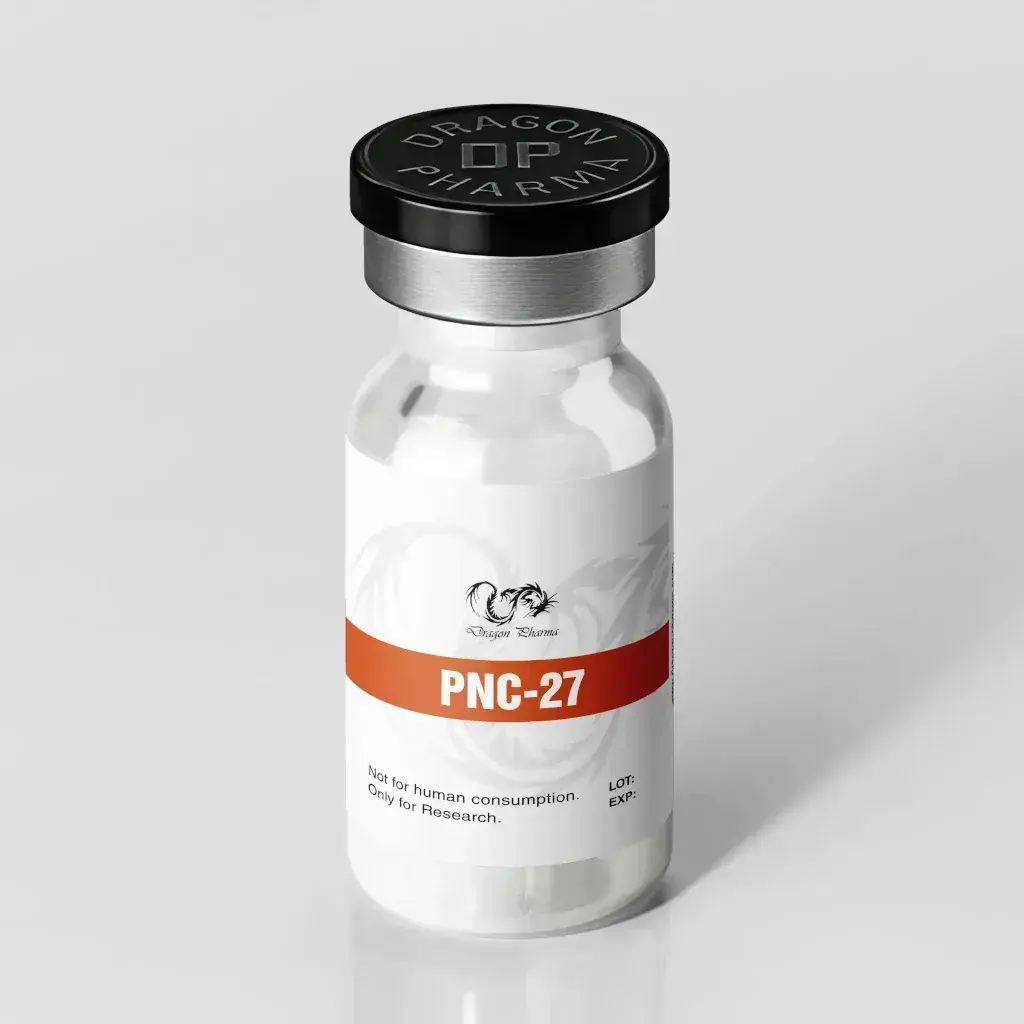
PNC-27 Injectable
PNC-27 10 mg contains a synthetic chimeric peptide composed of the p53 transactivation domain (residues 12–26) linked to a membrane-residency peptide (MRP) sequence derived from Antennapedia. The peptide sequence (PPLSQETFSDLWKLLKKWKMRRNQFWVKVQRG) enables binding to the HDM-2 protein in cancer cell membranes, inducing transmembrane pore formation and rapid necrotic cell death.
In research contexts, PNC-27 is investigated for its selective cytotoxicity against cancer cells that express elevated levels of membrane-bound HDM-2, while sparing normal cells that lack this membrane expression. Preclinical studies have demonstrated efficacy against pancreatic cancer, acute myeloid leukemia, and ovarian cancer cell lines, as well as tumor regression in mouse models.
In bodybuilding and performance-enhancement contexts, PNC-27 has **no documented use or rationale**. It is an anticancer research peptide, not an anabolic or metabolic agent. The FDA has issued a public warning against its use, citing lack of proven efficacy in humans, potential contamination, and serious adverse effects. Any non-research use falls outside any conceivable approved indication.
Research Properties of PNC-27 10 mg
- Chimeric p53-penetratin peptide targeting membrane-bound HDM-2
- Induces transmembrane pore formation and cancer cell necrosis
- Selective cytotoxicity against cancer cells vs. normal cells in vitro
- Investigated in pancreatic cancer, AML, and ovarian cancer models
- 10 mg per vial for research applications
Chimeric p53-Penetratin Anticancer Peptide
PNC-27 was designed to exploit the differential expression of HDM-2 (human double minute 2) on the surface of cancer cells versus normal cells. The peptide contains p53 residues 12–26 that adopt a native HDM-2-binding conformation, linked to a membrane-residency peptide that enables membrane interaction and pore formation.
In vitro studies have demonstrated that PNC-27 induces 100% cell death in MIA-PaCa-2 pancreatic cancer cells within 90 minutes at 50 μg/mL. The mechanism involves binding to membrane-bound HDM-2, followed by dimerization and formation of transmembrane pores that cause rapid extrusion of intracellular contents (necrosis).
In vivo studies have shown that PNC-27 at 40 mg/kg intraperitoneally reduces AML engraftment and prolongs survival in mouse models. The peptide has demonstrated efficacy against chemotherapy-resistant cancers and primary tumors in preclinical models.
Defining Characteristic
Membrane Pore Formation via HDM-2 Binding
PNC-27's defining mechanism is its ability to bind membrane-bound HDM-2 on cancer cells and form transmembrane pores, causing rapid necrotic cell death without requiring functional p53.
PNC-27 10 mg vs Other Dragon Pharma Preparations
Dragon Pharma offers several peptides referenced in oncology and cell death research. PNC-27 is distinct from PE 22-28 (a p53-derived peptide with different mechanism) and from ARA-290 (an innate repair receptor agonist). PNC-27's membrane pore-forming mechanism is unique among these compounds.
Typical Dosage Ranges
Common reference ranges for PNC-27 in human contexts are **not well characterized** because no human clinical trials have been conducted. Preclinical animal studies used 40 mg/kg intraperitoneally once daily for 2–3 weeks. In vitro studies used 50 μg/mL for 0–3 hours. These doses are not translatable to human use without clinical data.
| Use Case |
Common Reference Range |
Frequency |
| In vitro research |
50 μg/mL |
0–3 hours |
| In vivo (mouse models) |
40 mg/kg |
Daily for 2–3 weeks |
| Human use |
Not established |
No clinical data |
Reconstitution & Handling
PNC-27 10 mg is supplied as a lyophilized powder requiring reconstitution. Bacteriostatic Water is commonly referenced for reconstituting research peptides. A 10 mg vial reconstituted with 2 mL yields a concentration of 5 mg/mL. Standard sterile technique and peptide handling practices should be observed. Store lyophilized powder at -20°C and reconstituted solution at 2–8°C.
Stacking & Research Considerations
No established research exists on combining PNC-27 with other peptides. Its membrane pore-forming mechanism is distinct from other Dragon Pharma preparations. Concurrent use with MDM2 inhibitors could theoretically compete for binding. Any combination research would be exploratory and unsupported by data.
Important
Individual Response Varies
The information above is for educational reference and does not constitute medical advice. PNC-27 has not been evaluated by the FDA for safety or efficacy in humans, and the FDA has warned against its use.
Important Safety Information
PNC-27 has never been tested in human clinical trials. No Phase 1 safety data, no human pharmacokinetic studies, and no long-term safety follow-up exist. In 2017, the FDA warned that PNC-27 products may contain Variovorax paradoxus bacteria, which can cause serious infections, especially in immunocompromised individuals.
Important
FDA Warning
The FDA has issued a public warning against the use of PNC-27. It is not approved for any indication, may contain harmful bacteria, and has not demonstrated safety or efficacy in humans.
Potential Adverse Effects
Theoretical safety concerns include off-target membrane disruption in normal tissues at high systemic concentrations. PNC-27 induces necrotic cell death, which releases damage-associated molecular patterns (DAMPs) that can trigger inflammatory responses. Immunogenicity risk is present due to the non-human Antennapedia-derived sequence. No human safety profile has been established.
Conditions Requiring Medical Evaluation
No formal contraindication list exists for human use because no approved indication exists. Individuals with immunocompromised status should be particularly cautious due to contamination risks identified by the FDA. Pregnancy and breastfeeding are contraindications due to lack of safety data.
Monitoring Considerations
No standardized monitoring protocol exists for PNC-27. If used in any research context, monitoring of inflammatory markers, immune function, and potential hypersensitivity reactions may be considered, though no reference ranges for non-medical contexts are established.
Product Care
Storage & Handling
Store lyophilized powder at -20°C, protected from light and moisture. After reconstitution, store at 2–8°C and use within a reasonable timeframe. Do not freeze reconstituted solution. Discard if solution becomes cloudy or develops particulate matter.
Keep all research peptides and injectable products out of the reach of children.
USA Domestic 3–5 business days
International 10–15 business days
Order Processing 24–48 business hours
Tracking Provided after dispatch
Direct Supply
Discreet Delivery & Original Packaging
The outer shipping package remains discreet, with no external product details. Products are supplied through the official Dragon Pharma distribution chain.
What to Expect
- Orders are processed after payment confirmation
- USA Domestic shipping is typically faster when local stock is available
- International orders include tracking, though update frequency may vary by destination
- Multiple warehouses may result in separate shipments when applicable
Authenticity Verification
To verify your PNC-27 10 mg product, use the security code on the vial label and cross-check it on the official Dragon Pharma site. Original packaging and batch documentation help reinforce product legitimacy.
For complete delivery details, tracking policy, and reshipment terms, please see our Shipping Info page.
Recommended Conditions
Store lyophilized powder at -20°C, protected from light and moisture. The unopened vial should be kept under conditions that preserve the peptide's structural integrity until reconstitution.
Once reconstituted, PNC-27 solution should be stored at 2–8°C and used within a reasonable timeframe. Do not freeze reconstituted solution. Discard if solution becomes cloudy or develops particulate matter.
Keep out of reach of children. Follow proper handling practices for research peptides and use appropriate sterile technique during reconstitution.
Quick Reference
Do & Don't
- Do store lyophilized powder at -20°C
- Do protect from light and moisture
- Do use reconstituted solution within a reasonable timeframe
- Don't freeze reconstituted solution
- Don't expose to excessive heat
- Don't use if powder appears discolored
What is PNC-27 10 mg used for?
PNC-27 10 mg is a research peptide supplied as a lyophilized powder. It contains a chimeric p53-penetratin peptide investigated for selective cytotoxicity against cancer cells expressing membrane-bound HDM-2. There is no FDA-approved human indication for PNC-27.
How often should PNC-27 10 mg be administered?
Common reference ranges for PNC-27 in human contexts are not well characterized because no human clinical trials have been conducted. Preclinical animal studies used 40 mg/kg intraperitoneally once daily for 2–3 weeks. These doses are not translatable to human use without clinical data.
Does PNC-27 10 mg require PCT?
PNC-27 is not an anabolic steroid and does not suppress endogenous testosterone production. Post-cycle therapy designed for steroid cycles is not applicable. Its mechanism involves membrane pore formation in cancer cells, not hormonal pathways.
What does PNC-27 do?
PNC-27 binds to HDM-2 protein expressed on the membranes of cancer cells, inducing transmembrane pore formation and rapid necrotic cell death. This mechanism is selective for cancer cells that overexpress membrane HDM-2, sparing normal cells that lack this expression.
How long does PNC-27 take to work?
In vitro studies have shown that PNC-27 induces 100% cell death in MIA-PaCa-2 pancreatic cancer cells within 90 minutes at 50 μg/mL. In vivo effects in mouse models are observed over 2–3 weeks of daily administration. No human onset timeline exists.
Is PNC-27 the best anticancer peptide?
No single anticancer peptide is universally superior. PNC-27's research profile focuses on membrane pore formation via HDM-2 binding, while other peptides have different mechanisms. PNC-27 has not been tested in humans and the FDA has warned against its use.
What is the difference between PNC-27 and PNC-28?
PNC-27 contains p53 residues 12–26 linked to penetratin, while PNC-28 contains p53 residues 17–26 linked to penetratin. Both induce cancer cell necrosis through membrane pore formation, but their p53-derived sequences differ. Both are research peptides with no human approval.
What is the difference between PNC-27 and PE 22-28?
PE 22-28 is a p53-derived peptide with a different sequence and mechanism. PNC-27's unique feature is its membrane pore-forming activity via HDM-2 binding. These compounds have distinct research profiles.
Is 10 mg of PNC-27 a lot?
10 mg is the total labeled content of the PNC-27 10 mg vial. Because no standardized human dosage exists for this research peptide, the milligram amount cannot be classified as high or low relative to established protocols. Preclinical doses are in the mg/kg range.
What strength is PNC-27 10 mg?
PNC-27 10 mg by Dragon Pharma contains 10 mg of PNC-27 per vial as a lyophilized powder. The vial size is 2 mL. This is a research presentation.
Can PNC-27 be stacked with other peptides?
There is no established research on combining PNC-27 with other peptides. Its membrane pore-forming mechanism is distinct from other compounds, and concurrent use with MDM2 inhibitors could theoretically compete for binding.
No reviews found
Please log in to write PNC-27 10 mg review.