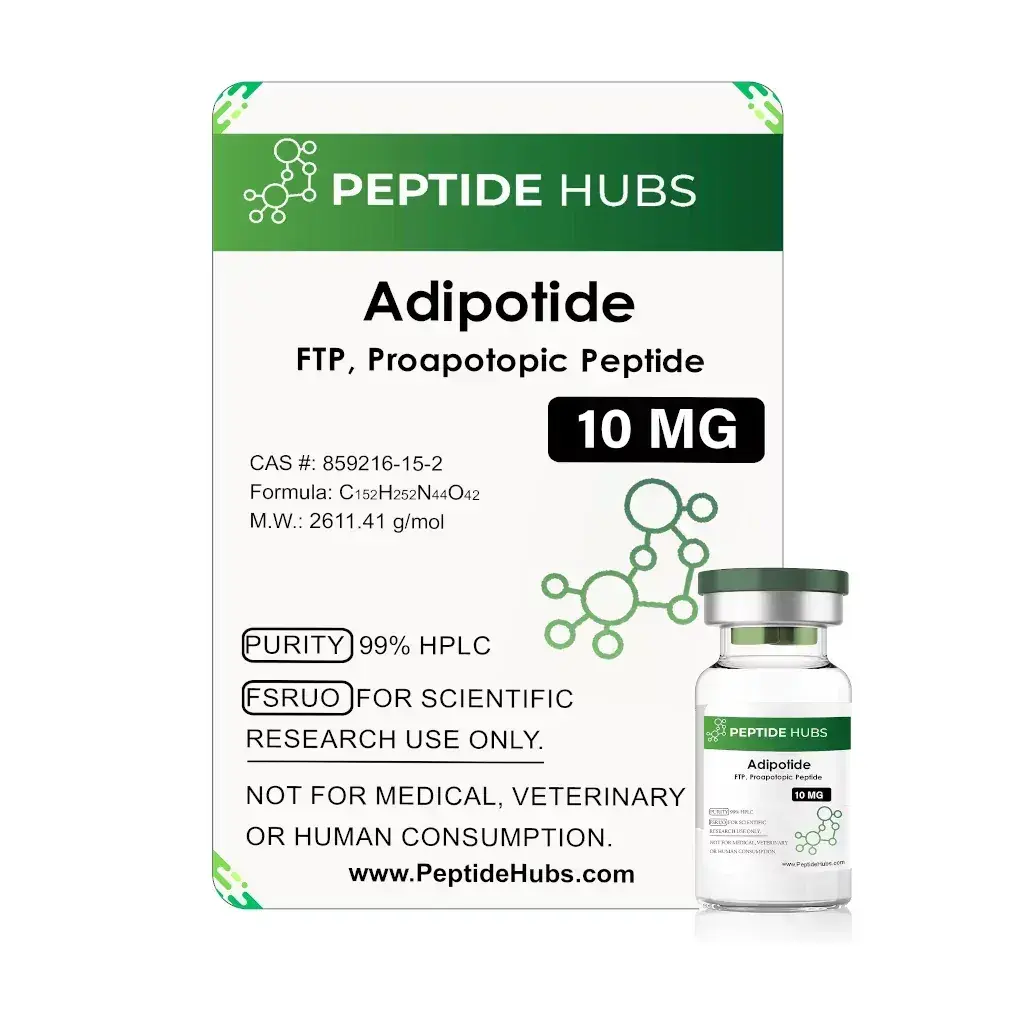
Adipotide (FTPP) 10 mg is a lyophilized research peptide manufactured by Peptide Hubs and supplied as a 10 mg/vial powder in a 2 mL vial.
Adipotide (FTPP) 10 mg contains a synthetic chimeric peptidomimetic known as prohibitin-targeting peptide 1 (TP01). This compound consists of two functional domains: a cyclic homing sequence (CKGGRAKDC) that binds to prohibitin on the vasculature of white adipose tissue, and a proapoptotic D-amino acid sequence (D(KLAKLAK)2) designed to trigger programmed cell death once internalized.
Adipotide was investigated as an anti-obesity candidate in preclinical research. In obese rhesus macaques, daily subcutaneous administration at 0.43 mg/kg for 28 days produced approximately 10.6% body weight reduction and 38.7% reduction in total body fat percentage. These findings attracted attention because they suggested a novel approach—targeting the blood supply that supports adipose tissue rather than modulating appetite or metabolism through receptor signaling.
However, the same studies identified dose-dependent renal toxicity, with evidence of reversible renal tubular degeneration. A subsequent Phase I clinical trial was terminated, and clinical development was discontinued. Adipotide is not approved for human use by any regulatory authority and has no established human dosing or safety profile.
Adipotide (FTPP) 10 mg is supplied as a lyophilized (freeze-dried) powder in a 2 mL vial. Reconstitution with an appropriate solvent is required before use in research contexts.
Adipotide is a chimeric peptidomimetic with a molecular weight of approximately 2,460 Da. Its structure consists of a cyclic homing domain linked to a D-amino acid proapoptotic sequence via a glycine-glycine linker.
Adipotide belongs to a class of research compounds known as vascular-targeting peptidomimetics. Unlike GLP-1 receptor agonists or other metabolic peptides that modulate appetite or insulin signaling, adipotide is designed to physically disrupt the blood vessels supplying white adipose tissue.
The homing domain (CKGGRAKDC) was identified through in vivo phage display and binds to prohibitin, a protein expressed on the surface of endothelial cells in white adipose tissue vasculature. After binding and internalization, the proapoptotic domain (D(KLAKLAK)2) interacts with mitochondrial membranes, disrupting their integrity and triggering apoptosis.
In preclinical studies, this mechanism produced rapid weight loss and fat reduction in obese mice and rhesus monkeys. However, prohibitin is not expressed exclusively on adipose vasculature—the renal system also takes up the compound, and the proapoptotic payload causes collateral damage to renal tissue. This toxicity profile was the primary reason clinical development was discontinued.
Adipotide is distinguished by its two-part design: a homing domain that targets prohibitin on adipose vasculature, and a proapoptotic effector domain that triggers cell death once internalized. This “hunter-killer” architecture is fundamentally different from receptor-modulating peptides.
Peptide Hubs offers a range of research peptides targeting different aspects of metabolic and endocrine biology. Within this lineup, AOD 9604 is commonly discussed alongside adipotide for its fat-loss research applications, though AOD-9604 operates through a fragment of human growth hormone rather than vascular targeting. The two compounds address fat metabolism through fundamentally different mechanisms.
For research focused on appetite regulation and metabolic signaling rather than vascular targeting, Survodutide represents a different approach entirely, acting as a dual GLP-1/glucagon receptor agonist. These peptides are not interchangeable and carry very different risk profiles.
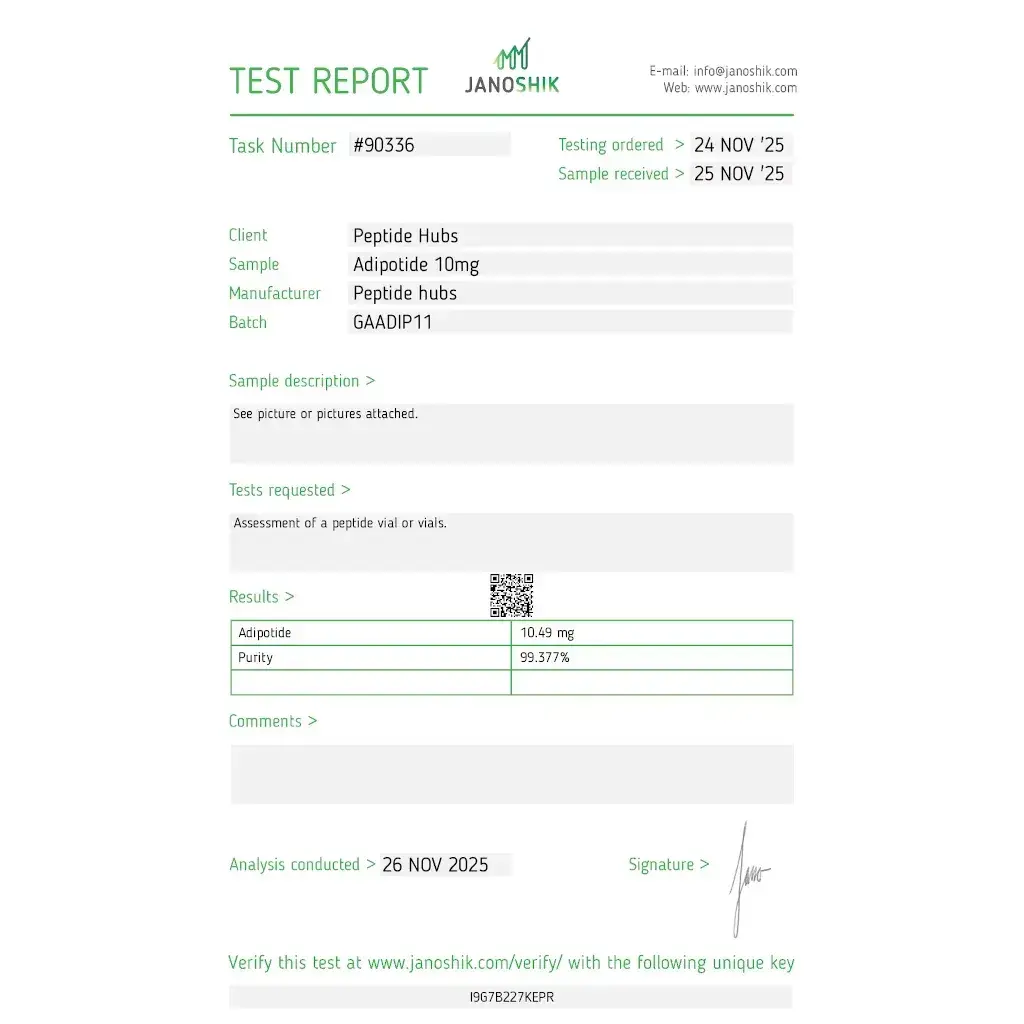
Published laboratory reports for Adipotide (FTPP) 10 mg are shown below with the test date and measured content.
 View Report
Laboratory results apply to the specific tested sample represented in each published report and should not be interpreted as a measurement of every vial or production batch.
The information below is provided for educational reference only. Adipotide is not approved for human use and has no established clinical dosing regimen. All doses referenced in research were administered under controlled preclinical or clinical trial conditions with intensive safety monitoring.
Because adipotide has no approved human indication and its clinical development was discontinued, there is no medically established dosage range. The published primate study used 0.43 mg/kg administered subcutaneously once daily for 28 days. A Phase I clinical trial used a dose-escalation design but was terminated, and specific doses were not publicly released.
| Use Case | Common Reference Range | Injection Frequency |
|---|---|---|
| Primate study (research only) | 0.43 mg/kg | Once daily, 28 days |
| Community protocol (anecdotal) | 0.25–0.5 mg/kg | Once daily, 2–4 weeks |
Community protocols reference daily subcutaneous injections for 2–4 weeks with weight-based dosing. These are anecdotal conventions, not evidence-based recommendations.
Adipotide (FTPP) 10 mg is supplied as a lyophilized powder and requires reconstitution before use. A 10 mg vial reconstituted with 1 mL of solvent yields a concentration of 10 mg/mL. Reconstituted peptide should be stored refrigerated and used within the recommended timeframe.
Unreconstituted powder should be stored sealed and protected from light. The compound is water-soluble.
Adipotide’s documented renal toxicity requires intensive monitoring in any research context. Baseline and mid-cycle assessment of renal function markers—including creatinine, cystatin C, and urinalysis with microalbumin—has been recommended in research protocols. Rising creatinine, new proteinuria, or falling eGFR are described as stop signals rather than dose-reduction signals.
Hydration is emphasized in research protocols due to the renal clearance pathway of the compound.
No human safety or efficacy data exists for adipotide. All dosage information is derived from animal research or community convention and should not be interpreted as medical guidance.
Adipotide is not approved for human use by any regulatory authority. Preclinical and clinical data indicate significant safety concerns, including dose-dependent renal toxicity.
Adipotide’s mechanism of action involves inducing apoptosis in the vasculature of white adipose tissue. However, prohibitin is not expressed exclusively on adipose vasculature, and the compound is taken up by the renal system as well, where the proapoptotic payload causes collateral damage to renal tissue.
In the primate study, mild, dose-dependent, reversible renal tubular degeneration was observed, accompanied by elevated serum creatinine that normalized post-treatment. A Phase I human clinical trial was terminated, and clinical development was discontinued.
Adipotide is sold as a research chemical with no approved human use. Given its mechanism of inducing cell death and documented organ toxicity in animal studies, non-medical use carries serious unknown risks.
Preclinical studies documented dose-dependent renal toxicity, including renal tubular degeneration and elevated serum creatinine. The kidney’s role in filtering and clearing the peptide is believed to contribute to this toxicity, as the proapoptotic domain causes collateral damage to renal tubular epithelial cells during excretion.
Injection site reactions are commonly reported in community discussions. Other theoretical concerns include effects on non-target tissues expressing prohibitin.
Given the documented renal toxicity, any research context involving adipotide should include comprehensive renal function assessment. Individuals with pre-existing kidney conditions should exercise extreme caution.
Research protocols have emphasized monitoring of renal function markers including creatinine, cystatin C, and urinalysis with microalbumin. Hydration is also emphasized due to the renal clearance pathway.
Store lyophilized powder sealed and protected from light and moisture. Once reconstituted, store refrigerated and use within the recommended timeframe. Keep out of reach of children.
Adipotide (FTPP) 10 mg is supplied through the official Peptide Hubs distribution chain and shipped in original manufacturer packaging with discreet handling.
The outer shipping package remains discreet, with privacy-focused handling. Products are supplied through the official Peptide Hubs distribution chain.
To verify your Adipotide (FTPP) 10 mg product, use the security code on the vial label and cross-check it on the Peptide Hubs official site. Original packaging and manufacturer presentation help reinforce product legitimacy.
For complete delivery details, tracking policy, and reshipment terms, please see our Shipping Info page.
Proper storage conditions help preserve peptide stability and integrity throughout shelf life.
Store lyophilized powder sealed and protected from light and moisture. For longer-term storage, refrigeration or freezing of the unreconstituted powder may be appropriate, though specific stability data for this product is limited.
Once reconstituted, store refrigerated and use within the recommended timeframe for peptide solutions. Avoid repeated temperature fluctuations.
Keep out of reach of children. Follow proper handling practices.
Answers to common questions about Adipotide (FTPP) 10 mg, prohibitin-targeting peptides, and research compound handling.
Adipotide (FTPP) 10 mg is a research peptide studied in preclinical models for targeted ablation of white adipose tissue vasculature. It is not approved for human use and has no established clinical application.
No approved human dosing schedule exists. The published primate study used once-daily subcutaneous injections for 28 days. Community protocols reference similar daily schedules for 2–4 weeks.
Adipotide does not suppress endogenous testosterone production and does not require post-cycle therapy in the way anabolic steroids do. However, its documented renal toxicity makes any non-medical use a serious safety concern.
Adipotide is a bifunctional peptidomimetic. Its homing domain binds prohibitin on white adipose tissue vasculature, and its proapoptotic domain triggers cell death once internalized. This mechanism was designed to destroy the blood supply feeding fat tissue.
In the primate study, weight loss and fat reduction were observed over a 28-day treatment period. No human timeline has been established because clinical development was discontinued.
Adipotide is not a “best” option for any application because it was never approved for human use and was discontinued due to safety concerns. Its mechanism of inducing cell death in blood vessels carries risks that are fundamentally different from receptor-modulating compounds.
Adipotide targets adipose vasculature through prohibitin binding and apoptosis induction, while AOD 9604 is a growth hormone fragment studied for lipolytic effects through different pathways. They are not comparable in mechanism or risk profile.
Adipotide works by destroying blood vessels feeding fat tissue, while Survodutide is a dual GLP-1/glucagon receptor agonist that modulates appetite and metabolism through receptor signaling. These mechanisms are fundamentally different.
10 mg represents the full vial content, not a single dose. Research protocols have used weight-based dosing (e.g., 0.43 mg/kg in primates), meaning a single vial could provide multiple doses depending on body weight.
Adipotide (FTPP) 10 mg is labeled at 10 mg of adipotide per vial. It is supplied as a lyophilized powder in a 2 mL vial. The lab report shows a measured content of 10.49 mg.
Yes. A published laboratory report dated November 26, 2025 measured Adipotide (FTPP) 10 mg at 10.49 mg, equivalent to 104.9% of its 10 mg label claim. The batch number is GAADIP11.
Store the lyophilized powder sealed and protected from light and moisture. Once reconstituted, refrigerate and use within the recommended timeframe for peptide solutions.