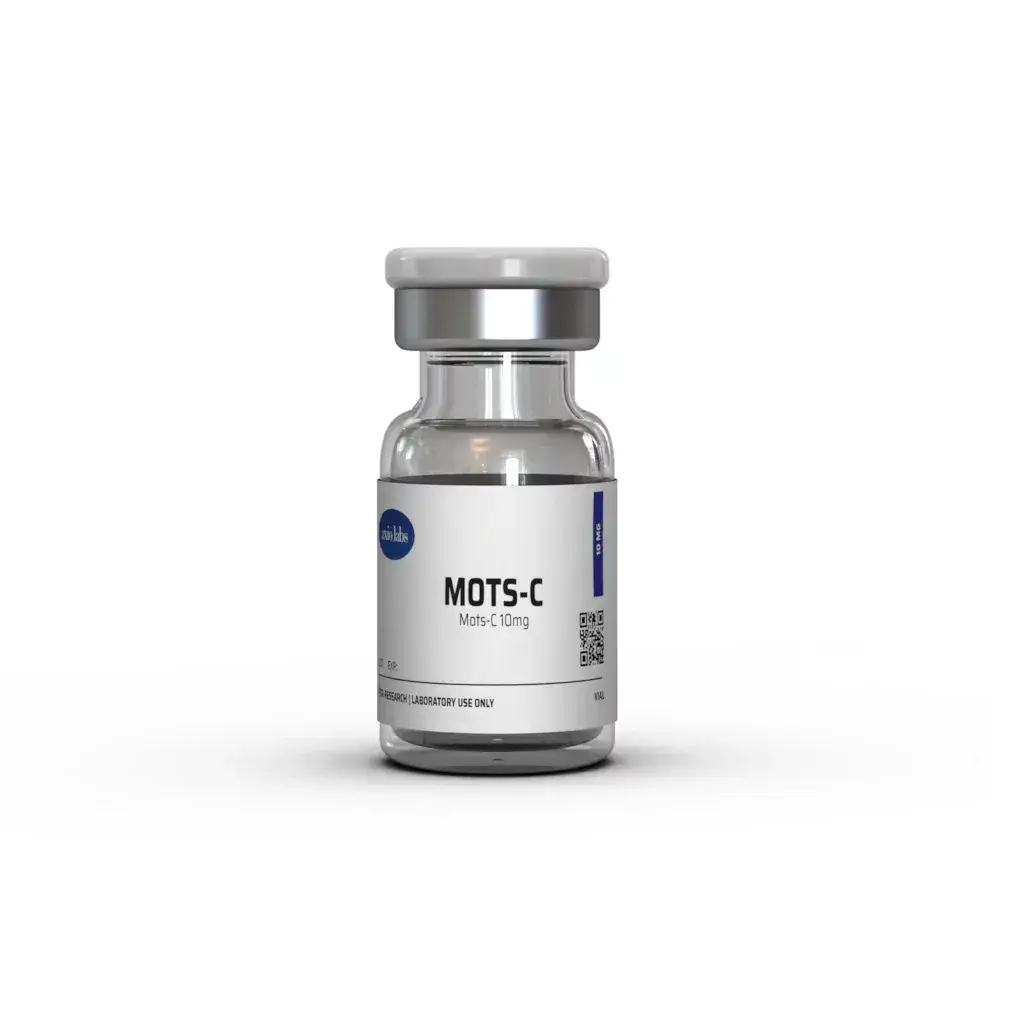
MOTS-c 10 mg is a lyophilized research peptide manufactured by Axiolabs containing MOTS-c (mitochondrial open reading frame of the 12S rRNA-c) at 10 mg per vial, supplied as a powder for reconstitution in a 2 mL vial.
MOTS-c 10 mg contains the synthetic 16-amino-acid mitochondrial-derived peptide known as MOTS-c. Unlike most peptides that are encoded in the nuclear genome, MOTS-c is encoded within the mitochondrial DNA's 12S rRNA region and functions as a retrograde signaling molecule that communicates mitochondrial status to the nucleus.
In research settings, MOTS-c has been studied for its roles in metabolic regulation, insulin sensitivity, and cellular stress responses. Animal studies demonstrate that MOTS-c activates AMPK, a central energy-sensing pathway, and regulates genes involved in antioxidant response and metabolic homeostasis. A Phase 2a clinical trial is currently evaluating MOTS-c in adults with prediabetes and excess weight or obesity, assessing insulin sensitivity improvements over 12 weeks of treatment.
In non-medical bodybuilding and fitness contexts, MOTS-c is commonly referenced for its exercise-mimetic properties, with users reporting enhanced workout capacity, improved energy levels, and support for metabolic conditioning. Such use falls outside approved indications, as no FDA-approved product exists for this compound. MOTS-c is on the WADA Prohibited List under category S4 (Metabolic Modulators).
MOTS-c 10 mg is supplied as a lyophilized powder in a 2 mL vial. Lyophilization preserves peptide stability during storage and transport. The powder requires reconstitution with an appropriate solvent before experimental use.
MOTS-c is a mitochondrial-derived peptide that acts as a metabolic regulator and retrograde signaling molecule between mitochondria and the nucleus.
MOTS-c is encoded by a short open reading frame within the mitochondrial 12S rRNA gene and consists of 16 amino acids. Its discovery highlighted the existence of functional peptides encoded by mitochondrial DNA, a concept that has expanded understanding of mitochondrial-to-nuclear communication.
The peptide's primary mechanism involves activation of AMPK, a cellular energy sensor that coordinates metabolic responses to exercise and nutrient availability. MOTS-c also translocates to the nucleus under metabolic stress, where it regulates expression of antioxidant response genes.
Research has explored MOTS-c in contexts including insulin resistance, obesity, exercise capacity, and age-related metabolic decline. A Phase 2a clinical trial is evaluating the compound's effects on insulin sensitivity in adults with prediabetes, representing the first substantial human clinical investigation of MOTS-c.
MOTS-c has no FDA-approved human product. A Phase 2a randomized, double-blind, placebo-controlled trial is ongoing to evaluate efficacy and safety in prediabetic adults. Outside of clinical research, the compound is available as a research chemical and is not intended for human use.
Axiolabs offers several research peptides with distinct mechanisms and applications. Ipamorelin is a growth hormone secretagogue that stimulates GH release, while TB 500 contains a thymosin beta 4 fragment with actin-binding properties. GHK-CU is a copper-binding tripeptide with different research applications.
Unlike GH-secretagogues and tissue-repair peptides, MOTS-c's primary research focus is metabolic regulation through the AMPK pathway. This mechanistic distinction makes it a unique addition to research protocols exploring mitochondrial function and metabolic health.
The information below is provided for educational reference only. MOTS-c is a research peptide with no approved human dosing. Non-medical use falls outside approved indications.
In non-medical research contexts, MOTS-c protocols are described in community discussions and educational resources. A common reference range for performance-oriented research is 5–10 mg per week, administered through subcutaneous injection. Some users reference a conservative approach starting at 1 mg daily, with options to increase frequency for those seeking more pronounced metabolic effects.
| Use Case | Common Reference Range | Frequency |
|---|---|---|
| Beginner research protocol | 1 mg | Daily |
| Standard performance protocol | 5 mg | 2–3 times weekly |
| Aggressive research protocol | 5 mg | Every other day |
These ranges represent community-reported practices and are not derived from completed human clinical trials. MOTS-c dosing in controlled research settings has not been established for non-medical applications.
In non-medical research discussions, MOTS-c is sometimes referenced alongside other compounds with complementary mechanisms. Because MOTS-c activates AMPK and supports metabolic pathways, it is discussed in contexts where users are pursuing metabolic conditioning or body recomposition goals.
Unlike anabolic steroids or GH-secretagogues, MOTS-c does not require post-cycle therapy for hormonal recovery. Research protocols typically include an off-cycle period of 4–8 weeks following an 8–12 week active phase to assess individual response and avoid continuous pathway stimulation.
In community-reported experiences, some users describe injection site reactions or histamine-type responses with MOTS-c. Starting with a lower dose and titrating gradually is commonly recommended to assess individual tolerance. Because MOTS-c activates AMPK, individuals using blood glucose-lowering medications should be aware of potential additive effects on glucose levels.
MOTS-c has no established human dosing for non-medical use. Any information about non-medical use is derived from user-reported practices and is not validated by controlled clinical research. This information does not constitute medical advice.
MOTS-c is a research compound with limited human safety data. No FDA-approved product exists, and clinical experience is currently limited to an ongoing Phase 2a trial.
MOTS-c is not approved for human use by the FDA. The compound is intended for research purposes only. No prescribing information, established contraindications, or validated safety profile exists for human administration of MOTS-c.
Preclinical studies in animal models have not reported organ toxicity, immunogenicity, or malignant transformation at the doses studied. However, these findings do not substitute for prospective safety monitoring in human use.
Non-medical use of MOTS-c falls outside approved indications and carries unknown risks. Product purity does not establish that non-medical use is safe or appropriate for an individual.
Because human safety data is limited, the full adverse effect profile of MOTS-c is unknown. Theoretical concerns include hypoglycemia in individuals using concurrent glucose-lowering therapy, as MOTS-c may enhance insulin sensitivity. Injection site reactions, including localized redness, swelling, or induration, are common to subcutaneous peptide therapies and are generally mild and self-limiting.
Some community users have reported histamine-type reactions that may worsen with continued use. Gradual titration is commonly recommended to assess tolerance.
Theoretical concerns exist around immune activation given MOTS-c's interactions with immune cell metabolism, though no adverse immune effects have been reported in available animal safety studies.
No formal contraindications exist for MOTS-c because no approved product or prescribing label exists. Precautionary considerations based on the compound's known mechanisms include active malignancy, pregnancy or breastfeeding, severe organ dysfunction, and concurrent use of blood glucose-lowering medications.
Competitive athletes should be aware that MOTS-c is prohibited by the World Anti-Doping Agency (WADA) under category S4 as an AMPK activator. Its use by athletes subject to anti-doping testing would constitute a doping violation.
Because MOTS-c has no approved human therapeutic use, no standardized monitoring protocols exist. Research or non-medical use should be accompanied by awareness of the lack of established safety parameters. Some clinicians suggest baseline and follow-up assessment of fasting glucose, insulin, and metabolic markers in research contexts.
Store the lyophilized powder under conditions appropriate for research peptides. Inspect the vial before use and do not use a product that appears damaged or compromised.
Keep all research compounds out of the reach of children.
MOTS-c 10 mg is supplied through the official Axiolabs distribution chain and shipped in original manufacturer packaging with discreet, privacy-focused handling.
The outer shipping package remains discreet, with privacy-focused handling and no unnecessary external product details. Products are supplied through the official Axiolabs distribution chain.
To verify your MOTS-c 10 mg product, use the security code on the vial label and cross-check it on the Axiolabs official site. Official Axiolabs presentation and original packaging help reinforce product legitimacy and buyer confidence.
For complete delivery details, tracking policy, and reshipment terms, please see our Shipping Info page.
Proper storage conditions help preserve peptide stability and overall product integrity throughout shelf life.
Store the lyophilized powder in a cool, dry place away from direct light. For long-term storage of lyophilized research peptides, refrigeration or freezing is commonly recommended to preserve stability. Once reconstituted, peptide solutions typically require refrigerated storage at 2–8°C and should be used within 28 days.
Keep the vial in its original packaging until use. Inspect the powder before reconstitution and avoid use if it appears discolored, clumped, or if the vial or seal is compromised.
Keep out of reach of children. Follow proper handling practices when working with research compounds.
Answers to common questions about MOTS-c 10 mg, the MOTS-c peptide, and its research applications.
MOTS-c 10 mg contains the mitochondrial-derived peptide MOTS-c. In research settings, MOTS-c has been studied for its roles in metabolic regulation, insulin sensitivity, and cellular stress responses. In non-medical bodybuilding contexts, MOTS-c is commonly referenced for its exercise-mimetic properties and support for metabolic conditioning, though such use is not supported by completed human clinical trials and falls outside approved indications.
There is no established human dosing schedule for MOTS-c. In non-medical research discussions, user-reported protocols typically reference 1 mg daily or 5 mg two to three times weekly. Some users follow a conservative titration starting at lower doses. These figures represent community-reported practices and are not derived from controlled clinical trials.
MOTS-c is a peptide and does not suppress endogenous testosterone production in the way anabolic steroids do. Post-cycle therapy is not applicable to MOTS-c in the context of hormonal recovery. Research protocols typically include an off-cycle period of 4–8 weeks following an 8–12 week active phase.
MOTS-c is a mitochondrial-derived peptide that functions as a retrograde signaling molecule. Its primary mechanism involves activation of AMPK, a cellular energy sensor that coordinates metabolic responses. Research has explored MOTS-c's roles in insulin sensitivity, metabolic homeostasis, and cellular stress resistance in preclinical models.
No established timeline exists for MOTS-c effects in humans. The ongoing Phase 2a trial evaluates 12 weeks of treatment, suggesting that meaningful metabolic effects may require sustained administration. In community-reported experiences, some users describe noticing energy or performance changes within the first few weeks, though these reports are anecdotal.
There is no universally established "best" metabolic peptide. Different peptides have distinct mechanisms and research applications. MOTS-c's primary focus is AMPK pathway activation and mitochondrial signaling, while other compounds may target different metabolic pathways. The appropriate choice depends on the specific research context and goals.
MOTS-c and Ipamorelin have fundamentally different mechanisms. MOTS-c is a mitochondrial-derived peptide that activates AMPK and regulates metabolic pathways. Ipamorelin is a growth hormone secretagogue that stimulates GH release. In non-medical research contexts, the two are sometimes discussed together for body recomposition, with MOTS-c addressing metabolic and fat-burning aspects while Ipamorelin supports GH-mediated recovery and muscle growth.
MOTS-c and TB 500 are distinct research peptides with different origins and mechanisms. MOTS-c is a mitochondrial-derived peptide involved in metabolic regulation, while TB 500 contains a thymosin beta 4 fragment with actin-binding properties. They are investigated in different research contexts and are not interchangeable.
Without established human dosing, no milligram amount can be classified as appropriate or excessive. MOTS-c 10 mg is labeled at 10 mg of lyophilized powder per vial. In non-medical research discussions, 10 mg represents a common single-vial size that may cover one to two weeks of a performance-oriented protocol, but this does not establish any dosing guidance.
MOTS-c 10 mg is labeled at 10 mg of MOTS-c peptide per vial. It is supplied as a lyophilized powder in a 2 mL vial manufactured by Axiolabs.
Yes. MOTS-c is prohibited by the World Anti-Doping Agency (WADA) under category S4 as an AMPK activator (metabolic modulator). Its use by athletes subject to anti-doping testing would constitute a doping violation. The ban applies at all times, both in-competition and out-of-competition.