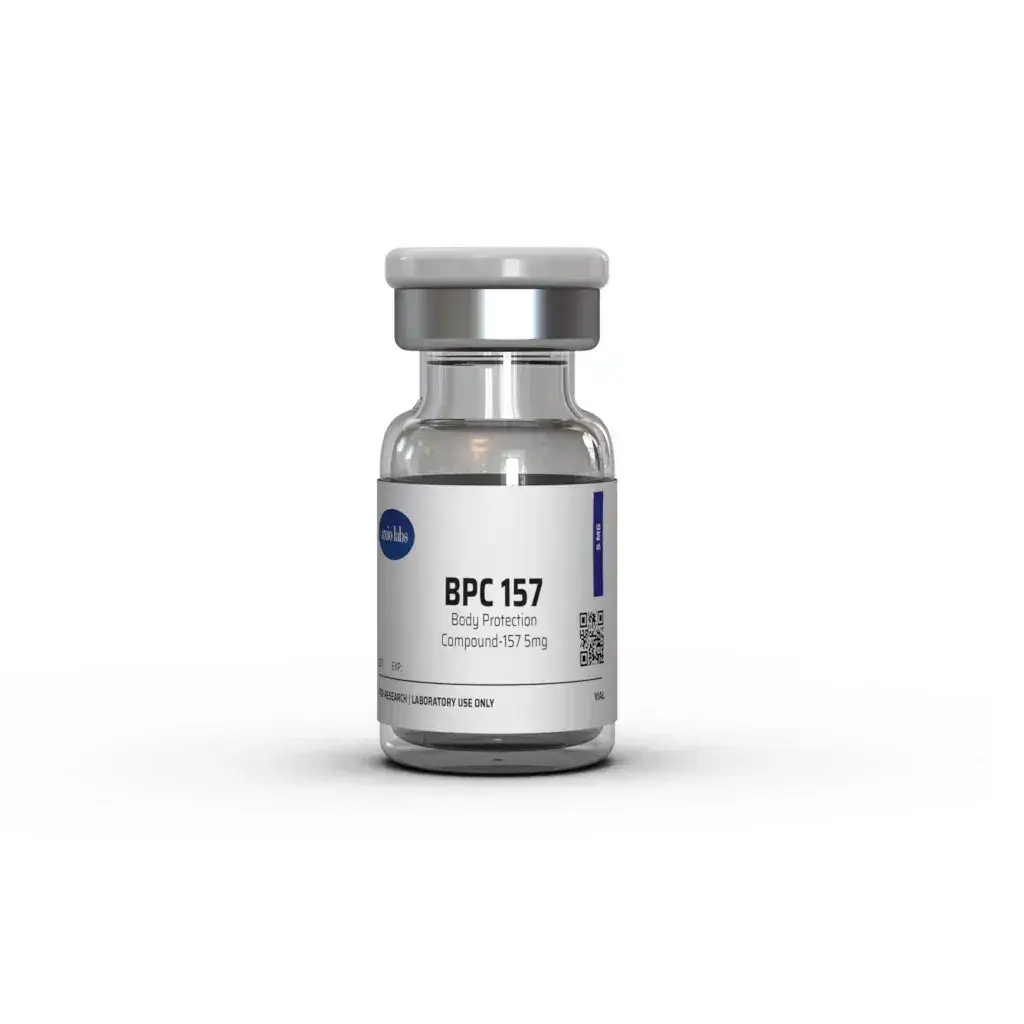
BPC 157 5 mg is a lyophilized powder pentadecapeptide product manufactured by Axiolabs and supplied as 5 mg/vial in a 2 mL vial.
BPC 157 5 mg contains pentadecapeptide BPC 157, a synthetic 15-amino acid peptide derived from a sequence found in human gastric juice. The full chemical sequence is Gly-Glu-Pro-Pro-Pro-Gly-Lys-Pro-Ala-Asp-Asp-Ala-Gly-Leu-Val, sometimes abbreviated as GEPPPGKPADDAGLV. BPC 157 is also known by the research names PL 14736, PL-10, and Bepecin.
In the research context, BPC 157 has been studied extensively in preclinical animal models for its potential effects on tissue repair and healing. Preclinical research suggests that BPC 157 may influence pathways involved in tissue protection, angiogenesis, and repair. Studies in rats have investigated its effects on tendon healing, muscle crush injuries, and bone defects. A Phase 2 clinical trial evaluating BPC 157 for acute hamstring muscle strain repair began in February 2026.
BPC 157 is not approved for human use by the FDA and is not a dietary ingredient. It is listed as a prohibited substance by the World Anti-Doping Agency (WADA). Products containing BPC 157 are often labeled as research chemicals and carry statements such as "Not for human consumption". In non-medical bodybuilding contexts, BPC 157 is commonly referenced for its perceived effects on recovery and tissue repair, based on preclinical findings, though such use falls outside approved indications and human clinical evidence remains limited.
BPC 157 5 mg is supplied as a lyophilized powder requiring reconstitution with an appropriate diluent. The lyophilized format supports stability during storage and transport. Research protocols describe reconstitution with bacteriostatic water for injection.
Pentadecapeptide BPC 157 is a synthetic peptide with a distinctive amino acid sequence, characterized by its origin from gastric juice research and its investigation in preclinical tissue repair studies.
BPC 157 is a stable gastric pentadecapeptide, meaning it consists of 15 amino acids. Its sequence includes a high proportion of proline residues (four of fifteen), which may contribute to its stability. The peptide has a molecular weight of 1419.54 g/mol and a molecular formula of C62H98N16O22.
In preclinical research, BPC 157 has been administered via multiple routes including intraperitoneal injection, oral administration in drinking water, and topical application. Dosages in animal models ranged from picogram to microgram per kilogram of body weight, demonstrating activity at very low doses. The peptide is described as having a distinctive effect on the nitric oxide (NO) system, modulating its function in ways that support tissue protection.
A Phase 2 clinical trial registered in 2026 is evaluating BPC 157 administered subcutaneously once daily for 14 days in participants with acute grade II hamstring muscle strain, with co-primary endpoints of time to return to sport and change in MRI-assessed injury volume. This represents the first registered human clinical trial for this specific application.
BPC 157 is a synthetic 15-amino acid peptide derived from a sequence found in human gastric juice, notable for its stability and its investigation in preclinical tissue repair models.
Axiolabs produces several peptide and research products referenced in different contexts. BPC 157 5 mg is a pentadecapeptide, placing it in a distinct category from other research peptides such as TB 500 (Thymosin Beta 4) and GHK-CU.
For those considering growth hormone-related research peptides, Ipamorelin and Sermorelin are also available. The choice between these research compounds depends on the specific research context and mechanism of interest.
The information below is provided for educational and research reference only. BPC 157 is not approved for human use, and human safety and efficacy data are limited. Non-medical use falls outside approved indications and is prohibited in sport.
In preclinical animal studies, BPC 157 has been administered at dosages ranging from 10 picograms to 10 micrograms per kilogram of body weight, via intraperitoneal injection, oral administration, or topical application. In non-medical bodybuilding contexts, BPC 157 is commonly referenced at doses of 250–500 micrograms per day, often split into two administrations. These figures reflect community discussion, not established human clinical data.
| Use Case | Common Research Reference | Frequency |
|---|---|---|
| Preclinical animal models (published) | 10 pg – 10 µg / kg | Once daily |
| Non-medical bodybuilding (community reference) | 250–500 µg / day | Once or twice daily |
| Clinical trial protocol (Phase 2) | Per trial protocol | Subcutaneous, once daily |
In non-medical contexts, BPC 157 is sometimes referenced alongside TB 500 for perceived synergistic effects on tissue recovery, though no controlled human studies have evaluated this combination. Research protocols should account for the lack of established human safety data and the regulatory status of BPC 157 as a prohibited substance in sport.
The safety of BPC 157 in humans is not established. Proposed risks based on laboratory studies include pathologic angiogenesis and potential effects on tumor growth, though in vivo studies have also reported anti-tumor effects. Injection site risks apply to any injectable preparation. Peptides obtained through unregulated channels may pose contamination risks.
BPC 157 does not affect the hypothalamic-pituitary-gonadal axis and does not require post-cycle therapy for testosterone recovery. It is not a hormonal compound and is distinct from anabolic steroids.
Dosing strategies and support protocols should account for individual experience and health status. The information above is for educational reference and does not constitute medical advice.
BPC 157 is not approved for human use and human safety data are limited. Medical supervision is required for any clinical application. Non-medical use falls outside approved indications and is prohibited in sport.
BPC 157 is an unapproved drug and is not a dietary ingredient. The FDA has cautioned against compounded drugs containing BPC 157 due to safety risks and potential contamination. BPC 157 is listed in WADA's class S0: Non-Approved Substances. There are no established human safety or efficacy data from well-designed clinical trials.
BPC 157 is not approved for bodybuilding or athletic performance enhancement. Non-medical use falls outside approved indications and may carry additional health risks beyond those associated with supervised medical use.
Proposed risks based on laboratory studies include pathologic angiogenesis, potential effects on tumor growth, and neurodegenerative disease concerns, though in vivo research has also reported anti-tumor effects. The clinical significance of these laboratory findings is not established.
Injection site risks apply to any injectable preparation. Peptides acquired through unregulated channels may pose contamination risks, including toxic elemental impurities and variable active ingredient content.
Individuals with active malignancy, a history of cancer, or conditions potentially affected by angiogenesis should exercise particular caution, as BPC 157 has been investigated for effects on angiogenesis. Medical evaluation is required before any consideration of use.
No established monitoring protocols exist for BPC 157 due to the lack of human clinical data. Any research application should be conducted under appropriate oversight and with consideration of the compound's investigational status.
Store lyophilized powder sealed, away from moisture. Recommended storage is -80°C for 2 years or -20°C for 1 year. Once reconstituted, solutions should be aliquoted and stored to prevent product inactivation from repeated freeze-thaw cycles. Keep out of reach of children.
BPC 157 5 mg is shipped in original manufacturer packaging with discreet, privacy-focused handling.
Outer packaging remains discreet with no external product details. Products are supplied in original manufacturer presentation.
To verify product authenticity, examine the packaging for manufacturer security features and compare against official Axiolabs presentation. Original packaging and consistent labeling help confirm product legitimacy.
For complete delivery details, please see our Shipping Info page.
Proper storage conditions are essential for maintaining the stability of lyophilized peptide powder.
Store lyophilized powder sealed, away from moisture. Recommended storage conditions are -80°C for 2 years or -20°C for 1 year. Keep vials in their original packaging and protect from light. Once reconstituted, solutions should be aliquoted and stored to prevent product inactivation from repeated freeze-thaw cycles. Follow the specific storage instructions provided with the product.
Keep out of reach of children. Follow proper handling and sterile practices when reconstituting.
Answers to common questions about BPC 157 5 mg, pentadecapeptide, dosing, and product characteristics.
BPC 157 5 mg contains pentadecapeptide BPC 157, a research peptide. It is not approved for human use. In preclinical research, it has been studied for potential effects on tissue repair. In non-medical bodybuilding contexts, it is commonly referenced for recovery, though human clinical evidence remains limited.
In preclinical studies, BPC 157 was administered once daily via various routes. In non-medical bodybuilding contexts, 250–500 micrograms per day split into two administrations is commonly referenced. The Phase 2 clinical trial protocol involves subcutaneous administration once daily for 14 days.
No. BPC 157 does not affect the hypothalamic-pituitary-gonadal axis and does not require post-cycle therapy for testosterone recovery. It is not a hormonal compound and is distinct from anabolic steroids.
BPC 157 is a synthetic 15-amino acid peptide derived from human gastric juice. Preclinical research suggests it may influence pathways involved in tissue protection, angiogenesis, and repair. Its full mechanism and human clinical effects are not fully established.
The time to any potential effect depends on the context and individual factors. Preclinical studies have assessed outcomes at various timepoints, including days 7, 14, and 21. In non-medical bodybuilding discussions, some users report noticing effects within 1–2 weeks, though these are anecdotal reports and not established clinical findings.
There is no universally "best" peptide for recovery, and BPC 157 is not approved for human use. BPC 157 has been extensively studied in preclinical models, but human clinical evidence remains limited. Other research peptides such as TB 500 are also referenced in non-medical contexts.
BPC 157 is a 15-amino acid pentadecapeptide derived from gastric juice. TB 500 (Thymosin Beta 4) is a different peptide with a distinct sequence and mechanism. Both are research peptides referenced in non-medical recovery contexts. Axiolabs offers TB 500 as a separate product.
BPC 157 is a pentadecapeptide studied for tissue repair mechanisms. GHK-CU is a copper peptide with different research applications. Both are research compounds with distinct mechanisms and are not approved for human use. Axiolabs offers GHK-CU as a separate product.
In non-medical bodybuilding contexts, 500 mcg per day is within commonly referenced ranges. However, there is no established human clinical dose for BPC 157, and preclinical studies used doses ranging from picograms to micrograms per kilogram. BPC 157 5 mg contains 5,000 mcg per vial, so a 500 mcg dose would require reconstitution and measurement.
BPC 157 5 mg is supplied as 5 mg of pentadecapeptide per vial in a 2 mL vial. The lyophilized powder requires reconstitution before use.
Lab testing information for BPC 157 5 mg is not available on this page. For product-specific testing inquiries, please contact customer support.
The safety and effectiveness of BPC 157 have not been thoroughly evaluated in humans. It is an unapproved drug and is on WADA's prohibited list. Proposed risks based on laboratory studies include pathologic angiogenesis, though in vivo research has also reported anti-tumor effects.