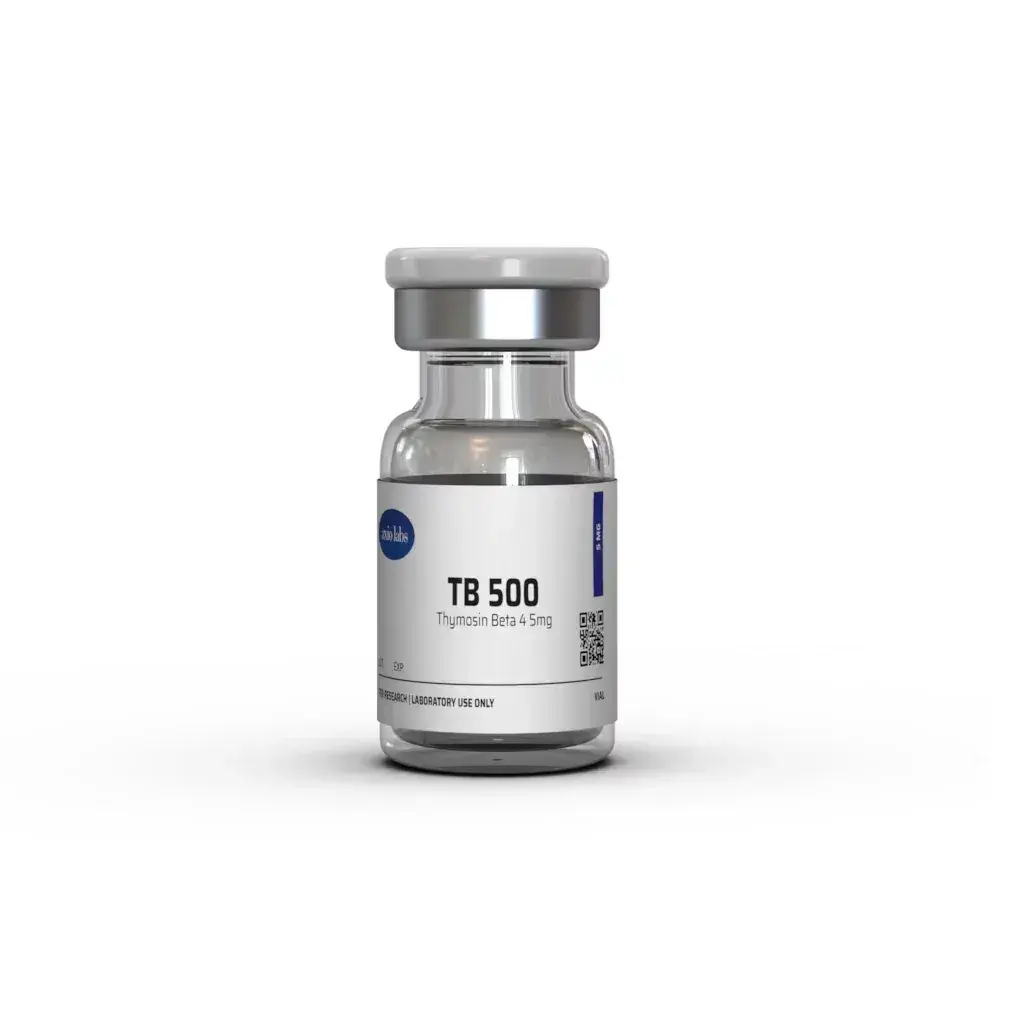
TB 500 5 mg is a lyophilized research peptide manufactured by Axiolabs containing Thymosin Beta 4 (the TB-500 fragment) at 5 mg per vial, supplied as a powder for reconstitution in a 2 mL vial.
TB 500 5 mg contains the synthetic peptide fragment corresponding to the active actin-binding region of thymosin beta 4, specifically the N-terminal acetylated 17-23 fragment (Ac-LKKTETQ). Thymosin beta 4 is a naturally occurring 43-amino-acid peptide found in high concentrations in most human cells, where it functions primarily as a G-actin sequestering protein that regulates cytoskeletal organization.
In medical research contexts, thymosin beta 4 has been investigated for roles in tissue repair, wound healing, angiogenesis, and cell migration. The TB-500 fragment specifically represents the actin-binding domain believed responsible for many of these cellular effects. Currently, an investigational Phase 1/2 clinical trial is evaluating a TB-500 formulation in adults with atherosclerotic cardiovascular disease for safety, tolerability, and exploratory cardiovascular biomarkers.
In non-medical bodybuilding and fitness contexts, TB-500 is commonly referenced for its purported roles in soft tissue recovery, joint health, and injury repair support. Such use falls outside approved medical indications and is not supported by completed human clinical trials for musculoskeletal outcomes. Thymosin beta-4 and its fragments are prohibited by the World Anti-Doping Agency under peptide hormones and growth factors.
TB 500 5 mg is supplied as a lyophilized powder in a 2 mL vial. Lyophilization removes water from the peptide solution under low temperature and pressure, producing a stable powder that requires reconstitution with an appropriate solvent before experimental use. This format is common for research peptides to preserve stability during storage and transport.
Thymosin beta 4 is a small, highly conserved actin-binding peptide that plays a fundamental role in cytoskeletal regulation and cellular migration processes.
Thymosin beta 4 functions primarily as a G-actin sequestering protein, binding monomeric actin in a 1:1 complex and preventing its polymerization into filaments while maintaining a pool of actin monomers available when the cell requires filament assembly. This actin-binding activity is the defining mechanism attributed to the compound and its fragments.
The TB-500 fragment specifically contains the actin-binding domain (LKKTETQ) identified as the region responsible for thymosin beta 4's interactions with actin. Preclinical research has explored the peptide's roles in processes including cell migration, angiogenesis, and wound healing in animal models.
Human clinical data for the TB-500 fragment is limited. A Phase 1/2 trial is ongoing for cardiovascular applications, and earlier Phase 1 studies of recombinant human thymosin beta 4 used intravenous administration in healthy volunteers. No completed Phase 2 or Phase 3 trials have evaluated subcutaneous TB-500 for musculoskeletal outcomes.
TB-500 (thymosin beta 4 fragment) has no FDA-approved human product. The FDA has stated there is a lack of clinical and nonclinical safety information for TB-500. The compound is available as a research chemical and is not intended for human use.
Within the research peptide category, TB-500 is frequently discussed alongside other compounds investigated for tissue-related mechanisms. BPC 157 is a synthetic pentadecapeptide derived from a gastric protein with a distinct mechanism, while GHK-CU is a copper-binding tripeptide with different research applications. Each peptide has a unique structure and proposed mechanism of action.
The information below is provided for educational reference only. TB-500 is a research peptide with no approved human dosing. Medical use requires appropriate oversight, and non-medical use falls outside approved indications.
Common reference ranges for this compound in non-medical bodybuilding contexts are not well characterized in publicly available resources. Published human pharmacokinetic data for subcutaneous TB-500 in musculoskeletal indications has not been formally published. Research protocols for TB-500 in non-medical settings typically describe a loading phase and a maintenance phase, though these figures are derived from user-reported practices rather than controlled clinical trials.
| Use Case | Common Reference Range | Frequency |
|---|---|---|
| Non-medical research protocol (loading) | 2–5 mg | Twice weekly for 4–6 weeks |
| Non-medical research protocol (maintenance) | 2–2.5 mg | Once weekly for 4–8 weeks |
| Cycle length (user-reported) | Variable | 4–12 weeks active, with rest periods |
These ranges represent user-reported practices in non-medical settings and should not be interpreted as validated clinical guidance. No human dose-finding studies have established safe or effective protocols for subcutaneous TB-500 in musculoskeletal applications.
TB 500 5 mg is supplied as a lyophilized powder. If reconstitution is performed for research purposes, the 5 mg vial content allows for flexible concentration selection based on the solvent volume used. Reconstituted peptide solutions are typically stored under refrigeration and used within a defined timeframe.
Because TB-500 is not approved for human use, no standardized administration guidelines exist. Any handling should follow appropriate laboratory safety practices.
In non-medical research discussions, TB-500 is sometimes referenced alongside BPC 157, with the two peptides proposed to have complementary mechanisms. However, no human studies have evaluated the combination of BPC-157 and TB-500, and there is no published compatibility data confirming safety or stability of co-administration.
TB-500 has no established human dosing. Any information about non-medical use is derived from user-reported practices and is not validated by controlled clinical research. This information does not constitute medical advice.
Thymosin beta 4 and its fragments are research compounds with limited human safety data. No FDA-approved product exists, and the FDA has noted a lack of clinical and nonclinical safety information for TB-500.
TB-500 is not approved for human use by the FDA. The compound is intended for research purposes only. No prescribing information, established contraindications, or validated safety profile exists for human administration of TB-500.
Published Phase 1 trials of recombinant human thymosin beta 4 used intravenous administration in healthy volunteers and reported adverse events described as mild to moderate. These trials did not evaluate subcutaneous TB-500 administration, and the safety data from IV studies of the full-length protein may not apply to the TB-500 fragment administered by other routes.
Non-medical use of TB-500 falls outside approved indications and carries unknown risks. Product purity and laboratory verification do not establish that non-medical use is safe or appropriate for an individual.
Human safety data for TB-500 is limited. In Phase 1 trials of related thymosin beta 4 formulations, reported adverse events included headache, nausea, lightheadedness, and fatigue, described as infrequent and generally mild to moderate. Injection site reactions have been reported in non-medical settings but were not evaluated in clinical trials using IV administration.
Thymosin beta 4 promotes cell migration, angiogenesis, and cell survival mechanisms. These mechanisms could theoretically support tumor growth or progression. Individuals with active malignancy or a history of cancer should discuss this concern with an oncologist before considering any peptide that promotes angiogenesis or cell proliferation.
The long-term effects of exogenous thymosin beta 4 supplementation on immune regulation have not been characterized in humans.
No formal contraindications exist for TB-500 because no approved product or prescribing label exists. Precautionary considerations based on the compound's known mechanisms include active malignancy or history of cancer, pregnancy or breastfeeding, bleeding disorders or anticoagulant use, and age under 18.
Competitive athletes should be aware that thymosin beta-4 and its fragments are prohibited by the World Anti-Doping Agency under Section S2 (Peptide Hormones, Growth Factors, Related Substances) and are banned both in-competition and out-of-competition. Detection methods exist and are used in anti-doping testing.
Because TB-500 has no approved human therapeutic use, no standardized monitoring protocols exist. Any research or non-medical use should be accompanied by awareness of the lack of established safety parameters.
Laboratory testing of the product itself, such as purity analysis, is separate from any clinical monitoring of an individual.
Store the lyophilized powder under conditions appropriate for research peptides. Inspect the vial before use and do not use a product that appears damaged or compromised.
Keep all research compounds out of the reach of children.
TB 500 5 mg is supplied through the official Axiolabs distribution chain and shipped in original manufacturer packaging with discreet, privacy-focused handling.
The outer shipping package remains discreet, with privacy-focused handling and no unnecessary external product details. Products are supplied through the official Axiolabs distribution chain.
To verify your TB 500 5 mg product, use the security code on the vial label and cross-check it on the Axiolabs official site. Official Axiolabs presentation and original packaging help reinforce product legitimacy and buyer confidence.
For complete delivery details, tracking policy, and reshipment terms, please see our Shipping Info page.
Proper storage conditions help preserve peptide stability and overall product integrity throughout shelf life.
Store the lyophilized powder in a cool, dry place away from direct light. For long-term storage of lyophilized research peptides, refrigeration or freezing is commonly recommended to preserve stability. Once reconstituted, peptide solutions typically require refrigerated storage and should be used within a defined timeframe.
Keep the vial in its original packaging until use. Inspect the powder before reconstitution and avoid use if it appears discolored, clumped, or if the vial or seal is compromised.
Keep out of reach of children. Follow proper handling practices when working with research compounds.
Answers to common questions about TB 500 5 mg, Thymosin Beta 4, and research peptide applications.
TB 500 5 mg contains the synthetic TB-500 fragment of thymosin beta 4. In research settings, thymosin beta 4 has been investigated for roles in actin regulation, cell migration, and tissue-related processes. In non-medical bodybuilding contexts, TB-500 is commonly referenced for purported soft tissue recovery support, though such use is not supported by completed human clinical trials and falls outside approved indications.
There is no established human dosing schedule for TB-500. In non-medical research discussions, user-reported protocols typically describe a loading phase of 2–5 mg twice weekly for 4–6 weeks, followed by a maintenance phase of 2–2.5 mg once weekly. These figures represent user-reported practices and are not derived from controlled clinical trials.
TB-500 is a peptide and does not suppress endogenous testosterone production in the way anabolic steroids do. Post-cycle therapy is not applicable to TB-500 in the context of hormonal recovery from steroid cycles. However, any non-medical peptide use should be considered in the context of individual health and research parameters.
Thymosin beta 4 is a naturally occurring peptide that functions primarily as a G-actin sequestering protein, regulating cytoskeletal organization and cell migration. Research has explored its roles in wound healing, angiogenesis, and tissue repair processes in preclinical models. The TB-500 fragment represents the actin-binding domain of the full protein.
No established timeline exists for TB-500 effects in humans. Human pharmacokinetic data for subcutaneous TB-500 in musculoskeletal applications has not been formally published. Any timeline referenced in non-medical contexts is based on user reports rather than controlled clinical observation.
There is no universally established "best" recovery peptide, and TB-500 has not been validated in completed human trials for recovery outcomes. Different research peptides have distinct structures and proposed mechanisms. BPC 157 is another peptide frequently discussed in recovery research contexts, with a different mechanism of action.
TB-500 and BPC 157 are distinct synthetic peptides with different origins and primary mechanisms. TB-500 corresponds to the actin-binding fragment of thymosin beta 4, while BPC 157 is a pentadecapeptide derived from a gastric protein. In non-medical research discussions, they are sometimes referenced together as having potentially complementary mechanisms, but no human studies have evaluated the combination.
TB-500 is a thymosin beta 4 fragment with actin-binding activity, while GHK-CU is a copper-binding tripeptide with different research applications related to collagen synthesis and skin remodeling. The two compounds have distinct structures and are investigated in different research contexts.
Without established human dosing, no milligram amount can be classified as appropriate or excessive. TB 500 5 mg is labeled at 5 mg of lyophilized powder per vial. In non-medical research discussions, 5 mg represents a common single-vial size, but this does not establish any dosing guidance. No validated reference range exists for this compound.
TB 500 5 mg is labeled at 5 mg of Thymosin Beta 4 (TB-500 fragment) per vial. It is supplied as a lyophilized powder in a 2 mL vial manufactured by Axiolabs.
Yes. Thymosin beta-4 and its fragments, including TB-500, are explicitly prohibited by the World Anti-Doping Agency under Section S2 of the Prohibited List (Peptide Hormones, Growth Factors, Related Substances, and Mimetics). The compound is banned both in-competition and out-of-competition, and detection methods are used in anti-doping testing.