Typical Dosage Ranges
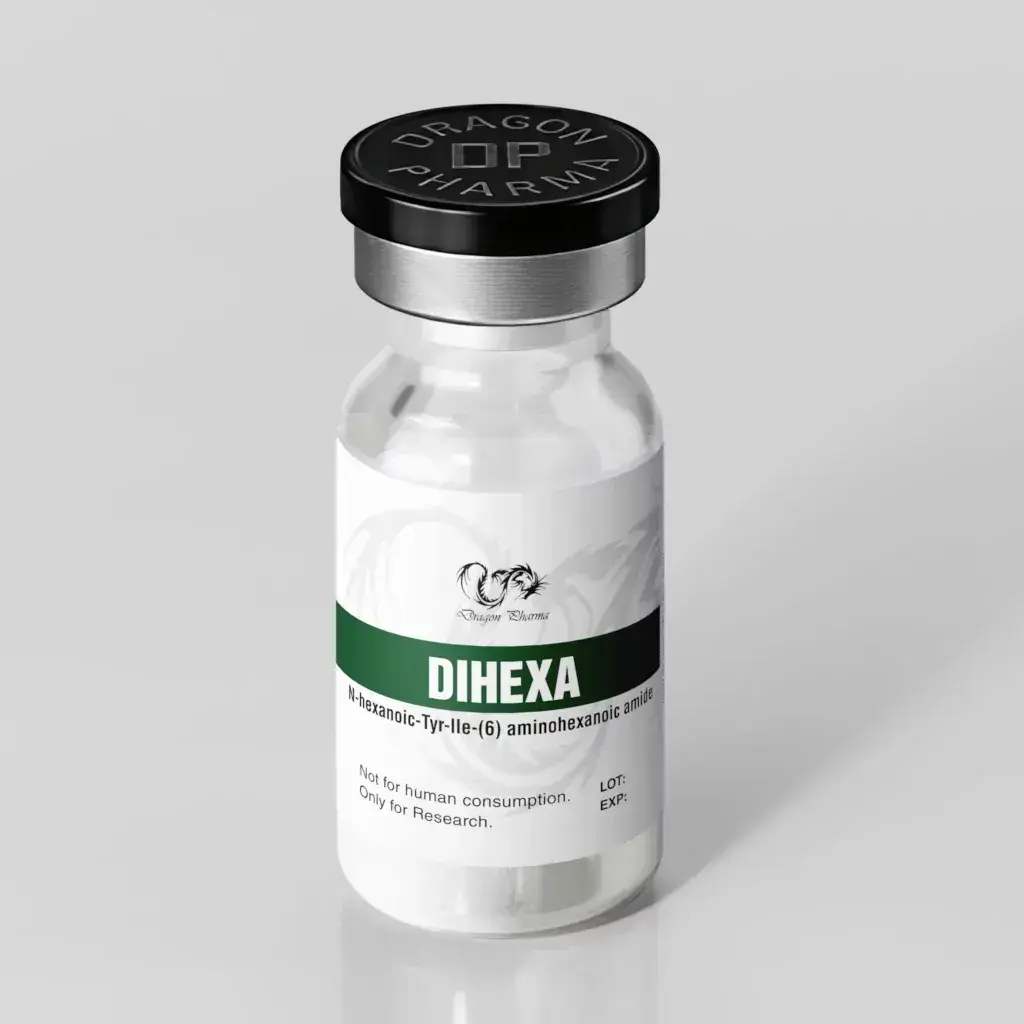
No established human dosage exists for DIHEXA. In preclinical research, the most cited dose is 2 mg/kg/day orally in aged rats and scopolamine-impaired rats . In non-medical community contexts, oral doses of 5–20 mg daily are referenced, with some users reporting doses as high as 40 mg daily . The community dosing range is extrapolated from rat studies using allometric scaling, but human-equivalent doses cannot be reliably calculated from rodent data . A 5 mg dose is 5,000 mcg, which is 10 to 100 times higher than typical peptide doses, making unit verification critical .
| Use Case |
Common Reference Range |
Frequency |
| Preclinical research (rat) |
2 mg/kg/day |
Once daily, oral |
| Non-medical (low reference) |
5–10 mg |
Once daily |
| Non-medical (higher reference) |
10–20 mg |
Once daily |
| Non-medical (aggressive) |
20–40 mg |
Once daily |
Community doses are extrapolated from animal studies and are not validated by human clinical trials. DIHEXA has no established human dosing.
Stacking & Cycle Considerations
DIHEXA is not an anabolic compound and is not stacked for muscle-building purposes. In non-medical research contexts, it is sometimes referenced alongside other cognitive peptides. Community discussions describe combining DIHEXA with Semax for a cognitive stack targeting both synaptogenesis and BDNF upregulation . For neuroprotective research, Cerebrolysin is sometimes referenced in combination, though no clinical data exists on such combinations.
Because DIHEXA has an unusually long half-life, accumulation is a significant consideration. Community protocols reference cycling patterns of 90 days on followed by 30 days off, or shorter cycles of 4–8 weeks with equal time off . The long half-life means that even after stopping, the compound may remain active in the body for weeks .
Managing Side Effects
No human safety data exists for DIHEXA. Anecdotal community reports describe headaches, brain fog, fatigue, irritability, and mood changes . These reports are not a safety profile and cannot substitute for controlled clinical data. There is no published chronic toxicology, genotoxicity, reproductive toxicity, or carcinogenicity data for DIHEXA in humans .
The most significant safety concern is theoretical but serious: DIHEXA activates the HGF/c-Met pathway, which is implicated in cancer progression when dysregulated . The FDA has approved cancer drugs specifically to block c-Met, and a compound that stimulates this pathway with no long-term safety data raises a legitimate concern that has not been studied . Individuals with a personal or family history of cancer should be particularly cautious .
Product quality is another practical risk. Independent testing found that 9 of 12 commercial DIHEXA samples were below 95% purity . A batch-specific HPLC and mass spec COA from an independent third-party lab is often recommended, but this does not address the fundamental safety questions .
Post-Cycle Therapy
DIHEXA is not part of any post-cycle therapy protocol. It has no relationship to the hypothalamic-pituitary-gonadal axis, and its research focus has been on synaptic connectivity and cognition. PCT compounds such as Clomid and Nolvadex address entirely different biological systems.
Important
Research Use Only
DIHEXA has never been approved for human use. Its evidence base is entirely preclinical, a key supporting study was retracted, and its mechanism raises theoretical cancer concerns. The information above is for educational reference and does not constitute medical advice. Human use is not recommended.