



S 23 10 mg is an oral mastorin tablet manufactured by Dragon Pharma and dosed at 10 mg per tablet in a 100-tablet package.
S 23 10 mg contains mastorin (S-23), a nonsteroidal selective androgen receptor modulator (SARM) developed by GTX, Inc. as a potential male hormonal contraceptive. S-23 binds to the androgen receptor with high affinity (Ki of 1.7 nM), more strongly than older SARMs such as andarine. In animal studies, it demonstrated a favorable anabolic-to-androgenic ratio and dose-dependent suppression of spermatogenesis with spontaneous recovery after cessation of treatment.
S-23 was specifically engineered to suppress gonadotropins and spermatogenesis, achieving azoospermia in intact male rats when combined with estradiol benzoate. It is not approved by the FDA for any human indication and is classified as an unapproved new drug when sold for human consumption. The World Anti-Doping Agency (WADA) prohibits S-23 at all times, and it is detectable in urine for extended periods following oral administration.
In non-medical bodybuilding contexts, S 23 is commonly referenced for muscle hardening and body recomposition, particularly during late-stage cutting or contest preparation phases. However, S-23 is widely regarded as one of the most suppressive SARMs available, with research demonstrating significant reductions in luteinizing hormone (LH) and follicle-stimulating hormone (FSH) even at moderate doses. Non-medical use falls outside approved indications and carries substantial health risks including hormonal suppression, lipid profile disruption, and potential liver stress.
S-23 is a nonsteroidal SARM with high androgen receptor affinity and full agonist activity, originally investigated as a male hormonal contraceptive due to its potent suppression of gonadotropins and spermatogenesis.
S-23 is an arylpropionamide-derived SARM that binds the androgen receptor with high affinity (Ki of 1.7 nM) and was identified as a full agonist in vitro. In castrated male rats, the ED50 of S-23 in the prostate and levator ani muscle was 0.43 and 0.079 mg/d, respectively, indicating potent anabolic activity. Molecular dynamics simulations have shown that S-23 exhibits greater conformational flexibility compared to steroidal SARMs like YK-11, with RMSD values suggesting moderate binding stability.
The half-life of S-23 is commonly referenced as approximately 12 hours based on pharmacokinetic data, which supports twice-daily dosing to maintain stable blood levels. Some sources cite a range of 12–24 hours, though the shorter estimate is more frequently referenced in practical contexts.
S-23 is distinguished from other SARMs by its potent suppression of gonadotropins. In intact male rats treated for 14 days, S-23 alone suppressed LH levels by greater than 50% at doses above 0.1 mg/d. When combined with estradiol benzoate in a 10-week study, four of six animals showed no sperm in the testis and zero pregnancies in mating trials, with full reversibility observed after 100 days of recovery.
S-23 is distinguished by its high androgen receptor affinity, potent suppression of endogenous testosterone production, and reputation for producing dry, hardened muscle without water retention.
Dragon Pharma offers multiple compounds discussed in bodybuilding and performance contexts. S-23's SARM mechanism and potent suppression profile contrast with anabolic steroids such as Anavar 50 or Winstrol 50, which act as full androgen receptor agonists and carry 17-alpha-alkylation or injectable administration. It is also distinct from other SARMs such as MK 2866 (ostarine), which is considered significantly milder, and LGD 4033, which has a longer half-life and different selectivity profile. RAD 140 is another SARM often compared to S-23, though community discussion generally places RAD-140 in a lower potency tier.
The distinction between S 23 and these compounds is primarily one of potency and suppression: S-23 is widely regarded as one of the strongest and most suppressive SARMs available.
Published laboratory reports for S 23 10 mg are shown below with the test date, measured mastorin content, and percentage of the product's 10 mg label claim.
 View Report
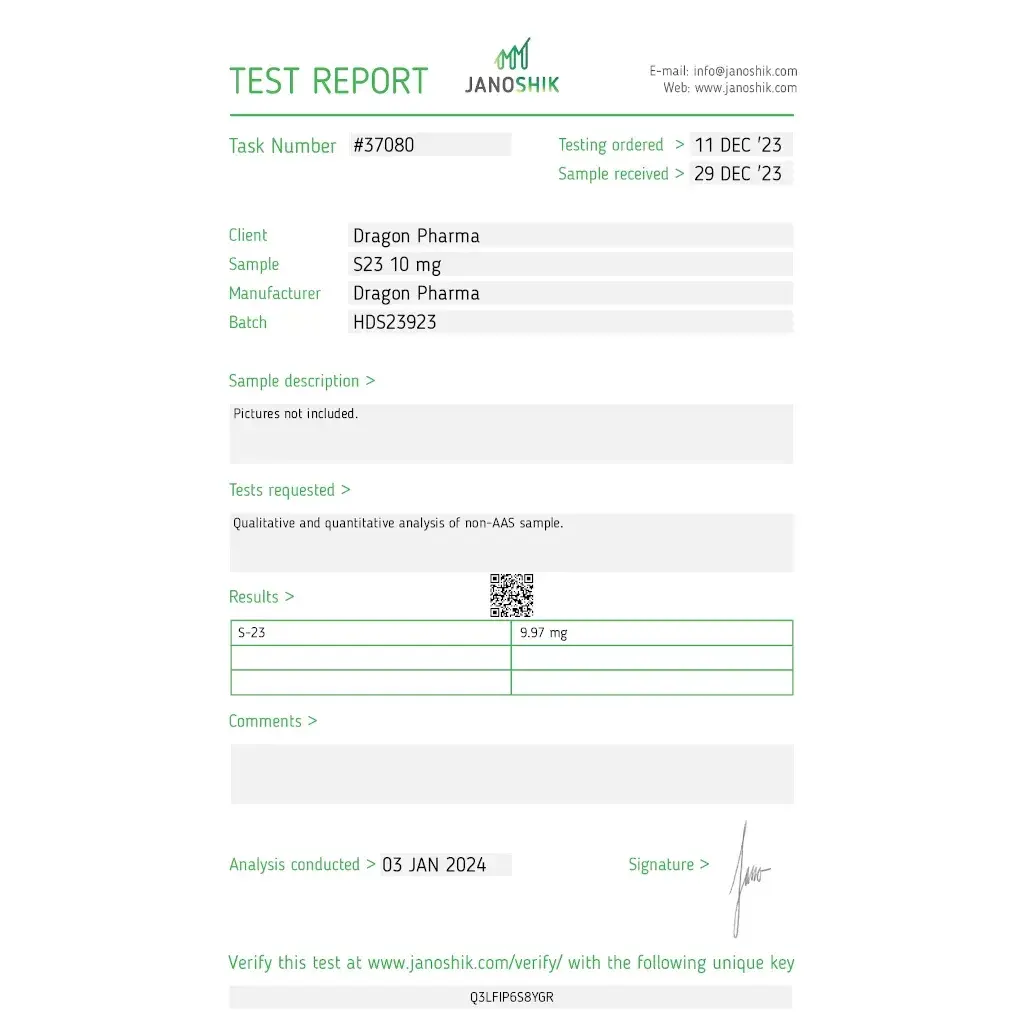 View Report
Laboratory results apply to the specific tested sample represented in each published report and should not be interpreted as a measurement of every tablet or production batch.
The information below is provided for educational reference only. S-23 is not approved for human use and is classified as an unapproved new drug when sold for human consumption. Non-medical use falls outside approved indications and carries substantial health risks.
S-23 has no established human dosage for medical use. In non-medical bodybuilding contexts, S-23 is commonly referenced in the range of 10–30 mg per day, with twice-daily dosing recommended due to its approximately 12-hour half-life. Research community protocols often start at the lower end (10 mg) for 2–4 weeks to assess individual response. Cycle duration is commonly referenced as 6–10 weeks.
| Use Case | Common Reference Range | Frequency |
|---|---|---|
| Beginner (non-medical) | 10–15 mg / day | Split into 2 doses |
| Intermediate (non-medical) | 15–20 mg / day | Split into 2 doses |
| Advanced (non-medical) | 20–30 mg / day | Split into 2 doses |
| Cycle duration (non-medical) | 6–10 weeks | Due to suppression risk |
In non-medical contexts, S-23 is frequently referenced as a standalone hardening agent or as an add-on to a testosterone base. Experienced users running a low-dose test base (250–400 mg/week) through the cycle sidestep the PCT question entirely because they are already suppressed, and S-23 becomes a hardening add-on rather than a compound requiring isolated recovery. Stacking S-23 with other SARMs dramatically increases hormonal suppression risk and is generally discouraged.
Cycle duration for S-23 is commonly referenced as 6–10 weeks, with longer durations increasing the risk of hormonal suppression, lipid profile disruption, and potential liver stress.
S-23 is one of the most suppressive SARMs studied, with research showing significant reductions in LH and FSH even at moderate doses. Post-cycle therapy is mandatory, not optional. Lipid profile changes are common, with HDL routinely dropping 20–40% on an 8-week run; a week-4 lipid check is recommended to catch this early. Liver enzyme elevation has been reported and appears dose-dependent. Androgenic side effects including acne, oily skin, and hair loss in genetically predisposed individuals are possible. TUDCA and NAC are commonly referenced for liver support.
PCT is non-negotiable with S-23 because HPG shutdown is the expected outcome, not a rare side effect. A standard protocol commonly referenced includes Nolvadex at 40 mg/day for weeks 1–2 and 20 mg/day for weeks 3–4, with Clomid (50 mg/day then 25 mg/day) added if recovery is sluggish. Agents such as Clomid or Nolvadex are commonly referenced for this purpose. Bloodwork to confirm recovery of LH, FSH, and total testosterone is the real "go" signal for a subsequent cycle, not a calendar date.
S-23 is not approved for human use and is one of the most suppressive SARMs available. The information above is for educational reference and does not constitute medical advice. Non-medical use is strongly cautioned against.
S-23 is not approved by the FDA for any human indication. The FDA has issued warning letters regarding SARMs, citing safety concerns including life-threatening reactions, liver toxicity, and potential increased risk of heart attack and stroke.
S-23 (mastorin) is a SARM that has not been approved by the FDA for any human indication. Products marketed as S-23 are considered unapproved new drugs when sold for human consumption. S-23 is prohibited by WADA at all times and is detectable in urine for up to 28 days following oral administration.
S-23 was specifically investigated as a male hormonal contraceptive and demonstrated reversible suppression of spermatogenesis in animal studies. This indicates that HPG suppression is an intrinsic property of the compound, not an incidental side effect.
S-23 has no approved human indication. Non-medical use falls outside approved indications and carries significant health risks including severe hormonal suppression, hepatotoxicity, and cardiovascular concerns. Product strength and laboratory verification do not establish safety for human consumption.
Hormonal suppression: S-23 causes marked suppression of gonadotropins (LH and FSH), testicular atrophy, and primarily azoospermic semen after administration. Normal reproductive function was restored after cessation in animal studies, but this required 100 days of recovery.
Lipid profile changes: Research has indicated negative effects on cholesterol, including reduced HDL, increased LDL, and elevated triglycerides. HDL routinely drops 20–40% on an 8-week S-23 run.
Liver stress: Liver enzyme elevations have been reported with S-23 use and appear dose-dependent. Community reports describe darkened urine and recommend TUDCA and NAC for liver support.
Androgenic effects: Despite being selective, S-23 can cause acne, oily skin, hair loss in genetically predisposed individuals, and mood changes including increased aggression or irritability.
Cardiovascular concerns: The FDA has stated that SARMs have the potential to increase the risk of heart attack and stroke.
Given the potential for severe hormonal suppression, lipid disruption, and liver stress, any consideration of S-23 exposure warrants comprehensive medical evaluation including liver function tests, lipid panel, and hormonal assessment. Individuals under 25, women (due to virilization risk), people with existing liver conditions, cardiovascular disease, or hormone-sensitive cancers should absolutely avoid S-23.
There is no established monitoring protocol for non-medical S-23 use. Comprehensive bloodwork is strongly recommended, including baseline (2 weeks before), week 4 on-cycle, end of cycle, end of PCT, and 8 weeks post-PCT. The week-4 lipid check is particularly important, as HDL drops may be significant by that point. Liver enzymes, total and free testosterone, LH, FSH, and E2 should be monitored.
Store in a cool, dry place away from direct light and moisture. Keep the product in its original packaging and out of the reach of children. This product is not for human consumption.
S 23 10 mg is supplied through the Dragon Pharma distribution chain and shipped in original manufacturer packaging with discreet, privacy-focused handling.
The outer shipping package remains discreet, with privacy-focused handling and no unnecessary external product details. Products are supplied through the Dragon Pharma distribution chain.
To verify your S 23 10 mg product, cross-check the security features on the packaging against Dragon Pharma's official presentation. Batch-linked lab proof and original packaging help reinforce product legitimacy.
For complete delivery details, tracking policy, and reshipment terms, please see our Shipping Info page.
Proper storage conditions help preserve tablet integrity and overall product stability throughout shelf life.
Store in a cool, dry place away from excessive heat, moisture, and direct light. Maintaining stable conditions helps preserve the integrity of the tablets.
Keep the tablets in their original packaging until use. Do not use if the packaging appears compromised or if the tablets show signs of degradation such as discoloration or crumbling.
Keep out of reach of children. This product is not for human consumption.
Answers to common questions about S 23 10 mg, mastorin, SARM mechanisms, dosing, and safety.
S 23 10 mg contains mastorin (S-23), a SARM. It has no approved medical use. In non-medical bodybuilding contexts, it is commonly referenced for muscle hardening and body recomposition during cutting phases, though such use falls outside approved indications and carries substantial health risks.
S-23 has a half-life commonly referenced as approximately 12 hours, supporting twice-daily dosing. In non-medical contexts, it is typically referenced as being taken twice daily, often morning and evening, to maintain stable blood levels.
Yes, absolutely. PCT is non-negotiable with S-23 because HPG shutdown is the expected outcome, not a rare side effect. S-23 was specifically investigated as a male contraceptive and demonstrated reversible suppression of spermatogenesis in animal studies. Agents such as Clomid or Nolvadex are commonly referenced for PCT.
S-23 is a nonsteroidal SARM that binds the androgen receptor with high affinity (Ki 1.7 nM) and full agonist activity. It selectively activates androgenic signaling in muscle and bone, and was originally developed as a male hormonal contraceptive due to its potent suppression of gonadotropins and spermatogenesis.
S-23 reaches steady state within 3–4 days of twice-daily dosing, so front-loading provides no additional benefit. In non-medical contexts, users often report noticeable hardening and vascularity effects within the first 1–2 weeks, with body composition changes developing over a 6–10 week cycle.
S-23 is widely regarded as one of the most potent and suppressive SARMs available. Community comparisons place it significantly above ostarine and RAD-140 in terms of strength of effect and suppression. However, potency comes with proportional risk, and S-23 is not recommended for beginners.
Both are SARMs, but community discussion generally places S-23 in a higher potency tier than RAD 140. S-23 is also significantly more suppressive, with a well-documented impact on LH and FSH. RAD-140 is often described as more manageable for intermediate users.
S-23 is substantially more potent and suppressive than MK 2866 (ostarine). Ostarine is often described as a beginner SARM with milder effects and less suppression, while S-23 is considered an advanced compound for experienced users willing to manage full PCT and regular bloodwork.
S-23 has no established human dosage. In non-medical contexts, 10 mg per day is commonly referenced as a conservative starting point, with reference ranges extending to 30 mg per day. Research community protocols often start at the lower end for 2–4 weeks to assess individual response. S 23 10 mg is labeled at 10 mg per tablet.
S 23 10 mg is labeled at 10 mg of mastorin per tablet. It is supplied in a 100-tablet package, giving 1,000 mg of total labeled mastorin content.
Yes. Published laboratory reports for S 23 10 mg are available. The most recent report dated April 18, 2025 measured the product at 12.43 mg per tablet, equivalent to 124.30% of its 10 mg label claim. Complete reports can be viewed in the Lab Reports tab.
No. S-23 is not approved by the FDA for any human indication and is classified as an unapproved new drug when sold for human consumption. It is prohibited by WADA at all times and is detectable in urine for up to 28 days following oral administration.


