
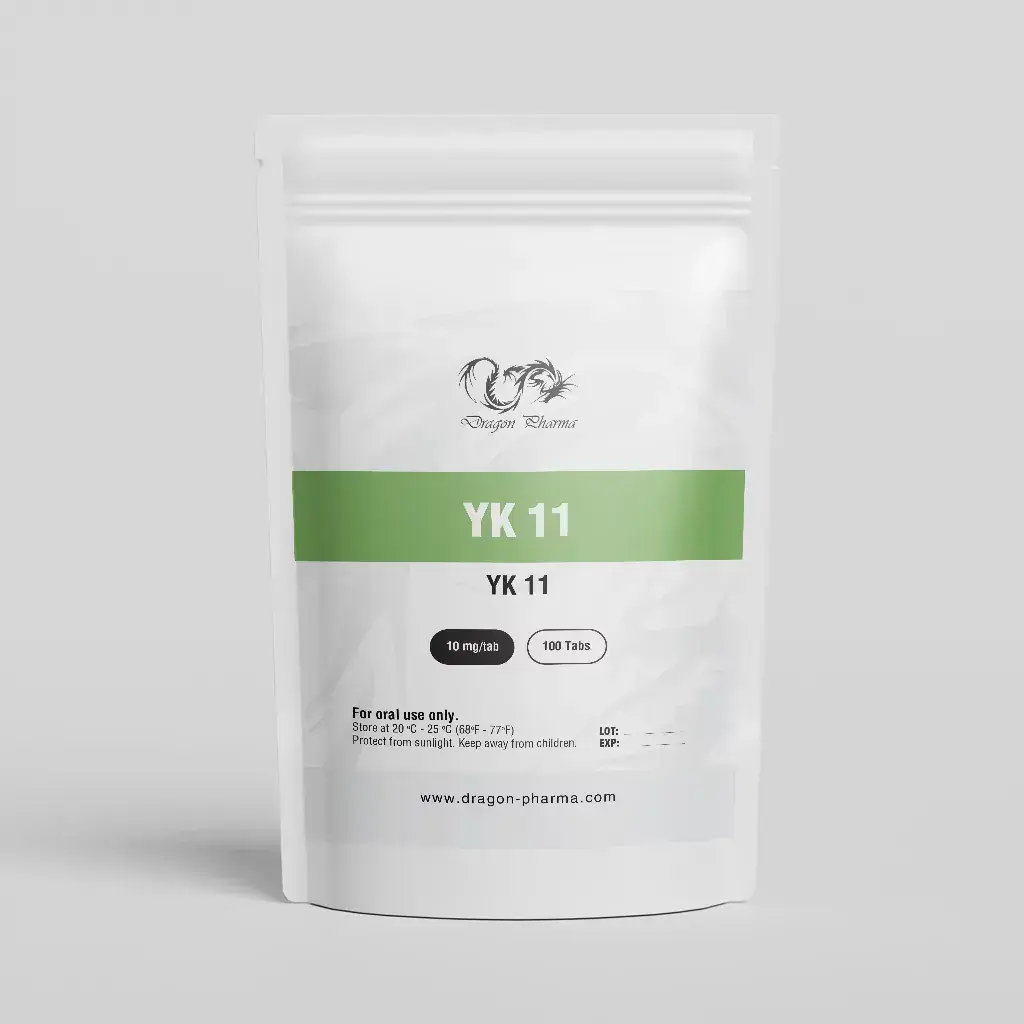
YK 11 10 mg is an oral YK-11 tablet manufactured by Dragon Pharma and dosed at 10 mg per tablet in a 100-tablet package.
YK 11 10 mg contains YK-11, a synthetic steroidal compound classified as a selective androgen receptor modulator (SARM) with additional myostatin-inhibiting properties. Unlike traditional SARMs such as ostarine or ligandrol, YK-11 is built on a steroidal backbone, making it structurally distinct from nonsteroidal SARMs. It is described as a partial androgen receptor agonist that does not induce the N/C interaction required for full AR agonist function, resulting in gene-selective transactivation.
YK-11 has been investigated in cell culture and animal models. In C2C12 mouse myoblast cells, YK-11 induced myogenic differentiation and upregulated follistatin (FST) mRNA expression, an endogenous inhibitor of myostatin. A mouse model of sepsis demonstrated that YK-11 administration prevented muscle mass loss, reduced inflammatory cytokines, and decreased mortality. A 2024 rat study found that YK-11 exhibited high binding affinity for androgen receptors in the hippocampus and significantly altered neurochemistry, leading to impairments in memory consolidation. YK-11 is not approved by the FDA for any human indication and is classified as an unapproved new drug when sold for human consumption.
In non-medical bodybuilding contexts, YK 11 is commonly referenced for its dual mechanism of androgen receptor activation and myostatin inhibition, with anecdotal reports describing rapid muscle fullness and strength increases. However, no controlled human trials exist to establish efficacy, safety, or appropriate dosing. The compound undergoes extensive and rapid metabolic conversion, with no intact YK-11 detected in human urine after administration, suggesting a short biological half-life. Non-medical use falls outside approved indications and carries substantial health risks including neurotoxicity, hormonal suppression, and potential liver stress.
YK-11 is a steroidal SARM characterized by a dual mechanism of action involving partial androgen receptor agonism and myostatin inhibition through follistatin upregulation, with a short estimated half-life and extensive metabolic conversion.
YK-11 is structurally a steroidal compound, distinguishing it from nonsteroidal SARMs like ostarine and ligandrol. Its chemical structure includes a 19-norpregnane backbone with an orthoester-derived moiety at the D-ring, a feature that appears to be metabolically labile. In vitro studies using ARE-luciferase assays showed that YK-11 acts as a partial AR agonist and does not induce the N/C interaction necessary for full AR activation, resulting in gene-selective transactivation compared to DHT.
YK-11's myostatin-inhibiting activity is mediated through follistatin. In C2C12 myoblast cells, YK-11 treatment significantly induced FST mRNA expression, whereas DHT did not. Follistatin is an extracellular protein that binds and inhibits myostatin, a negative regulator of muscle growth. In a mouse sepsis model, YK-11 administration repressed myostatin protein levels, reduced phosphorylation of Smad2 and FOXO3a, and prevented muscle mass loss.
The pharmacokinetics of YK-11 are poorly characterized. A human elimination study using deuterated YK-11 found no intact parent compound in urine, with 14 metabolites detected instead, suggesting rapid and extensive metabolism. Based on this data, the half-life of YK-11 is estimated at 6–10 hours in non-medical discussions, supporting split dosing. A physiologically based pharmacokinetic (PBPK) model in rats showed YK-11 plasma concentration increased within approximately 9–15 hours, with significant brain permeability.
YK-11 is distinguished by its steroidal structure and dual mechanism of AR agonism plus follistatin-mediated myostatin inhibition. No controlled human trials exist, and all efficacy and safety data comes from cell culture and animal models.
Dragon Pharma offers multiple compounds discussed in bodybuilding and performance contexts. YK-11's steroidal SARM mechanism and myostatin inhibition contrast with nonsteroidal SARMs such as MK 2866 (ostarine) or LGD 4033, which act solely through the androgen receptor without myostatin inhibition. It is also distinct from anabolic steroids such as Anavar 50 or Winstrol 50, which are full AR agonists with different side effect profiles. S 23 is another potent SARM, but it lacks YK-11's myostatin-inhibiting activity.
The distinction between YK 11 and these compounds is primarily one of mechanism: YK-11 combines partial AR agonism with follistatin-mediated myostatin inhibition, a dual pathway that is unique among SARMs.
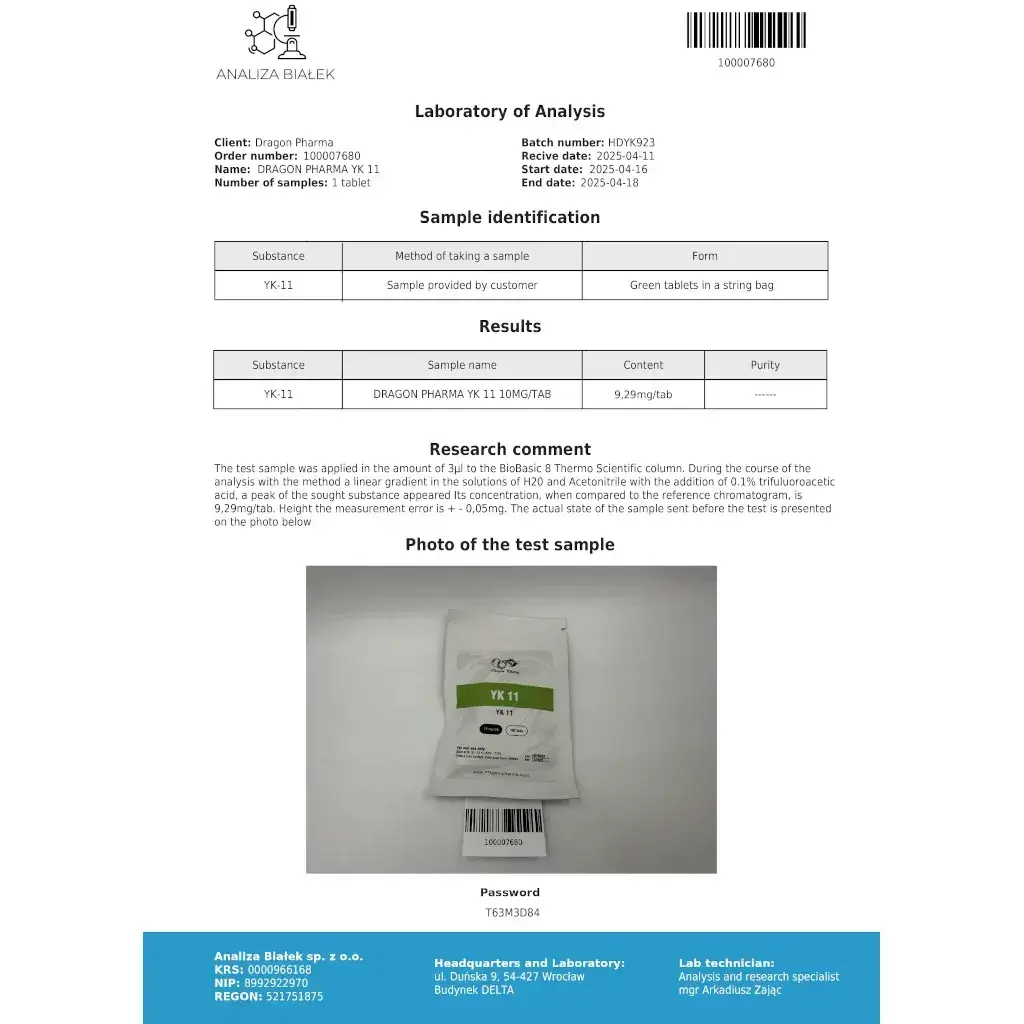
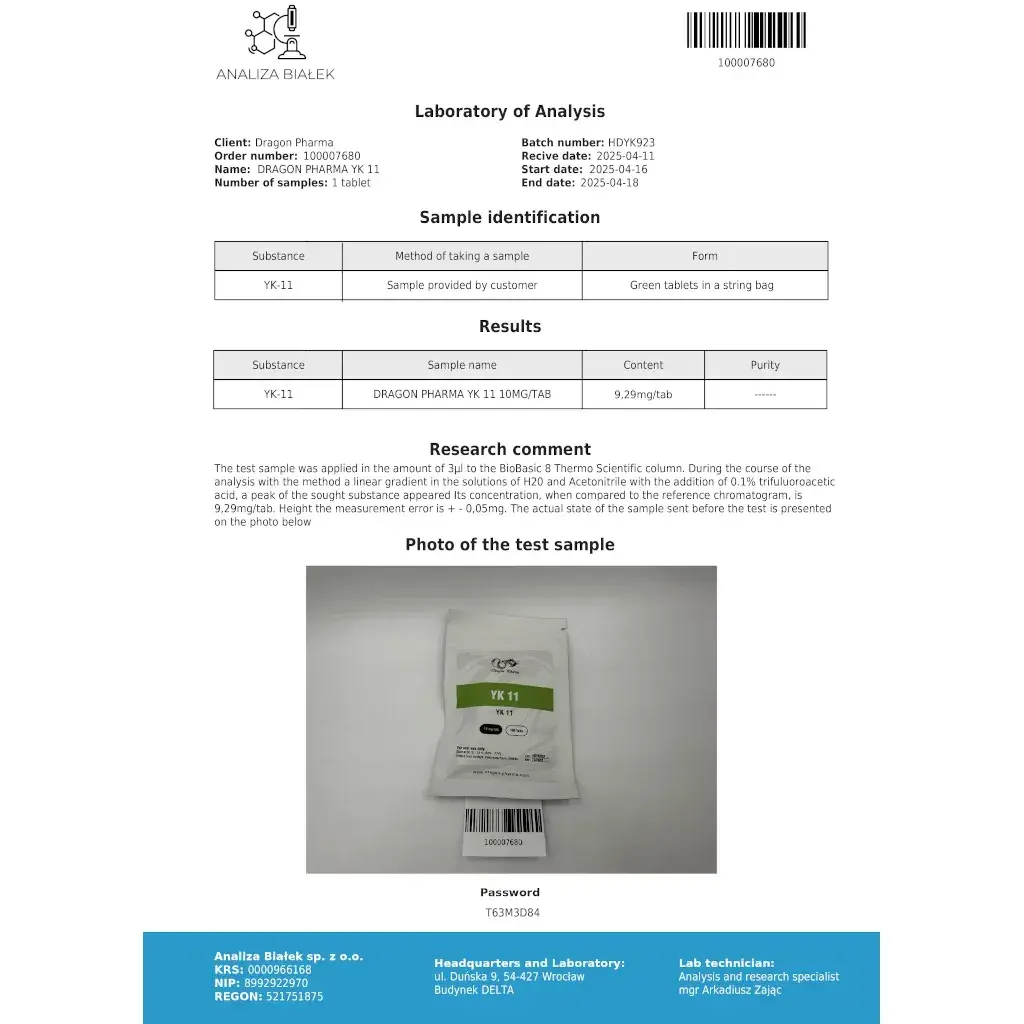
Published laboratory reports for YK 11 10 mg are shown below with the test date, measured YK-11 content, and percentage of the product's 10 mg label claim.
 View Report
Laboratory results apply to the specific tested sample represented in each published report and should not be interpreted as a measurement of every tablet or production batch.
The information below is provided for educational reference only. YK-11 is not approved by the FDA for any human indication and is classified as an unapproved new drug when sold for human consumption. No controlled human trials exist to establish safety or efficacy. Non-medical use falls outside approved indications and carries substantial health risks.
No safe or effective dosage has been established for humans. In non-medical bodybuilding contexts, YK-11 is commonly referenced in the range of 5–15 mg per day, with some sources referencing doses as low as 2–5 mg daily for beginners. Due to the estimated short half-life of 6–10 hours, split dosing twice daily is commonly referenced to maintain more stable blood levels.
| Use Case | Common Reference Range | Frequency |
|---|---|---|
| Beginner (non-medical) | 2–5 mg / day | Split into 2 doses |
| Intermediate (non-medical) | 5–10 mg / day | Split into 2 doses |
| Advanced (non-medical) | 10–15 mg / day | Split into 2 doses |
| Cycle duration (non-medical) | 6–8 weeks | Due to suppression and toxicity concerns |
In non-medical contexts, YK-11 is frequently referenced as a standalone compound or stacked with other SARMs such as MK 2866 or RAD 140. However, community discussion advises against stacking multiple suppressive compounds due to cumulative risk. YK-11 has been described as "essentially three PEDs in one" (SARM, myostatin inhibitor, and steroidal compound), which increases the complexity of managing side effects. Cycle duration is commonly referenced as 6–8 weeks, with longer cycles potentially increasing suppression and side effect risk.
YK-11 is considered one of the most suppressive and harsh SARMs, with community reports describing it as second only to S-23 in suppression severity. Ligament and joint issues have been reported, and users are commonly advised to supplement with collagen and glucosamine. Because YK-11 has been shown to depress estradiol levels, some users reference DHEA supplementation to maintain some estrogenic activity. Neurotoxicity has been observed in rodent studies, with YK-11 altering hippocampal neurochemistry and impairing memory consolidation. Bloodwork including liver function tests, lipid panel, and hormonal assessment is strongly recommended.
YK-11 suppresses endogenous testosterone production, and post-cycle therapy is considered essential in non-medical contexts. A SERM-based PCT is commonly referenced, with enclomiphene or nolvadex being common choices. Agents such as Clomid or Nolvadex are commonly referenced for this purpose. Due to the short half-life, PCT can be initiated 2–3 days after the last dose. Endogenous testosterone recovery typically takes 4–6 weeks, though recovery timelines vary based on cycle length and dose.
YK-11 is not approved for human use and has not been evaluated in controlled human trials. The information above is for educational reference and does not constitute medical advice. Non-medical use is strongly cautioned against.
YK-11 is not approved by the FDA for any human indication. No controlled human safety or efficacy studies exist, and all available data comes from cell culture and animal models.
YK-11 is an investigational compound that has never been approved for human use. The FDA has classified YK-11 capsules as unapproved new drugs when sold for human consumption. A human elimination study found no intact YK-11 in urine after administration, indicating rapid and extensive metabolism to 14 identified metabolites. This rapid metabolism has been cited as a potential limitation on the compound's bioavailability and activity at target tissues.
YK-11 is prohibited by WADA, and its metabolites are characterized for doping control purposes. Athletes subject to drug testing should be aware that YK-11 use is detectable through its urinary metabolites.
YK-11 has no approved human indication. Non-medical use falls outside approved indications and carries significant health risks including neurotoxicity, severe hormonal suppression, and unknown long-term effects. Product strength and laboratory verification do not establish safety for human consumption.
Neurotoxicity: A 2024 rat study found that YK-11 at anabolic doses significantly altered hippocampal neurochemistry, increased pro-inflammatory cytokines (IL-1β and IL-6), reduced anti-inflammatory IL-10, and impaired memory consolidation. The study concluded that these findings "underscore concerns about the misuse risks of SARMs among athletes".
Hormonal suppression: YK-11 is considered one of the most suppressive SARMs, with community reports comparing its suppression severity to S-23. Suppression of endogenous testosterone production is expected, and PCT is considered essential.
Ligament and joint issues: Anecdotal reports describe ligament issues and potential tears associated with YK-11 use, leading to recommendations for collagen and glucosamine supplementation.
Estradiol suppression: YK-11 has been noted to depress estradiol levels, which may contribute to joint issues and other side effects. Some users reference DHEA supplementation to maintain some estrogenic activity.
Unknown long-term effects: Because no human trials have been conducted, the long-term effects of YK-11 use are entirely unknown.
Given the documented neurotoxicity in animal models and the complete absence of human safety data, any consideration of YK-11 exposure warrants comprehensive medical evaluation. Individuals with a history of neurological conditions, psychiatric disorders, or cardiovascular disease are at heightened theoretical risk. The 2024 rat study's findings on memory impairment raise particular concerns for cognitive function.
There is no established monitoring protocol for non-medical YK-11 use. For any human exposure, comprehensive bloodwork including liver function tests, lipid panel, and hormonal assessment (total and free testosterone, LH, FSH, estradiol) should be considered by a qualified healthcare professional. No safe monitoring parameters have been established because human safety data is entirely absent.
Store in a cool, dry place away from direct light and moisture. Keep the product in its original packaging and out of the reach of children. This product is not for human consumption.
YK 11 10 mg is supplied through the Dragon Pharma distribution chain and shipped in original manufacturer packaging with discreet, privacy-focused handling.
The outer shipping package remains discreet, with privacy-focused handling and no unnecessary external product details. Products are supplied through the Dragon Pharma distribution chain.
To verify your YK 11 10 mg product, cross-check the security features on the packaging against Dragon Pharma's official presentation. Batch-linked lab proof and original packaging help reinforce product legitimacy.
For complete delivery details, tracking policy, and reshipment terms, please see our Shipping Info page.
Proper storage conditions help preserve tablet integrity and overall product stability throughout shelf life.
Store in a cool, dry place away from excessive heat, moisture, and direct light. Maintaining stable conditions helps preserve the integrity of the tablets.
Keep the tablets in their original packaging until use. Do not use if the packaging appears compromised or if the tablets show signs of degradation such as discoloration or crumbling.
Keep out of reach of children. This product is not for human consumption.
Answers to common questions about YK 11 10 mg, YK-11, SARM mechanisms, dosing, and safety.
YK 11 10 mg contains YK-11, a steroidal SARM with myostatin-inhibiting properties. It has no approved medical use and no human trials have been conducted. In non-medical bodybuilding contexts, it is commonly referenced for its dual mechanism of androgen receptor activation and myostatin inhibition, though such use falls outside approved indications and carries substantial health risks.
YK-11 has an estimated half-life of 6–10 hours based on its rapid metabolism, supporting twice-daily dosing to maintain more stable blood levels. In non-medical contexts, it is typically referenced as being taken in divided doses throughout the day.
YK-11 is a steroidal compound with a dual mechanism: it acts as a partial androgen receptor agonist and inhibits myostatin through upregulation of follistatin. In cell studies, it induced myogenic differentiation and increased follistatin expression. In animal models, it prevented muscle wasting during sepsis.
No human data exists to establish onset time. In non-medical contexts, users report subtle improvements in workout pumps by the end of week 2, with noticeable strength and muscle hardness increases beginning during weeks 3–4. These reports are anecdotal and have not been validated in controlled trials.
YK-11 is frequently described as one of the most potent SARMs due to its dual mechanism and steroidal structure. Community discussion often places it among the strongest, along with S 23. However, no human data exists to quantify its potency or compare it to other SARMs.
YK-11 is a steroidal SARM with myostatin-inhibiting activity, while MK 2866 (ostarine) is a nonsteroidal SARM that acts solely through the androgen receptor. YK-11 is considered significantly more potent and suppressive, and it carries neurotoxicity concerns not associated with ostarine.
Both are potent SARMs, but YK-11 has a unique dual mechanism involving myostatin inhibition that RAD 140 lacks. YK-11 is also steroidal in structure, while RAD 140 is nonsteroidal. Community discussion generally places YK-11 in a higher potency and suppression tier than RAD 140.
YK-11 has no established human dosage. In non-medical contexts, 10 mg per day is commonly referenced as a moderate dose, with some sources recommending starting at 2–5 mg daily. YK 11 10 mg is labeled at 10 mg per tablet.
YK 11 10 mg is labeled at 10 mg of YK-11 per tablet. It is supplied in a 100-tablet package, giving 1,000 mg of total labeled YK-11 content.
Yes. A published laboratory report dated April 18, 2025 measured YK 11 10 mg at 9.29 mg per tablet, equivalent to 92.90% of its 10 mg label claim. Complete reports can be viewed in the Lab Reports tab.
No. YK-11 is not approved by the FDA for any human indication and is classified as an unapproved new drug when sold for human consumption. It is prohibited by WADA, and its metabolites are characterized for doping control purposes.