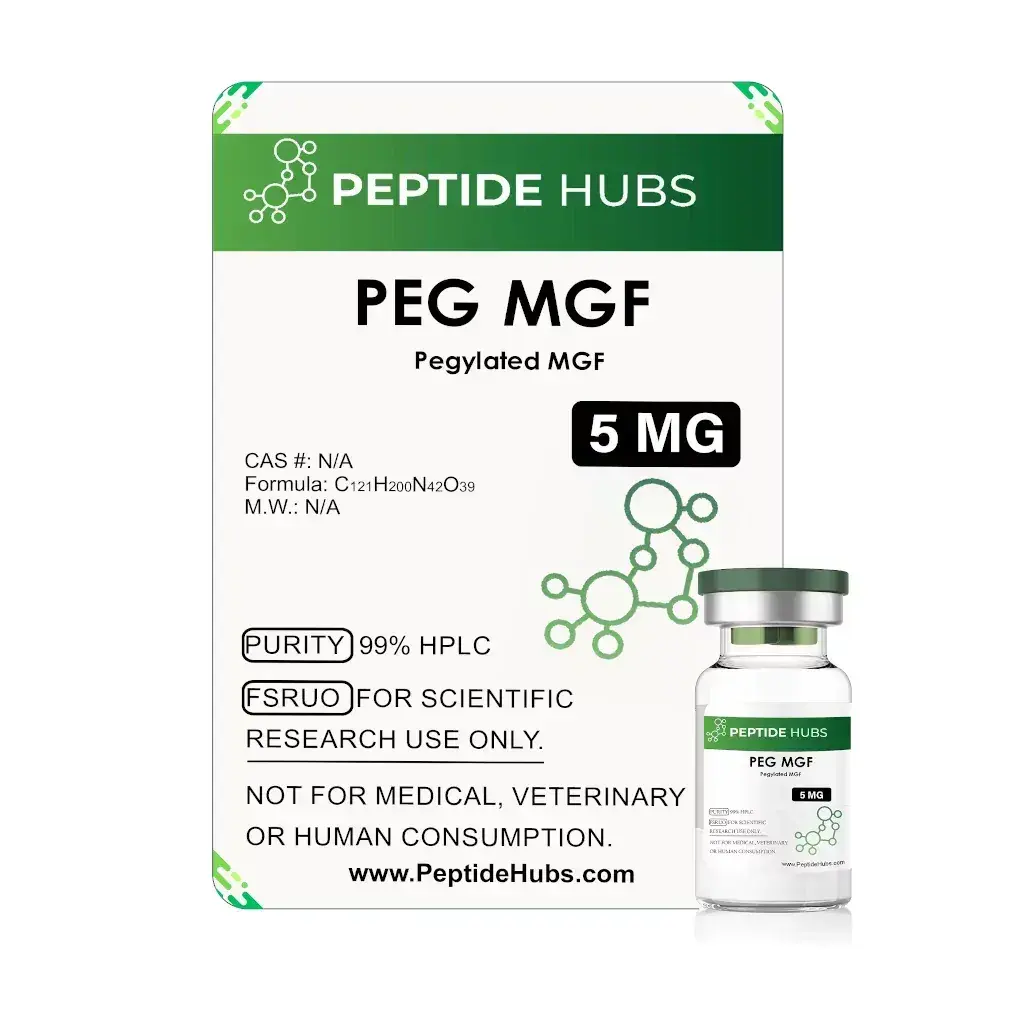
PEG MGF 5 mg is a lyophilized Pegylated Mechano Growth Factor research product manufactured by Peptide Hubs and supplied as a 5 mg/vial powder in a 2 mL vial.
PEG MGF 5 mg contains Pegylated Mechano Growth Factor (PEG-MGF), a synthetic peptide consisting of the 24-amino-acid E-domain of IGF-1Ec conjugated with polyethylene glycol (PEG). Mechano Growth Factor is a splice variant of the IGF-1 gene that is produced locally in skeletal muscle in response to mechanical loading and damage. Native MGF has an extremely short half-life of approximately 5–7 minutes due to rapid enzymatic degradation, which limits its practical utility in research settings.
The PEGylation process covalently attaches polyethylene glycol chains to the MGF peptide, sterically shielding it from proteolytic enzymes and extending its circulating half-life from minutes to several hours. This modification enables systemic administration via subcutaneous injection rather than requiring local intramuscular injection at the target site. PEG-MGF is proposed to activate muscle satellite cells (muscle stem cells) and initiate the repair response following muscle damage, acting through mechanisms that may be distinct from the classical IGF-1 receptor pathway.
PEG MGF 5 mg is not FDA-approved for any human use. As of April 2026, no completed randomized controlled trials of exogenous MGF or PEG-MGF administration have been published in peer-reviewed journals. The evidence base consists primarily of in vitro cell culture studies and animal models, with some findings showing proliferative effects on muscle progenitor cells while other laboratories have reported no effect in replication attempts.
PEG MGF 5 mg is supplied as a lyophilized (freeze-dried) powder in a 2 mL vial. Reconstitution with an appropriate solvent is required before use in research contexts.
PEG-MGF is a synthetic 24-amino-acid peptide with the sequence YQPPSTNKNTKSQRRKGSTFEEHK, conjugated with polyethylene glycol at the N-terminus.
PEG-MGF belongs to the class of IGF-1 splice variant peptides. The IGF-1 gene undergoes alternative splicing to produce multiple isoforms with distinct biological functions. While the liver produces systemic IGF-1 (IGF-1Ea) under growth hormone stimulation, skeletal muscle produces MGF locally in response to mechanical stress. The MGF E-domain peptide is responsible for its satellite cell activation properties and is believed to act through receptor systems distinct from the classical IGF-1 receptor, though the precise receptor has not been definitively identified.
In vitro studies have reported that the MGF E-peptide activates quiescent satellite cells in a dose-dependent manner, with optimal proliferative responses observed at concentrations of 50–100 ng/mL. However, the literature is not uniform: a replication attempt published in a high-quality journal found no proliferative change in C2C12 cells or primary skeletal myoblast cultures at peptide concentrations up to 500 ng/mL, directly contradicting earlier positive findings. This replication gap prevents strong conclusions about the MGF E-peptide's direct cellular mechanism.
In non-medical bodybuilding contexts, PEG-MGF is commonly referenced for muscle repair and recovery support. Community protocols typically use 200–400 mcg administered 2–3 times per week, with cycles of 4–8 weeks.
PEG-MGF is distinguished from native MGF by its PEGylation, which extends the half-life from approximately 5–7 minutes to several hours, enabling systemic distribution and less frequent dosing in research protocols.
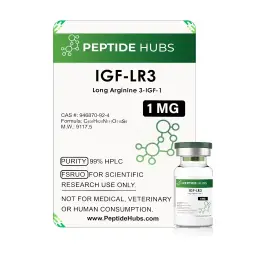
Peptide Hubs offers several research peptides targeting muscle growth and recovery pathways. Within this lineup, IGF-1 LR3 is commonly discussed alongside PEG-MGF for its growth factor activity, though IGF-1 LR3 acts through the IGF-1 receptor to promote differentiation and protein synthesis while MGF is proposed to act through IGF-1R-independent pathways to activate satellite cells.
For research focused on tissue repair rather than growth factor signaling, BPC 157 operates through angiogenic and cytoprotective mechanisms. For research requiring a reconstitution solution, Bacteriostatic Water is the standard diluent for preparing lyophilized peptides like PEG MGF 5 mg.
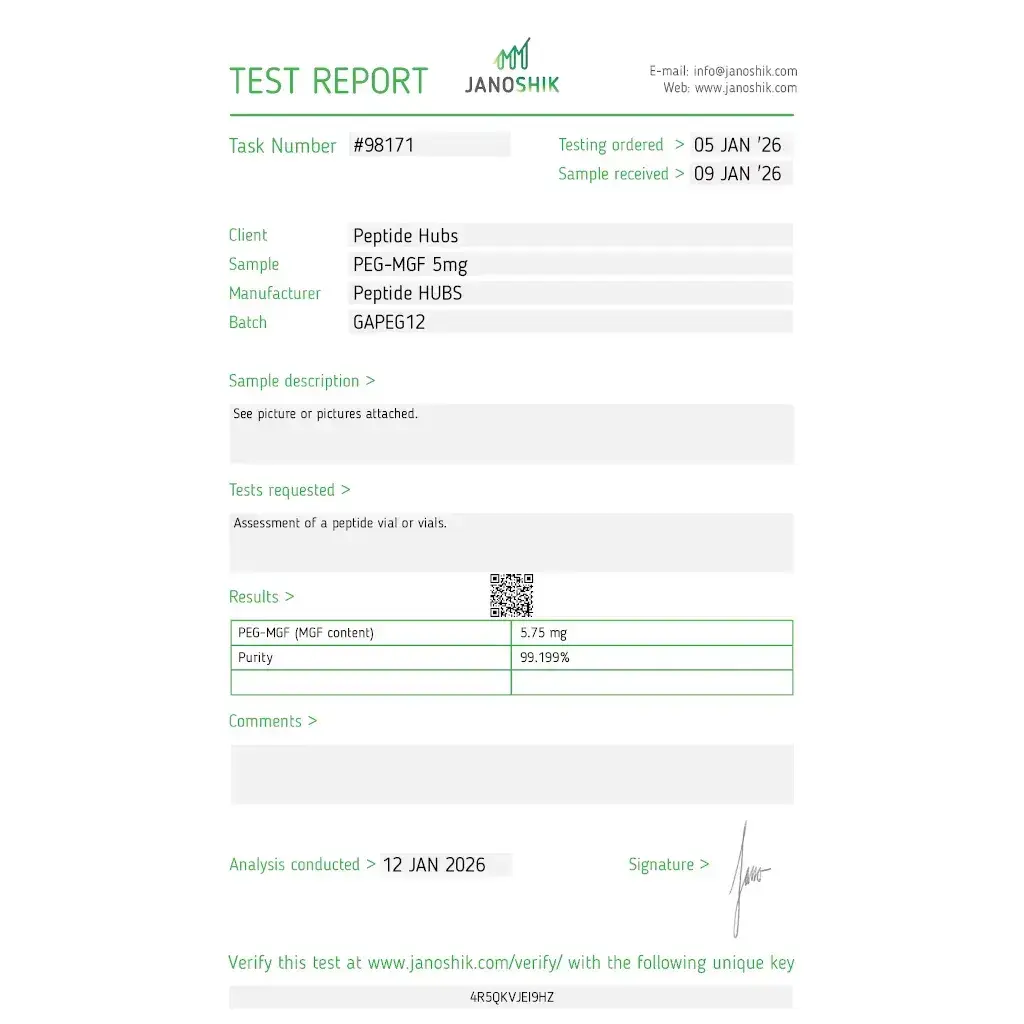
Published laboratory reports for PEG MGF 5 mg are shown below with the test date, measured content, and batch number.
 View Report
Laboratory results apply to the specific tested sample represented in each published report and should not be interpreted as a measurement of every vial or production batch.
The information below is provided for educational reference only. PEG-MGF is not an FDA-approved human drug. Its use for any non-medical purpose falls outside approved indications, and no established human dosing regimen exists.
Because PEG-MGF lacks FDA approval and human clinical trials, there is no medically established dosage range. In non-medical bodybuilding and research communities, reference ranges are derived from community convention and extrapolation from animal studies. Community protocols most commonly reference 200–400 mcg per injection administered 2–3 times per week.
| Use Case | Common Reference Range | Injection Frequency |
|---|---|---|
| Beginner protocol (non-medical) | 100–200 mcg | 2–3 times per week |
| Standard recovery protocol (non-medical) | 200–300 mcg | 2–3 times per week |
| Post-workout IM protocol (non-medical) | 200–400 mcg | Post-workout, 2–3 times per week |
| Recovery/injury protocol (non-medical) | 200–300 mcg | Daily for 5–7 days, then 2–3 times weekly |
These ranges are community conventions, not evidence-based medical recommendations. No human pharmacokinetic studies have been conducted for PEG-MGF, and all dosing information is extrapolated from preclinical data and PEGylation pharmacology principles.
PEG MGF 5 mg is supplied as a lyophilized powder and requires reconstitution before use. A 5 mg vial reconstituted with 2 mL of bacteriostatic water yields a concentration of 2.50 mg/mL, meaning a 200 mcg dose would require drawing 8 units on a U-100 insulin syringe.
Reconstituted solution should be stored refrigerated at 2–8°C and used within 2–3 weeks. Do not freeze reconstituted solution. Protect from light.
In non-medical bodybuilding contexts, PEG-MGF is sometimes combined with IGF-1 LR3 for a combined growth factor approach, or with BPC 157 for recovery-focused protocols. Standard community cycles typically run 4–8 weeks, followed by a break period.
No human pharmacokinetic or dose-response data exists for PEG-MGF. All dosage information is derived from animal research or community convention and should not be interpreted as medical guidance.
PEG-MGF is not FDA-approved for any human use. No human pharmacokinetic, safety, or efficacy studies have been conducted.
PEG-MGF has not received FDA approval and has never been tested in humans. The FDA currently names “Mechano Growth Factor Pegylated (PEG-MGF)” as a withdrawn nomination on its compounding-risk page and as one of five substances planned for a future PCAC discussion.
A significant safety consideration for PEGylated compounds is the potential for anti-PEG antibodies with repeated dosing, which can lead to accelerated blood clearance (ABC phenomenon) on subsequent doses. This is a class effect observed with other PEG-peptide conjugates.
PEG-MGF is sold strictly as a research chemical for laboratory use only. It is not intended for human consumption, medical treatment, or veterinary applications. Non-medical use falls outside approved indications.
No rodent toxicology data specific to PEG-MGF is publicly available. The literature on the base MGF peptide is not uniform, with some laboratories reporting proliferative effects while others have found no effect in replication attempts.
Theoretical concerns related to growth factor activity include proliferative effects that could be relevant in the context of malignancy. The FDA lists MGF in Category 3, the section for substances nominated without adequate support.
Given the complete absence of human safety data, any consideration of PEG-MGF use should involve consultation with a qualified healthcare professional. Individuals with a history of cancer or strong family history of malignancy should exercise particular caution due to theoretical mitogenic concerns with growth factor signaling.
No established monitoring protocol exists for PEG-MGF. Suggested baseline bloodwork in community protocols includes IGF-1, CBC, CMP with liver enzymes, and fasting glucose.
Store lyophilized powder at -20°C for long-term storage or 2–8°C short-term. Reconstituted solution should be stored at 2–8°C and used within 2–3 weeks. Do not freeze reconstituted solution. Protect from light. Keep out of reach of children.
PEG MGF 5 mg is supplied through the official Peptide Hubs distribution chain and shipped in original manufacturer packaging with discreet handling.
The outer shipping package remains discreet, with privacy-focused handling. Products are supplied through the official Peptide Hubs distribution chain.
To verify your PEG MGF 5 mg product, use the security code on the vial label and cross-check it on the Peptide Hubs official site. Original packaging and manufacturer presentation help reinforce product legitimacy.
For complete delivery details, tracking policy, and reshipment terms, please see our Shipping Info page.
Proper storage conditions help preserve peptide stability and integrity throughout shelf life.
Store lyophilized powder at -20°C for long-term storage or 2–8°C short-term. Protect from light.
Once reconstituted, store refrigerated at 2–8°C and use within 2–3 weeks. Do not freeze reconstituted solution.
Keep out of reach of children. Follow proper handling practices.
Answers to common questions about PEG MGF 5 mg, Pegylated MGF, and research peptide handling.
PEG MGF 5 mg is a research peptide studied in preclinical models for its potential effects on muscle satellite cell activation and tissue repair. In non-medical bodybuilding contexts, it is commonly referenced for muscle recovery support, though such use falls outside approved indications and lacks human clinical validation.
No established human dosing schedule exists. Community protocols commonly reference 2–3 times per week administration at 200–400 mcg per injection, based on convention rather than clinical data.
PEG-MGF does not suppress endogenous testosterone production and does not require post-cycle therapy in the way anabolic steroids do. However, any non-medical peptide use should be approached with caution given the complete absence of human safety data.
PEG-MGF is a PEGylated form of Mechano Growth Factor, an IGF-1 splice variant produced locally in muscle in response to mechanical loading. It is proposed to activate muscle satellite cells and initiate repair responses, acting through mechanisms that may be distinct from the classical IGF-1 receptor.
No human data establishes a timeline for effects. Native MGF has a half-life of approximately 5–7 minutes, while PEGylation extends this to several hours. Preclinical research suggests satellite cell activation occurs within hours of MGF expression, but translation to human timelines is speculative.
There is no universally “best” muscle growth peptide. PEG-MGF is one of several research peptides studied for muscle-related applications, each with distinct mechanisms. No human comparative data exists.
PEG-MGF is a PEGylated IGF-1 splice variant proposed to act through IGF-1R-independent pathways to activate satellite cells, while IGF-1 LR3 acts through the IGF-1 receptor to promote differentiation and protein synthesis. They are sequential rather than redundant in muscle repair biology.
PEG-MGF targets muscle satellite cell activation through growth factor signaling, while BPC 157 is a tissue-repair peptide studied for angiogenic and cytoprotective effects. They operate through different mechanisms and are sometimes combined in non-medical recovery protocols.
400 mcg is at the upper end of the range commonly referenced in community protocols (200–400 mcg per injection). Without human dose-response data, it is impossible to characterize any amount as appropriate or excessive.
PEG MGF 5 mg is labeled at 5 mg of PEG-MGF per vial. It is supplied as a lyophilized powder in a 2 mL vial.
Yes. A published laboratory report dated January 12, 2026 measured PEG MGF 5 mg at 5.75 mg, equivalent to 115.0% of its 5 mg label claim. The batch number is GAPEG12.
Store the lyophilized powder at -20°C for long-term storage or 2–8°C short-term. Once reconstituted, refrigerate at 2–8°C and use within 2–3 weeks. Do not freeze reconstituted solution.