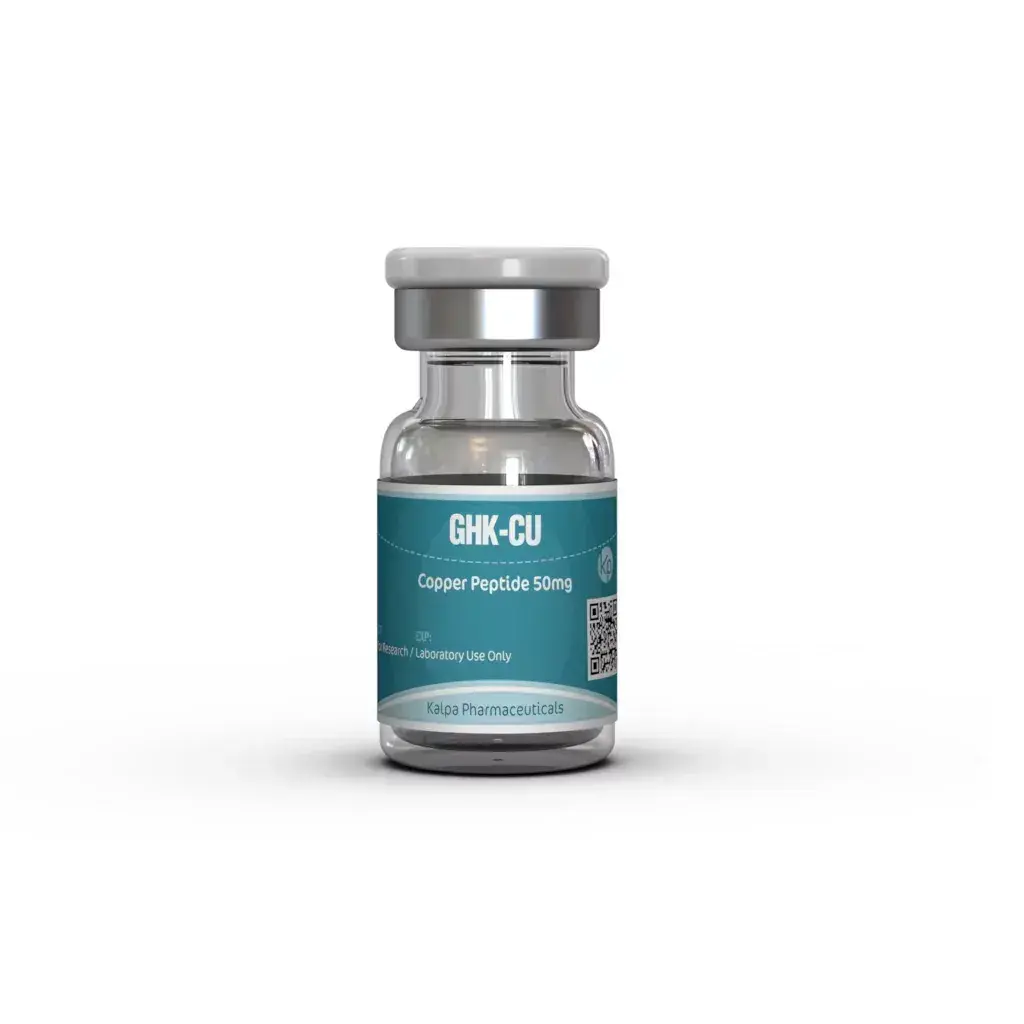
GHK-CU 50 mg is a lyophilized powder copper peptide formulation manufactured by Kalpa Pharmaceuticals and supplied in a 2 mL vial at 50 mg/vial.
GHK-CU 50 mg contains GHK-Cu (Copper Tripeptide-1), a naturally occurring copper-binding tripeptide composed of glycyl-L-histidyl-L-lysine complexed with copper(II). GHK is found in human plasma, saliva, and urine, and its copper complex GHK-Cu has been studied for its roles in matrix remodeling, inflammation regulation, and tissue repair. The peptide sequence was first isolated from human albumin and has been the subject of extensive dermatological and wound-healing research.
GHK-Cu is not currently an FDA-approved human pharmaceutical product. Injectable GHK-Cu has never had clear FDA authorization for routine compounding under Section 503A of the Federal Food, Drug, and Cosmetic Act, and is not on the formal 503A Bulks List. Topical formulations have historically had a more permissive regulatory position. The FDA is expected to further evaluate injectable GHK-Cu through the Pharmacy Compounding Advisory Committee (PCAC) process in 2027.
In research and non-medical contexts, GHK-Cu is commonly referenced for its potential effects on collagen synthesis, skin remodeling, and wound healing. Preclinical data consistently support effects on matrix remodeling, epithelial repair, inflammatory and redox regulation, and angiogenesis, though clinical evidence remains sparse. When used outside approved indications, the potential for adverse effects exists and such use falls outside approved medical indications.
GHK-CU 50 mg is supplied as a lyophilized powder that requires reconstitution with an appropriate diluent such as Bacteriostatic Water before use. This formulation is designed to preserve the stability of the copper peptide until it is ready for use.
GHK-Cu is a copper-binding tripeptide with a range of studied biological activities. Its mechanism of action and research applications distinguish it from anabolic steroids and other performance compounds.
GHK-Cu is a complex of the tripeptide glycyl-L-histidyl-L-lysine with copper(II). The histidine residue provides the primary copper-binding site, forming a stable complex. This copper-peptide complex has been studied for its roles in matrix remodeling, inflammation regulation, redox balance, angiogenesis, and tissue repair. GHK-Cu is thought to act as a signaling molecule that modulates gene expression related to collagen synthesis and extracellular matrix remodeling.
Preclinical data consistently support effects on matrix remodeling, epithelial repair, inflammatory and redox regulation, and angiogenesis. The clinical evidence, however, remains sparse and does not meet contemporary active-entity quality standards. A 13-participant post-CO2-laser study was negative on objective endpoints, while a 2026 18-participant split-face eyebrow study reported positive cosmetic hair outcomes but did not define GHK-Cu speciation or local exposure.
These characteristics explain why GHK-Cu is primarily referenced in research and dermatological contexts. It is not a compound with established human clinical efficacy.
The available evidence positions GHK-Cu as a promising but unproven therapeutic cargo rather than a clinically validated regenerative drug. Translation is limited less by biological plausibility than by pharmaceutical definition and evidence attribution.
Kalpa Pharmaceuticals offers several peptide and research formulations. The main practical distinction between these preparations involves the compound's mechanism and intended research or educational context.
Unlike anabolic steroids such as Testoxyl Cypionate 250 or Trenboxyl Acetate, GHK-Cu is not an androgen and works through copper-dependent signaling pathways rather than androgen receptor activation. For other peptide-based options in the Kalpa catalog, BPC 157 5 mg and TB 500 5 mg are research peptides studied for tissue repair, while Ipamorelin 5 mg is a growth hormone secretagogue.
The information below is provided for educational and research reference only. GHK-Cu is not an FDA-approved human pharmaceutical product. Injectable GHK-Cu is not on the 503A Bulks List and has never had clear FDA authorization for routine compounding. Non-medical use falls outside approved indications.
In research and clinical literature, GHK-Cu protocols are typically referenced in the range of 0.5–3 mg administered via subcutaneous injection, with frequency varying between weekly and monthly depending on the research context. These ranges are provided for educational reference only and do not constitute dosing guidance.
| Research Context | Common Reference Range | Frequency |
|---|---|---|
| Literature reference (initial) | 0.5–1 mg | Weekly or monthly |
| Literature reference (titration) | 1–1.5 mg | Weekly or monthly |
| Literature reference (maintenance) | 1.5–2 mg | Provider-determined |
GHK-CU 50 mg is supplied as a lyophilized powder that requires reconstitution with an appropriate diluent such as Bacteriostatic Water before use. The volume of diluent used determines the final concentration of the reconstituted solution. Reconstitution procedures should follow the guidelines provided with the specific product and use proper aseptic technique.
Once reconstituted, the solution should be stored under refrigeration and used within the recommended timeframe. The stability of GHK-Cu in solution can vary based on concentration, pH, and storage conditions.
In available literature, injection site reactions (erythema, edema, mild discomfort) occur in approximately 8–15% of reported cases and typically resolve within 1–3 days. Systemic adverse events remain rare in available trials, though long-term safety data in non-dermatology populations is sparse. Some animal and early-phase studies noted elevated inflammatory cytokines at higher doses, though clinical relevance in humans at therapeutic doses remains unclear.
Individuals with known copper sensitivity, Wilson's disease, or active systemic inflammation should exercise particular caution. Pregnant or nursing individuals lack sufficient safety data and should avoid this peptide. Aromatase inhibitors such as Arimixyl are not relevant to GHK-Cu use as it does not affect the aromatase pathway.
Post-cycle therapy is not applicable to GHK-Cu, as it is not a compound that suppresses the hypothalamic-pituitary-gonadal axis. It is a copper peptide studied for tissue repair and matrix remodeling. When GHK-Cu is used as part of a broader research protocol that includes anabolic compounds, standard PCT protocols such as those involving Clomixyl or Nolvaxyl would be relevant to those compounds, not to GHK-Cu itself.
Research protocols, reconstitution procedures and handling practices should be adjusted based on the specific context and the guidelines provided with the product. The information above is for educational reference and does not constitute medical advice.
GHK-Cu is a copper peptide that has been studied in dermatological and wound-healing contexts. Its safety profile in non-dermatological populations is not well characterized, and long-term safety data remains limited.
GHK-Cu is not an FDA-approved human pharmaceutical product. Injectable GHK-Cu has never had clear FDA authorization for routine compounding under Section 503A and is not on the formal 503A Bulks List. The FDA is expected to evaluate injectable GHK-Cu through the PCAC process in 2027.
Use of GHK-Cu outside approved research or medical contexts falls outside approved indications. The safety and efficacy of injectable GHK-Cu have not been established through controlled clinical trials.
Individuals with known copper sensitivity or Wilson's disease (a copper metabolism disorder) should avoid GHK-Cu. Pregnant or nursing individuals lack sufficient safety data and should avoid this peptide. Individuals with active systemic inflammation or immunocompromised states should obtain provider clearance before considering any copper-containing peptide.
Published dermatology studies report injection site reactions in 8–15% of participants, including erythema, mild edema, and temporary discomfort lasting 1–3 days. Systemic adverse events remain rare in available trials, though long-term safety data in non-dermatology populations is sparse.
Some animal and early-phase studies noted elevated inflammatory cytokines (IL-6, TNF-α) at higher doses, though clinical relevance in humans at therapeutic doses remains unclear. Allergic sensitization to copper compounds has been reported anecdotally but is not well-characterized in controlled GHK-Cu trials.
Individual safety profiles vary significantly based on genetic, inflammatory, and metabolic factors. Copper metabolism, inflammatory baseline, and immune response capacity all influence how individuals tolerate peptide compounds.
Individuals with known copper sensitivity, Wilson's disease, or active systemic inflammation should discuss GHK-Cu with a qualified healthcare provider before use. Patients on immunosuppressive therapy, those with uncontrolled inflammatory conditions, or individuals with a history of severe allergic responses to injectable compounds should obtain provider clearance.
A thorough medical evaluation and baseline inflammatory biomarkers can help contextualize individual risk. GHK-Cu is not appropriate for individuals with active infections or immunocompromised states.
Medically supervised peptide therapy typically involves follow-up assessment to evaluate treatment response, adverse effects, and relevant laboratory markers. For GHK-Cu, monitoring may include local injection site assessment and, where relevant, inflammatory markers.
For non-medical use of GHK-CU 50 mg, such monitoring is not typically performed, which increases the risk of unrecognized adverse effects.
Lyophilized GHK-Cu powder should be stored under refrigeration according to the manufacturer's instructions. Reconstituted solution should be refrigerated and used within the specified timeframe. Protect from excessive heat, moisture, and direct light.
Keep all medications and research products out of the reach of children. Follow the storage instructions provided with the product packaging.
GHK-CU 50 mg is supplied through the official Kalpa Pharmaceuticals distribution chain and shipped in original manufacturer packaging with discreet, privacy-focused handling.
The outer shipping package remains discreet, with privacy-focused handling and no unnecessary external product details. Products are supplied through the official Kalpa Pharmaceuticals distribution chain.
To verify your GHK-CU 50 mg product, use the security code on the vial label and cross-check it on the Kalpa official site. Official Kalpa Pharmaceuticals presentation, batch-linked lab proof, and original packaging help reinforce product legitimacy and buyer confidence.
For complete delivery details, tracking policy, and reshipment terms, please see our Shipping Info page.
Proper storage conditions help preserve formulation stability and overall product integrity throughout shelf life.
Lyophilized GHK-Cu powder should be stored under refrigeration according to the manufacturer's instructions. Protect from excessive heat, moisture, and direct light. Maintaining stable conditions helps preserve the integrity of the peptide formulation.
After reconstitution, store the solution under refrigeration and use within the recommended timeframe. Do not freeze the reconstituted solution. Before each use, inspect the solution and avoid use if it appears cloudy, discolored, contains particulate matter, or if the vial or seal is compromised.
Keep out of reach of children. Follow proper handling and sterile practices when using the product.
Answers to common questions about GHK-CU 50 mg, the copper peptide GHK-Cu, and its research and safety profile.
GHK-Cu is a copper-binding tripeptide that has been studied for its roles in matrix remodeling, inflammation regulation, tissue repair, and angiogenesis. In dermatological research, it has been investigated for potential effects on collagen synthesis and skin remodeling.
Preclinical data consistently support these effects, but the clinical evidence remains sparse and does not meet contemporary active-entity quality standards. GHK-Cu should be regarded as a promising but unproven therapeutic cargo rather than a clinically validated drug.
Published dermatology studies report injection site reactions in 8–15% of participants, including erythema, mild edema, and temporary discomfort lasting 1–3 days. Systemic adverse events remain rare in available trials, though long-term safety data in non-dermatology populations is sparse.
Some animal and early-phase studies noted elevated inflammatory cytokines at higher doses, though clinical relevance in humans at therapeutic doses remains unclear. Allergic sensitization to copper compounds has been reported anecdotally but is not well-characterized.
Research and clinical literature typically references GHK-Cu protocols in the range of 0.5–3 mg administered via subcutaneous injection, with frequency varying between weekly and monthly. These ranges are provided for educational reference only and do not constitute dosing guidance.
GHK-Cu is not an FDA-approved human pharmaceutical product, and injectable GHK-Cu is not on the 503A Bulks List. The safety and efficacy of injectable GHK-Cu have not been established through controlled clinical trials.
Injectable GHK-Cu has never had clear FDA authorization for routine compounding under Section 503A of the Federal Food, Drug, and Cosmetic Act, and is not on the formal 503A Bulks List. Topical formulations have historically had a more permissive regulatory position. The FDA is expected to evaluate injectable GHK-Cu through the PCAC process in 2027.
Regulatory status can vary, and individuals should consult appropriate legal or regulatory resources for current information.
GHK-CU 50 mg contains the copper peptide GHK-Cu in lyophilized powder form. It is supplied for research and educational purposes. In research contexts, GHK-Cu has been studied for matrix remodeling, tissue repair, and related biological activities.
It is not an FDA-approved human pharmaceutical product and is not intended for human use outside approved research contexts.
Frequency of use depends on the specific research or clinical context. In available literature, GHK-Cu protocols are typically referenced as weekly or monthly injections. These frequencies are for educational reference only and do not constitute dosing guidance.
Reconstitution and handling procedures should follow the guidelines provided with the specific product.
Post-cycle therapy is not applicable to GHK-Cu, as it is not a compound that suppresses the hypothalamic-pituitary-gonadal axis. It is a copper peptide studied for tissue repair and matrix remodeling.
When GHK-Cu is used as part of a broader research protocol that includes anabolic compounds, standard PCT protocols such as those involving Clomixyl or Nolvaxyl would be relevant to those compounds, not to GHK-Cu itself.
GHK-Cu is a complex of the tripeptide glycyl-L-histidyl-L-lysine with copper(II). It has been studied for its roles in matrix remodeling, inflammation regulation, redox balance, angiogenesis, and tissue repair. It is thought to act as a signaling molecule that modulates gene expression related to collagen synthesis and extracellular matrix remodeling.
Preclinical data support these effects, but clinical evidence remains sparse.
The time required to observe effects depends on the specific outcome being evaluated, the research or clinical context, and individual factors. In dermatological studies, some changes have been reported over weeks to months.
However, the clinical evidence for GHK-Cu remains limited, and the time to effect is not well characterized through controlled clinical research.
GHK-Cu is one of the most extensively studied copper peptides, but the literature frequently treats GHK-Cu as a single active ingredient despite formulation-dependent variation in coordination state, speciation, stability, and pharmacokinetics. There is no single copper peptide that is universally best.
The appropriate choice depends on the specific research or clinical context.
GHK-CU 50 mg contains the copper peptide GHK-Cu, which is studied for matrix remodeling and tissue repair through copper-dependent signaling pathways. BPC 157 5 mg is a different peptide studied for gastrointestinal and tissue repair properties through different mechanisms.
These are different compounds with different research profiles.
The milligram strength of the vial (50 mg) refers to the total amount of GHK-Cu in the vial, not the amount administered per dose. The dose administered depends on how the powder is reconstituted and the specific protocol being followed.
It is important to distinguish vial strength from administered dose. A 50 mg vial can be reconstituted with an appropriate volume of diluent to achieve the desired concentration for research or educational purposes.