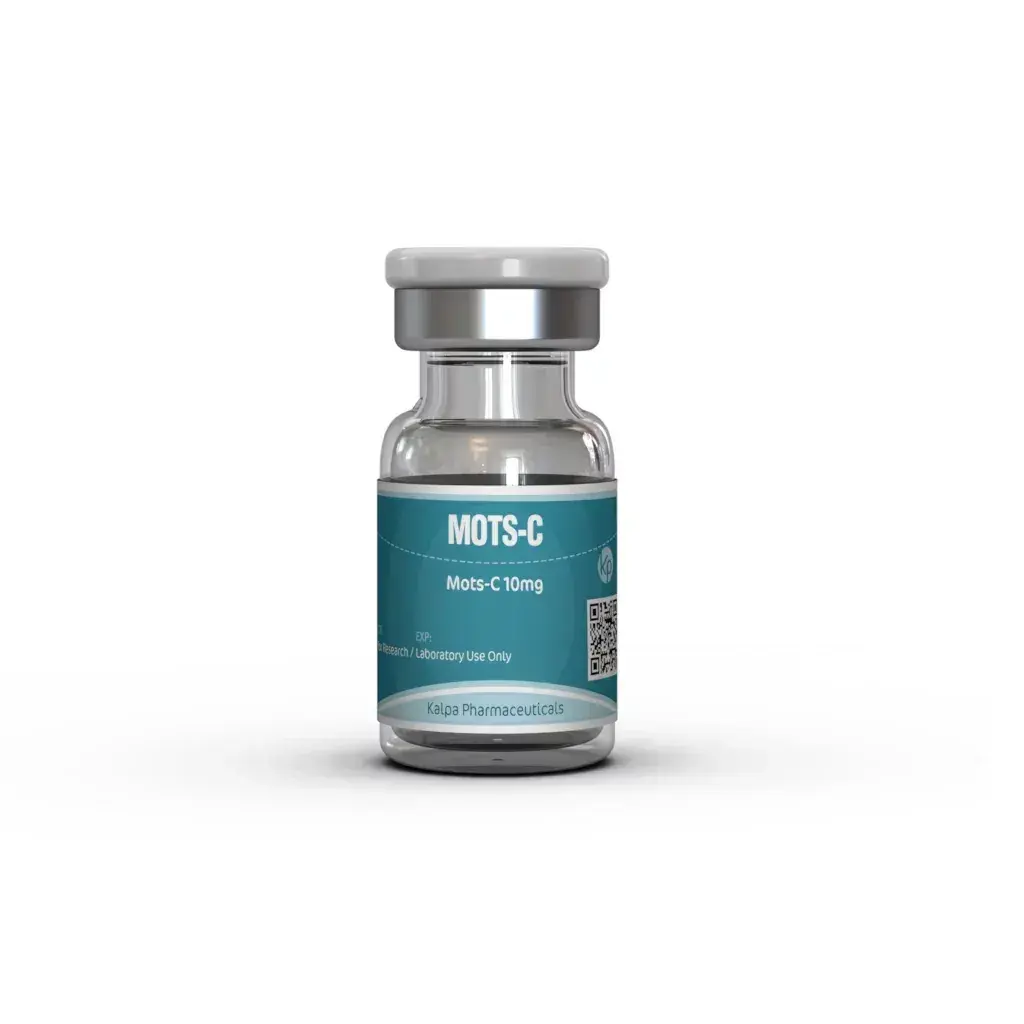
MOTS-c 10 mg is a lyophilized mitochondrial-derived peptide formulation manufactured by Kalpa Pharmaceuticals and supplied in a 2 mL vial at 5 mg/vial.
MOTS-c 10 mg contains MOTS-c (Mitochondrial Open Reading Frame of the 12S rRNA Type-C), a 16-amino-acid peptide encoded within the mitochondrial genome. Unlike most peptides, which are encoded by nuclear DNA, MOTS-c is produced by the mitochondria themselves. It is released during metabolic stress such as exercise and caloric restriction, then travels to the nucleus to regulate gene expression related to metabolic homeostasis.
MOTS-c is not currently an FDA-approved human pharmaceutical product. As of July 2026, an FDA advisory panel voted narrowly (7-5, with two abstentions) to recommend MOTS-c be allowed for compounding by pharmacies, though this recommendation does not constitute FDA approval. The regulatory pathway still requires removal from Category 2, formal PCAC recommendation, and Category 1 placement via notice-and-comment rulemaking, which realistically requires 8–12 months for unambiguous legality.
In research and non-medical contexts, MOTS-c is commonly referenced for its potential effects on metabolic regulation, insulin sensitivity, fat oxidation, and physical capacity. Preclinical data from animal models consistently support these effects, though human clinical evidence remains limited to early-phase trials. When used outside approved research contexts, the potential for adverse effects exists and such use falls outside approved medical indications.
MOTS-c 10 mg is supplied as a lyophilized powder that requires reconstitution with an appropriate diluent such as Bacteriostatic Water before use. This formulation is designed to preserve the stability of the peptide until it is ready for use.
MOTS-c is a mitochondrial-derived peptide with a unique mechanism of action. Its genomic origin and metabolic signaling pathways distinguish it from anabolic steroids and other performance compounds.
MOTS-c is a 16-amino-acid peptide encoded by the 12S rRNA region of the mitochondrial genome. It is the only major peptide coded inside the mitochondrial genome rather than the cell nucleus. During metabolic stress such as exercise or caloric restriction, MOTS-c is released and travels to the nucleus, where it regulates the expression of nuclear genes involved in metabolic homeostasis.
MOTS-c activates AMPK, the cell's primary energy sensor, which shifts fuel preference toward fat oxidation, enhances glucose uptake through GLUT4 translocation, and supports mitochondrial biogenesis. Recent research has demonstrated that MOTS-c directly binds to and activates CK2 (casein kinase 2), a mechanism that mediates its effects on skeletal muscle function. The peptide also inhibits the folate cycle, leading to accumulation of AICAR, an endogenous AMPK activator.
These characteristics explain why MOTS-c is commonly referenced in research and non-medical contexts for its potential metabolic and anti-aging properties. It is not a compound with established human clinical efficacy.
MOTS-c has extensive animal data demonstrating metabolic benefits, including prevention of diet-induced obesity, improved insulin sensitivity, and increased physical capacity in mice. However, human clinical evidence is limited, with no completed human safety trials published.
Kalpa Pharmaceuticals offers several peptide and research formulations. The main practical distinction between these preparations involves the compound's mechanism and intended research or educational context.
Unlike anabolic steroids such as Testoxyl Cypionate 250 or Trenboxyl Acetate, MOTS-c is not an androgen and works through AMPK-dependent metabolic pathways rather than androgen receptor activation. For other peptide-based options in the Kalpa catalog, Ipamorelin 5 mg is a growth hormone secretagogue, BPC 157 5 mg is a research peptide studied for tissue repair, and GHK-CU 50 mg is a copper peptide studied for matrix remodeling.
The information below is provided for educational and research reference only. MOTS-c is not an FDA-approved human pharmaceutical product. Non-medical use falls outside approved indications.
In research and non-medical contexts, MOTS-c is commonly referenced in the range of 5–10 mg per dose, administered 1–3 times per week, though such use falls outside approved medical indications. Some practitioners reference lower starting doses of 2–5 mg, with screening doses as low as 250 mcg for tolerance assessment. These ranges are derived from self-reported protocols and animal study extrapolations, not from controlled human clinical trials.
| Use Case | Common Reference Range | Injection Frequency |
|---|---|---|
| Metabolic support (research) | 5–10 mg per injection | 1–3 times weekly |
| Beginner/tolerance assessment | 250 mcg–2 mg | 1–3 times weekly |
| Cycle protocol | 5 mg per injection | 4–6 weeks on, 2–4 weeks off |
MOTS-c 10 mg is supplied as a lyophilized powder that requires reconstitution with an appropriate diluent such as Bacteriostatic Water before use. One important consideration is that MOTS-c may require isotonic bacteriostatic water (containing sodium chloride) rather than plain bacteriostatic water, as plain (hypotonic) water can cause injection-site burning.
Reconstitution should involve adding the diluent slowly down the side of the vial rather than directly onto the powder, followed by gentle swirling rather than shaking. Once reconstituted, the solution should be stored under refrigeration and used within the recommended timeframe.
No completed human safety trials have been published for MOTS-c, and there is no peer-reviewed human safety database. Anecdotal adverse signals include heart palpitations and increased heart rate. Approximately 10% of users may experience adverse reactions, with some reactions being serious.
MOTS-c involvement in AMPK and glucose metabolism suggests a possible interaction with medications for diabetes such as metformin. Individuals with pre-existing cardiac arrhythmia or structural heart disease, active or suspected malignancy, or those who are pregnant or breastfeeding should not use MOTS-c. Aromatase inhibitors such as Arimixyl are not relevant to MOTS-c use as it does not affect the aromatase pathway.
Post-cycle therapy is not applicable to MOTS-c, as it is not a compound that suppresses the hypothalamic-pituitary-gonadal axis. It is a mitochondrial-derived peptide studied for metabolic regulation. When MOTS-c is used as part of a broader research protocol that includes anabolic compounds, standard PCT protocols such as those involving Clomixyl or Nolvaxyl would be relevant to those compounds, not to MOTS-c itself.
Research protocols, reconstitution procedures and handling practices should be adjusted based on the specific context and the guidelines provided with the product. The information above is for educational reference and does not constitute medical advice.
MOTS-c is a research peptide that has been studied primarily in animal models. Its safety profile in humans is not well characterized, and no completed human safety trials have been published.
MOTS-c is not approved by the FDA for any medical use. Research on this compound has been limited primarily to laboratory and animal studies, with little to no human clinical trial data available. Its safety, efficacy, appropriate dosing, and long-term effects in humans have not been established.
As of July 2026, an FDA advisory panel voted narrowly (7-5, with two abstentions) to recommend MOTS-c be allowed for compounding by pharmacies, though this recommendation does not constitute FDA approval or demonstrated clinical benefit. The regulatory pathway still requires formal rulemaking, which realistically requires 8–12 months for unambiguous legality.
As of the 2024 WADA Prohibited List, MOTS-c is banned at all times under Section S4.4 (Metabolic Modulators — AMPK activators). Athletes subject to anti-doping testing should not use MOTS-c in any form. No Therapeutic Use Exemption is available for MOTS-c.
No completed human safety trials have been published, and there is no peer-reviewed human safety database for MOTS-c. Anecdotal adverse signals include heart palpitations and increased heart rate. Approximately 10% of users may experience adverse reactions, with some reactions being serious.
MOTS-c involvement in AMPK and glucose metabolism suggests a possible interaction with medications for diabetes such as metformin. Individuals with pre-existing cardiac arrhythmia or structural heart disease, active or suspected malignancy, or those who are pregnant or breastfeeding should not use MOTS-c.
Independent analysis of grey-market peptide products has identified mislabeling, inaccurate dosing, or contamination in approximately 30% of cases, including endotoxins, solvents, heavy metals, and degradation byproducts.
Individuals with diabetes, metabolic or endocrine disorders, malignancies, cardiovascular conditions, renal or hepatic impairment, or autoimmune diseases should exercise heightened caution regarding peptide exposure. MOTS-c involvement in AMPK and glucose metabolism suggests a possible interaction with medications for diabetes such as metformin.
Experimental peptide use is contraindicated during pregnancy or lactation. Athletes subject to anti-doping testing must avoid MOTS-c due to WADA prohibition.
Medically supervised peptide therapy typically involves follow-up assessment to evaluate treatment response, adverse effects, and relevant laboratory markers. For MOTS-c, monitoring may include metabolic markers and cardiovascular assessment given the anecdotal signals of palpitations.
For non-medical use of MOTS-c 10 mg, such monitoring is not typically performed, which increases the risk of unrecognized adverse effects.
Lyophilized MOTS-c powder should be stored under refrigeration according to the manufacturer's instructions. For long-term storage, -20°C is recommended. Reconstituted solution should be refrigerated and used within the recommended timeframe.
Keep all medications and research products out of the reach of children. Follow the storage instructions provided with the product packaging.
MOTS-c 10 mg is supplied through the official Kalpa Pharmaceuticals distribution chain and shipped in original manufacturer packaging with discreet, privacy-focused handling.
The outer shipping package remains discreet, with privacy-focused handling and no unnecessary external product details. Products are supplied through the official Kalpa Pharmaceuticals distribution chain.
To verify your MOTS-c 10 mg product, use the security code on the vial label and cross-check it on the Kalpa official site. Official Kalpa Pharmaceuticals presentation, batch-linked lab proof, and original packaging help reinforce product legitimacy and buyer confidence.
For complete delivery details, tracking policy, and reshipment terms, please see our Shipping Info page.
Proper storage conditions help preserve formulation stability and overall product integrity throughout shelf life.
Lyophilized MOTS-c powder should be stored under refrigeration according to the manufacturer's instructions. For long-term storage, -20°C is recommended. Protect from excessive heat, moisture, and direct light. Maintaining stable conditions helps preserve the integrity of the peptide formulation.
After reconstitution, store the solution under refrigeration and use within the recommended timeframe. Do not freeze the reconstituted solution. Before each use, inspect the solution and avoid use if it appears cloudy, discolored, contains particulate matter, or if the vial or seal is compromised.
Keep out of reach of children. Follow proper handling and sterile practices when using the product.
Answers to common questions about MOTS-c 10 mg, the mitochondrial-derived peptide, and its research and safety profile.
MOTS-c is a mitochondrial-derived peptide studied for its effects on metabolic regulation. Preclinical research has demonstrated that it activates AMPK, improves glucose metabolism in skeletal muscle, prevents diet-induced obesity, and enhances physical capacity in animal models. It has also been studied for potential anti-aging properties, as circulating levels decline with age.
However, human clinical evidence is limited, and no completed human safety trials have been published. MOTS-c is not an FDA-approved human pharmaceutical product.
Animal studies have shown that MOTS-c treatment reduces visceral fat accumulation and hepatic steatosis in high-fat diet-fed mice. It also inhibits genes related to lipogenesis and increases fatty acid oxidation. These effects are mediated through AMPK activation, which shifts fuel preference toward fat oxidation.
However, there are no published human randomized controlled trials on MOTS-c for fat loss specifically. Individual results depend on nutrition, exercise, and metabolic factors.
No completed human safety trials have been published, and there is no peer-reviewed human safety database for MOTS-c. Anecdotal adverse signals include heart palpitations and increased heart rate. Approximately 10% of users may experience adverse reactions, with some reactions being serious.
Individuals with pre-existing cardiac arrhythmia or structural heart disease, active or suspected malignancy, or those who are pregnant or breastfeeding should not use MOTS-c. MOTS-c may interact with medications for diabetes such as metformin.
MOTS-c 10 mg contains the research peptide MOTS-c in lyophilized powder form. It is supplied for research and educational purposes. In research contexts, MOTS-c has been studied as a mitochondrial-derived peptide for its metabolic regulatory properties.
It is not an FDA-approved human pharmaceutical product and is not intended for human use outside approved research contexts.
Frequency of use depends on the specific research or non-medical context. In self-reported protocols, MOTS-c is commonly referenced at 5–10 mg per dose, administered 1–3 times weekly. Typical cycling protocols reference 4–6 weeks on, followed by 2–4 weeks off.
These frequencies are for educational reference only, and no human clinical trial has established an evidence-based dosing schedule.
Post-cycle therapy is not applicable to MOTS-c, as it is not a compound that suppresses the hypothalamic-pituitary-gonadal axis. It is a mitochondrial-derived peptide studied for metabolic regulation.
When MOTS-c is used as part of a broader research protocol that includes anabolic compounds, standard PCT protocols such as those involving Clomixyl or Nolvaxyl would be relevant to those compounds, not to MOTS-c itself.
MOTS-c is a 16-amino-acid peptide encoded by the mitochondrial genome. During metabolic stress such as exercise, it is released and travels to the nucleus to regulate gene expression related to metabolic homeostasis. It activates AMPK, the cell's primary energy sensor, which shifts fuel preference toward fat oxidation, enhances glucose uptake, and supports mitochondrial biogenesis.
Preclinical data from animal models support these effects, but human clinical evidence remains limited.
In self-reported protocols, energy changes have been noted within hours, while metabolic improvements build over 2–4 weeks, with full effects by the end of the first cycle. However, there are no published human clinical trials establishing a time to effect for MOTS-c.
The time required to observe effects depends on the specific outcome being evaluated and individual factors.
There is no single metabolic peptide that is universally best. MOTS-c is unique as a mitochondrial-derived peptide, but other compounds such as GLP-1 agonists have more established human clinical evidence for metabolic effects.
For other peptide-based options in the Kalpa catalog, Ipamorelin 5 mg is a growth hormone secretagogue. The appropriate choice depends on the specific research or clinical context.
MOTS-c 10 mg contains the mitochondrial-derived peptide MOTS-c, which activates AMPK and regulates metabolic gene expression. Ipamorelin 5 mg is a growth hormone secretagogue that stimulates GH release through the ghrelin receptor pathway.
These are different compounds with different mechanisms and research profiles.
The milligram strength of the vial (5 mg) refers to the total amount of MOTS-c in the vial, not the amount administered per dose. The dose administered depends on how the powder is reconstituted and the specific protocol being followed.
It is important to distinguish vial strength from administered dose. A 5 mg vial can be reconstituted with an appropriate volume of diluent to achieve the desired concentration for research or educational purposes.
MOTS-c is not FDA-approved for any medical use. As of July 2026, an FDA advisory panel voted narrowly (7-5, with two abstentions) to recommend MOTS-c be allowed for compounding by pharmacies, though this recommendation does not constitute FDA approval. The regulatory pathway still requires formal rulemaking, which realistically requires 8–12 months for unambiguous legality.
MOTS-c is banned by WADA at all times under Section S4.4 (Metabolic Modulators — AMPK activators). Athletes subject to anti-doping testing should not use MOTS-c in any form.