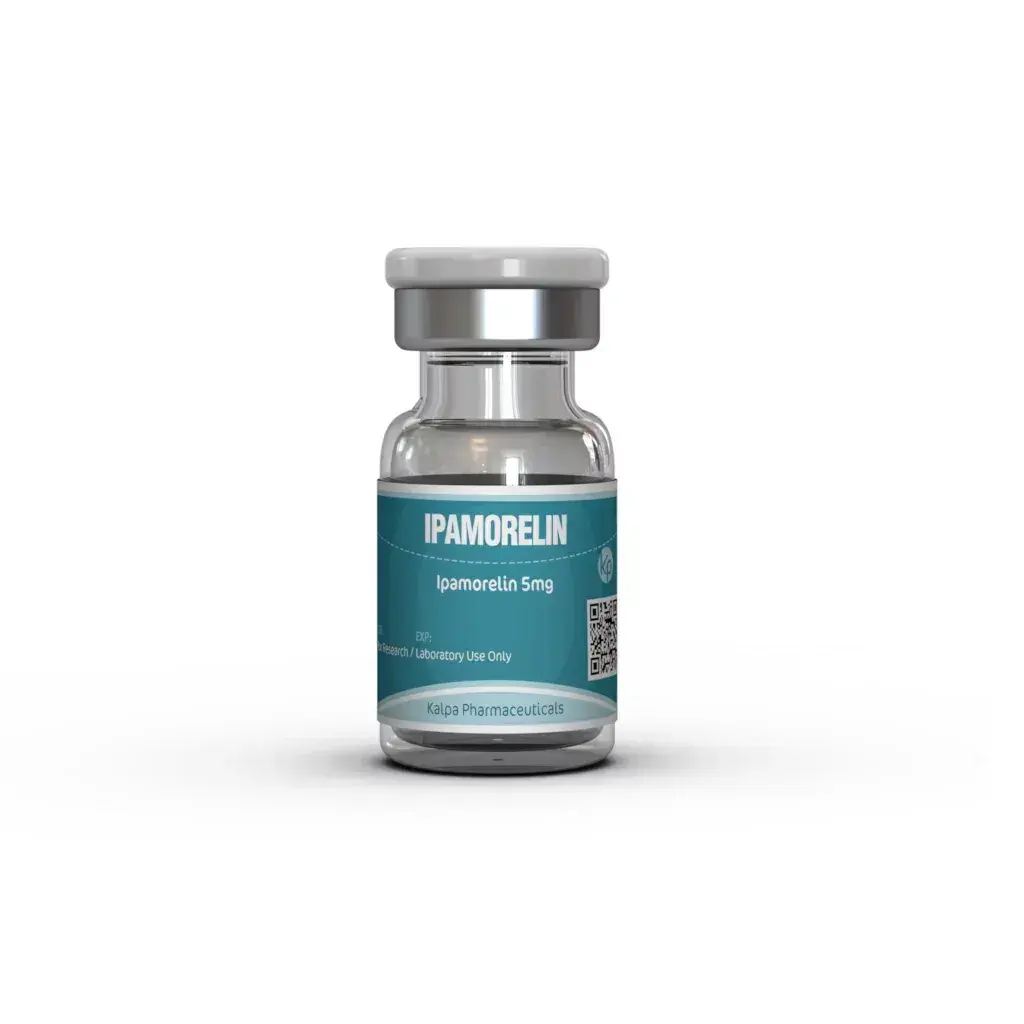
Ipamorelin 5 mg is a lyophilized pentapeptide formulation manufactured by Kalpa Pharmaceuticals and supplied in a 2 mL vial at 5 mg/vial.
Ipamorelin 5 mg contains ipamorelin, a synthetic pentapeptide (five amino acids) classified as a growth hormone secretagogue. It acts as a selective ghrelin receptor agonist, binding to the GHS-R1a receptor in the pituitary gland to stimulate endogenous growth hormone release through natural physiological pathways. What distinguishes ipamorelin from earlier secretagogues is its remarkable selectivity—it specifically targets GH release without significantly affecting cortisol, prolactin, ACTH, or appetite hormones.
Ipamorelin is not currently an FDA-approved human pharmaceutical product. As of 2026, ipamorelin is expected to be moved from the FDA's Category 2 restricted compounding list back to Category 1, which would restore the legal pathway for licensed compounding pharmacies to prepare it with a valid prescription. However, this regulatory designation does not constitute FDA approval, and the FDA's Pharmacy Compounding Advisory Committee is scheduled to formally review it in July 2026.
In research and non-medical contexts, ipamorelin is commonly referenced for its potential effects on growth hormone optimization, body composition, recovery, and sleep quality. When used outside approved research or medical contexts, the potential for adverse effects exists and such use falls outside approved medical indications.
Ipamorelin 5 mg is supplied as a lyophilized powder that requires reconstitution with an appropriate diluent such as Bacteriostatic Water before use. This formulation is designed to preserve the stability of the peptide until it is ready for use.
Ipamorelin is a selective growth hormone secretagogue pentapeptide with a favorable safety profile. Its mechanism of action and receptor selectivity distinguish it from earlier secretagogues and other performance compounds.
Ipamorelin functions as a ghrelin receptor agonist, activating GHS-R1a receptors in the hypothalamus and pituitary. This selectivity theoretically reduces unwanted endocrine effects compared to non-selective secretagogues, particularly limiting cortisol and prolactin elevation during stimulation cycles. Clinical research shows ipamorelin is approximately 13 times more selective than GHRP-6, with a half-life of about 2 hours.
By mimicking the natural hormone ghrelin, ipamorelin encourages the body's own production of growth hormone rather than providing exogenous GH. The release of GH leads to increased levels of IGF-1, which mediates muscle protein synthesis and tissue repair. The pulsatile release pattern mimics the body's natural secretion patterns, supporting physiological hormone balance and avoiding supraphysiologic spikes.
These characteristics explain why ipamorelin is commonly referenced in research and non-medical contexts for its potential effects on body composition, recovery, and anti-aging support.
Ipamorelin exhibits minimal cortisol and prolactin elevation in published studies, while sermorelin carries moderate risk of endocrine shifts at higher doses. The selectivity of ipamorelin distinguishes it from earlier growth hormone secretagogues.
Kalpa Pharmaceuticals offers several peptide and research formulations. The main practical distinction between these preparations involves the compound's mechanism and intended research or educational context.
Unlike anabolic steroids such as Testoxyl Cypionate 250 or Trenboxyl Acetate, ipamorelin is not an androgen and works through the ghrelin receptor pathway rather than androgen receptor activation. For other growth hormone-related options in the Kalpa catalog, Kalpatropin HGH provides exogenous somatropin, while Tesamorelin 5 mg is a GHRH analog that directly stimulates pituitary GH release. BPC 157 5 mg is a research peptide studied for tissue repair through different mechanisms.
The information below is provided for educational and research reference only. Ipamorelin is not an FDA-approved human pharmaceutical product. Non-medical use falls outside approved indications.
In research and non-medical contexts, ipamorelin is commonly referenced in the range of 200–300 mcg per injection, administered 2–3 times daily, though such use falls outside approved medical indications. The saturation dose (the point beyond which additional peptide doesn't increase GH release proportionally) is approximately 1 mcg/kg of body weight per injection. These ranges are derived from self-reported protocols and animal study extrapolations, not from controlled human clinical trials.
| Use Case | Common Reference Range | Injection Frequency |
|---|---|---|
| Muscle building / recovery | 200–300 mcg per injection | 2–3 times daily |
| Beginners (tolerance assessment) | 100–200 mcg per injection | 1–2 times daily |
| Anti-aging / wellness | 100–200 mcg per injection | 1–2 times daily |
Ipamorelin 5 mg is supplied as a lyophilized powder that requires reconstitution with an appropriate diluent such as Bacteriostatic Water before use. For a 5 mg vial, adding 2.5 mL of bacteriostatic water produces a concentration of 2000 mcg/mL, where a 200 mcg dose corresponds to 10 units on a standard insulin syringe.
Reconstitution should involve adding the diluent slowly down the side of the vial rather than directly onto the powder, followed by gentle swirling rather than shaking. Once reconstituted, the solution should be stored under refrigeration and used within the recommended timeframe, typically up to 28–30 days when bacteriostatic water is used.
Ipamorelin generally demonstrates a favorable safety profile with minimal cortisol or prolactin elevation in published studies. Common adverse effects are usually mild and may include injection site irritation, mild fluid retention, or transient joint aches. Unlike GHRP-6, ipamorelin does not stimulate appetite significantly, and unlike GHRP-2, it does not elevate cortisol.
Potential concerns include appetite stimulation in some users (which may counteract weight-loss goals) and ghrelin-mediated effects on cortisol and sleep in sensitive individuals. Long-term safety data remains sparse, and individual tolerability depends on injection-site reactions, baseline metabolic health, and concurrent medication interactions. Aromatase inhibitors such as Arimixyl are not relevant to ipamorelin use as it does not affect the aromatase pathway.
Post-cycle therapy is not applicable to ipamorelin, as it is not a compound that suppresses the hypothalamic-pituitary-gonadal axis. It is a growth hormone secretagogue that stimulates endogenous GH release. When ipamorelin is used as part of a broader research protocol that includes anabolic compounds, standard PCT protocols such as those involving Clomixyl or Nolvaxyl would be relevant to those compounds, not to ipamorelin itself.
Research protocols, reconstitution procedures and handling practices should be adjusted based on the specific context and the guidelines provided with the product. The information above is for educational reference and does not constitute medical advice.
Ipamorelin is a research peptide that has been studied in limited human trials. Its safety profile is generally favorable, but long-term safety data remains sparse.
Ipamorelin is not an FDA-approved human pharmaceutical product. As of 2026, it is expected to be moved from the FDA's Category 2 restricted compounding list back to Category 1, which would allow licensed compounding pharmacies to prepare it with a valid prescription. However, Category 1 status does not constitute FDA approval, and the FDA's Pharmacy Compounding Advisory Committee is scheduled to formally review it in July 2026.
Use of ipamorelin outside approved research or medical contexts falls outside approved indications. The safety and efficacy of ipamorelin have not been established through controlled clinical trials.
Ipamorelin is not for use in people with active cancers, untreated diabetic retinopathy, or severe systemic illness. Caution should be exercised with other endocrine drugs or agents affecting insulin sensitivity. Baseline screening including IGF-1, cortisol, prolactin, and metabolic markers is recommended before initiating therapy.
Ipamorelin has a favorable safety profile compared to earlier secretagogues and direct GH therapy. Common adverse effects are usually mild and may include injection site irritation, mild fluid retention, or transient joint aches. In clinical trials of ipamorelin for gastrointestinal recovery, adverse events were assessed as a measure of safety and tolerability.
Excess GH/IGF-1 over long periods is associated with risks such as insulin resistance, carpal tunnel syndrome, and edema, but these are less common with ipamorelin at recommended doses. Unlike GHRP-6, ipamorelin does not significantly stimulate appetite, and unlike GHRP-2, it does not elevate cortisol.
Individuals with active cancers, untreated diabetic retinopathy, or severe systemic illness should not use ipamorelin. Patients on immunosuppressive therapy, those with active infections, or individuals with a history of severe allergic responses to injectable compounds should obtain provider clearance.
Genetic variants in growth hormone pathway genes may influence receptor sensitivity and downstream signaling efficiency, which can impact individual response. A comprehensive biomarker assessment can help identify whether ipamorelin aligns with individual physiology.
Medically supervised peptide therapy typically involves follow-up assessment to evaluate treatment response, adverse effects, and relevant laboratory markers. For ipamorelin, monitoring may include IGF-1 levels, cortisol, prolactin, and metabolic markers. Repeat testing at 4–8 weeks helps assess individual response and tolerability before dose adjustment.
For non-medical use of Ipamorelin 5 mg, such monitoring is not typically performed, which increases the risk of unrecognized adverse effects.
Lyophilized ipamorelin powder should be stored under refrigeration according to the manufacturer's instructions. For long-term storage, -20°C is recommended. Reconstituted solution should be refrigerated and used within 28–30 days when bacteriostatic water is used. Do not freeze the reconstituted solution.
Keep all medications and research products out of the reach of children. Follow the storage instructions provided with the product packaging.
Ipamorelin 5 mg is supplied through the official Kalpa Pharmaceuticals distribution chain and shipped in original manufacturer packaging with discreet, privacy-focused handling.
The outer shipping package remains discreet, with privacy-focused handling and no unnecessary external product details. Products are supplied through the official Kalpa Pharmaceuticals distribution chain.
To verify your Ipamorelin 5 mg product, use the security code on the vial label and cross-check it on the Kalpa official site. Official Kalpa Pharmaceuticals presentation, batch-linked lab proof, and original packaging help reinforce product legitimacy and buyer confidence.
For complete delivery details, tracking policy, and reshipment terms, please see our Shipping Info page.
Proper storage conditions help preserve formulation stability and overall product integrity throughout shelf life.
Lyophilized ipamorelin powder should be stored under refrigeration according to the manufacturer's instructions. For long-term storage, -20°C is recommended. Protect from excessive heat, moisture, and direct light. Maintaining stable conditions helps preserve the integrity of the peptide formulation.
After reconstitution, store the solution under refrigeration and use within 28–30 days when bacteriostatic water is used. Do not freeze the reconstituted solution. Before each use, inspect the solution and avoid use if it appears cloudy, discolored, contains particulate matter, or if the vial or seal is compromised.
Keep out of reach of children. Follow proper handling and sterile practices when using the product.
Answers to common questions about Ipamorelin 5 mg, the selective growth hormone secretagogue, and its research and safety profile.
Ipamorelin is a selective growth hormone secretagogue that stimulates the pituitary gland to release more growth hormone naturally. Unlike older secretagogues, it specifically targets GH release without affecting cortisol, prolactin, ACTH, or appetite hormones.
Increased GH stimulates the liver to produce IGF-1, which mediates muscle growth, fat loss, tissue repair, and anti-aging benefits. Ipamorelin is commonly referenced for recovery support, body composition, and sleep quality.
Ipamorelin exhibits minimal cortisol and prolactin elevation in published studies, while sermorelin carries moderate risk of endocrine shifts at higher doses. Both require baseline screening and provider oversight.
Individual safety depends on metabolic health, baseline hormones, and drug interactions. Ipamorelin's selectivity for GH release without affecting stress hormones is a distinguishing characteristic.
Common adverse effects are usually mild and may include injection site irritation, mild fluid retention, or transient joint aches. Long-term safety data remains sparse, and individual tolerability varies.
Potential concerns include appetite stimulation in some users (which may counteract weight-loss goals) and ghrelin-mediated effects on cortisol and sleep in sensitive individuals. Ipamorelin is not for use in people with active cancers, untreated diabetic retinopathy, or severe systemic illness.
Ipamorelin is commonly referenced in non-medical contexts for body composition support, including fat loss. The rationale is that increased GH and IGF-1 levels may support lipolysis and lean mass preservation. CJC-1295 plus ipamorelin is a commonly referenced research peptide stack for fat loss, though there are no published human randomized controlled trials on this combination for fat loss specifically.
Animal studies have shown that GH secretagogues can increase body fat through GH-independent mechanisms that may include increased feeding, which is a consideration for fat-loss goals. Individual results depend on nutrition, exercise, and metabolic factors.
Ipamorelin 5 mg contains the research peptide ipamorelin in lyophilized powder form. It is supplied for research and educational purposes. In research contexts, ipamorelin has been studied as a growth hormone secretagogue for its selective GH-releasing properties.
It is not an FDA-approved human pharmaceutical product and is not intended for human use outside approved research contexts.
Frequency of use depends on the specific research or non-medical context. In self-reported protocols, ipamorelin is commonly referenced at 200–300 mcg per injection, administered 2–3 times daily. Optimal timing includes upon waking (fasted), post-workout, and 30–60 minutes before bed. These frequencies are for educational reference only.
Post-cycle therapy is not applicable to ipamorelin, as it is not a compound that suppresses the hypothalamic-pituitary-gonadal axis. It is a growth hormone secretagogue that stimulates endogenous GH release.
When ipamorelin is used as part of a broader research protocol that includes anabolic compounds, standard PCT protocols such as those involving Clomixyl or Nolvaxyl would be relevant to those compounds, not to ipamorelin itself.
Ipamorelin binds to ghrelin receptors in the pituitary gland to stimulate growth hormone secretion through natural pathways without affecting other hormones. It creates GH pulses that mimic the body's natural secretion patterns, supporting physiological hormone balance.
Increased GH stimulates the liver to produce IGF-1, which mediates muscle growth, fat loss, tissue repair, and anti-aging benefits.
Ipamorelin has a half-life of about 2 hours, with GH release occurring in a pulsatile manner after injection. However, observable changes in body composition or recovery typically develop gradually over weeks to months.
Clinical studies on GH secretagogues report IGF-1 elevation of 10–30% across responder populations, with individual variation significant. Realistic timelines span 4–8 weeks minimum for measurable changes.
There is no single growth hormone secretagogue that is universally best. Ipamorelin is considered one of the most selective and well-tolerated GH secretagogues, with minimal cortisol or prolactin effects. Tesamorelin 5 mg is a GHRH analog with FDA approval for a specific indication, while Kalpatropin HGH provides exogenous somatropin.
The appropriate choice depends on the specific research or clinical context.
Ipamorelin 5 mg contains the ghrelin receptor agonist ipamorelin, which stimulates GH release through the ghrelin pathway with minimal cortisol or prolactin effects. Tesamorelin 5 mg is a GHRH analog that directly stimulates pituitary GH release and has FDA approval for a specific indication.
These are different compounds with different mechanisms and clinical evidence bases.
The milligram strength of the vial (5 mg) refers to the total amount of ipamorelin in the vial, not the amount administered per dose. The dose administered depends on how the powder is reconstituted and the specific protocol being followed.
It is important to distinguish vial strength from administered dose. A 5 mg vial can be reconstituted with an appropriate volume of diluent to achieve the desired concentration for research or educational purposes. For example, adding 2.5 mL of bacteriostatic water to a 5 mg vial produces a concentration of 2000 mcg/mL.
Ipamorelin is expected to be moved from the FDA's Category 2 restricted compounding list back to Category 1 in 2026, which would allow licensed compounding pharmacies to prepare it with a valid prescription. However, Category 1 status does not constitute FDA approval, and the FDA's Pharmacy Compounding Advisory Committee is scheduled to formally review it in July 2026.
Ipamorelin is also prohibited for use by athletes under WADA and USADA guidelines.